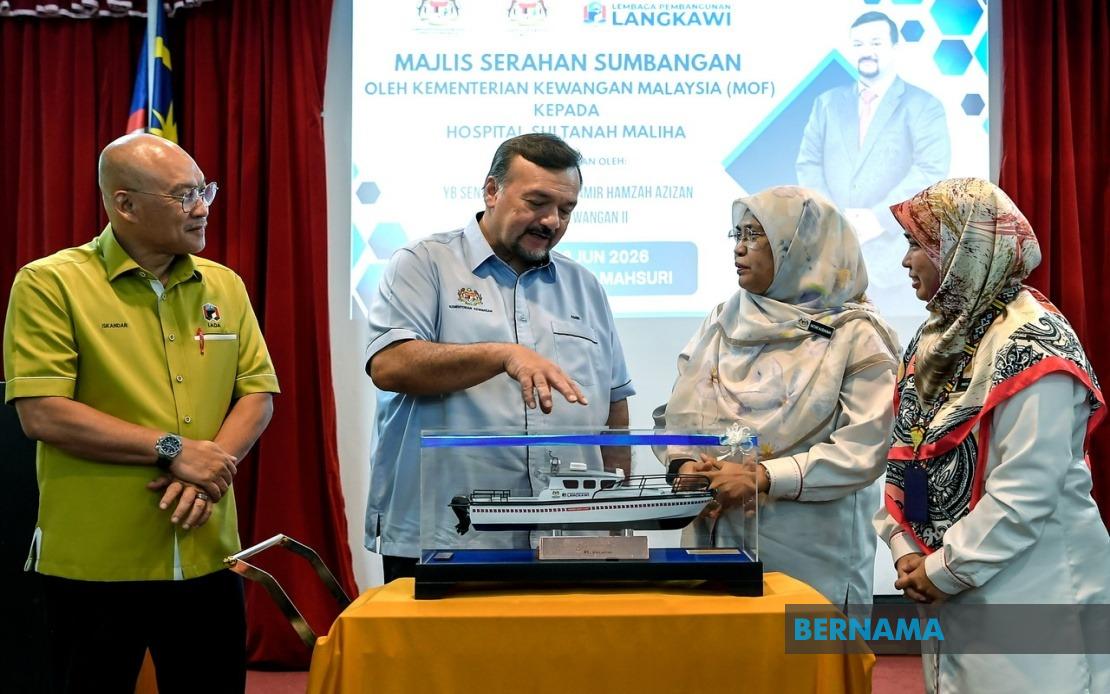
Malaysia's Ministry of Finance has committed RM5.5 million towards establishing a dedicated sea ambulance service in Langkawi, with operations expected to commence in early 2025. The investment represents a significant push to enhance emergency medical response capabilities for the island's residents and the millions of tourists who visit annually. Finance Minister II Datuk Seri Amir Hamzah Azizan, who also serves as co-chairman of the Langkawi Development Authority, announced the initiative while emphasising the government's broader commitment to strengthening healthcare infrastructure across the nation's tourism-dependent regions.
The current system for transferring critically ill or injured patients from Langkawi to mainland referral hospitals depends heavily on commercial passenger ferry services, a dependency that creates considerable operational constraints. During peak tourist seasons or when ferry schedules are reduced, patients requiring urgent specialist care face potential delays that can prove medically critical. The absence of a dedicated emergency water transport vessel has forced hospital administrators to improvise solutions that prioritise speed over patient comfort and medical safety, particularly when transferring individuals in unstable conditions across the approximately 30-kilometre strait separating Langkawi from the Kedah mainland.
Hospital Sultanah Maliha will operate and manage the new sea ambulance, positioning the facility as a regional hub for emergency maritime healthcare. The vessel will be specifically configured to accommodate two stretcher patients simultaneously, enabling the safe transport of multiple casualties during major incidents. The operational team will comprise up to 12 personnel, including paramedics and nurses trained in maritime emergency protocols, ensuring comprehensive medical support throughout the transfer journey. This staffing model reflects international best practices for maritime ambulance services, where trained personnel can monitor vital signs, administer interventions, and maintain patient stability during transit.
Patient dignity and privacy represent core considerations embedded within the service design. Unlike transfers aboard standard passenger ferries where medical emergencies unfold before dozens of paying customers, the dedicated sea ambulance provides a controlled medical environment. The vessel's configuration allows healthcare providers to maintain patient confidentiality, manage acute situations discreetly, and create psychological comfort for individuals already distressed by medical emergencies. For tourists experiencing sudden health crises far from home, this dedicated service carries significant reassurance value beyond purely clinical metrics.
Simultaneously, the Ministry of Finance has contributed RM700,000 in medical equipment to Hospital Sultanah Maliha as part of a broader modernisation programme. This investment encompasses diagnostic devices, information technology infrastructure, clinical furniture, transportation vehicles, and security systems designed to elevate service standards across the hospital's departments. The equipment acquisition aligns with contemporary healthcare delivery models and represents tangible recognition of Langkawi's dual healthcare burden, serving both a permanent population requiring comprehensive medical services and a transient tourist population whose emergency needs strain facility capacity during holiday periods.
Digitalisation of medical records emerges as a particularly transformative component of the hospital's infrastructure upgrade. The Ministry's support for implementing an Electronic Medical Record system connects Hospital Sultanah Maliha with the broader Malaysian health ecosystem, enabling seamless information exchange with referral centres on the mainland. Implementation of mobile computing systems—computers mounted on wheeled trolleys—permits clinical staff to document patient information in real time during ward rounds, eliminating the administrative delays and transcription errors inherent in paper-based or retrospective data entry systems. This interconnected approach accelerates diagnostic decision-making and ensures that specialists at receiving hospitals access complete, current medical histories immediately upon patient arrival.
Langkawi's status as a major international tourism destination—drawing millions of visitors annually to its beaches, duty-free shopping, and island attractions—creates distinctive demands on healthcare provision. Tourist populations tend to be more affluent, more likely to expect rapid specialist access, and represent significant foreign exchange earners whose satisfaction influences Malaysia's global reputation for visitor services. Deaths or serious complications arising from inadequate emergency response generate international media coverage that damages destination branding and affects future tourist flows. The investment in both maritime emergency capacity and facility modernisation therefore carries economic significance extending beyond conventional healthcare metrics.
The sea ambulance initiative responds to specific operational vulnerabilities that emerged during previous emergencies. Weather-related ferry cancellations have stranded patients requiring urgent transfers; congestion at ferry terminals has delayed emergency departures; and the psychological trauma of undergoing medical crisis aboard crowded public vessels has complicated patient management. These documented problems, rather than theoretical vulnerabilities, justified the Ministry's capital commitment and timeline for service establishment. Early 2025 deployment allows Hospital Sultanah Maliha to operationalise the vessel, train specialised personnel, and refine maritime protocols before the peak tourist season, ensuring the system functions reliably when demand intensifies.
The broader context involves Malaysia's strategic positioning within Southeast Asia's competitive tourism market. Neighbouring destinations in Thailand, Indonesia, and the Philippines invest substantially in healthcare tourism, marketing their facilities to international patients and ensuring emergency services meet international standards. Malaysia's commitment to upgrading Langkawi's emergency capacity reflects acknowledgment that regional competition extends to healthcare quality, and that tourist confidence in emergency response capabilities influences destination choice. Medical incidents mishandled in high-profile tourist settings generate viral social media narratives that foreign visitors rely upon when evaluating safety and healthcare reliability.
Implementation challenges remain material, including recruitment and retention of specialised maritime paramedics in a geographically remote location, maintenance of expensive marine equipment in a corrosive salt-water environment, and integration with existing ferry scheduling and coastal traffic management systems. Weather patterns across the Strait of Malacca—particularly during the southwest monsoon season—may periodically limit sea ambulance operations, creating contingency demands that planners must anticipate. Training protocols must address the unique medical complications of maritime transport, where motion, confined spaces, and communication limitations create treatment constraints absent from land-based ambulances.
The investment ultimately reflects broader government strategy to disperse healthcare modernisation beyond Kuala Lumpur's urban concentration, recognising that tourists and residents in peripheral regions deserve equivalent emergency response standards. Langkawi's selection for this pilot maritime ambulance initiative may signal intention to evaluate similar services for other archipelago regions, including Sabah and Sarawak's coastal communities. Successful implementation would establish Malaysia as a regional leader in maritime emergency healthcare, differentiating its tourism offering and reinforcing commitment to inclusive healthcare access regardless of geographic location.

