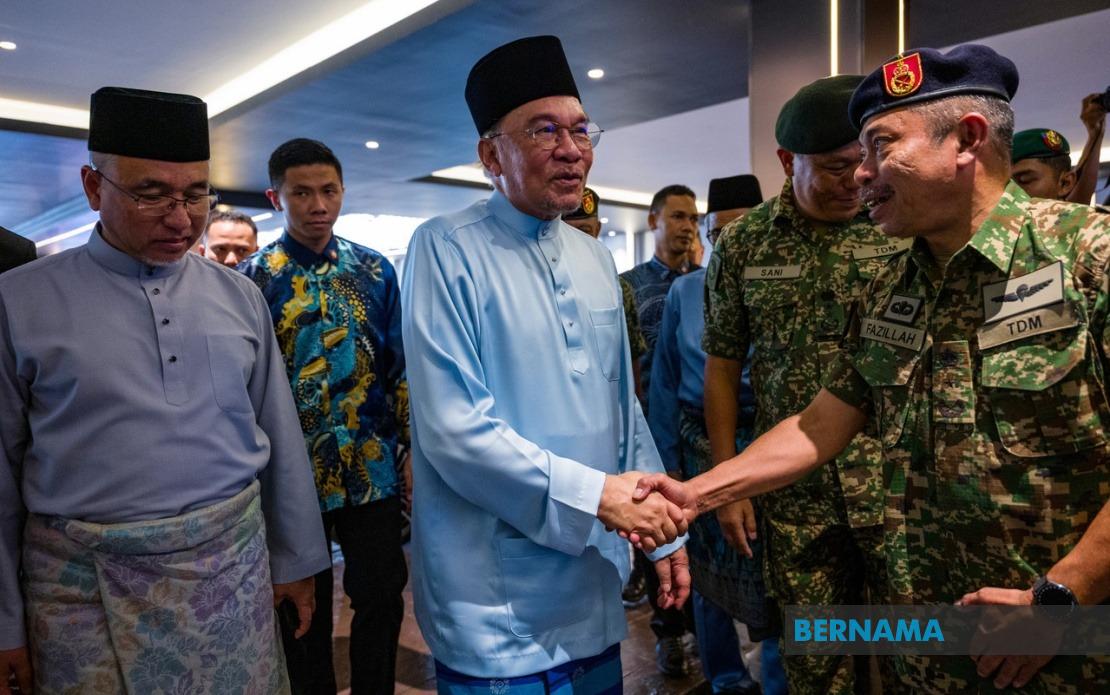
Prime Minister Datuk Seri Anwar Ibrahim has signalled his administration's intention to bolster defence spending in the 2027 Budget, a move that defence leadership views as evidence of serious commitment to upgrading the Malaysian Armed Forces' operational capabilities. The announcement was made during the Semarak Kenegaraan Programme at Terendak Camp in Melaka, where Anwar underscored the government's resolve to fortify the nation's military readiness through increased financial commitment.
Chief of Defence Force General Tan Sri Malek Razak Sulaiman welcomed the proposed budgetary increase, characterising it as a tangible demonstration of governmental support for the military institution. The defence chief emphasised that the additional resources would strengthen not only the force's operational capacity but also address longstanding personnel concerns that have plagued recruitment and retention efforts across the service branches. In his remarks to the media, Malek Razak positioned the funding boost as integral to realising the MAF's Future Force strategic development plan, which envisions a technologically advanced military capable of addressing contemporary security challenges.
Beyond hardware modernisation, the funding expansion explicitly targets personnel welfare improvements, reflecting recognition within government that soldier satisfaction directly correlates with operational effectiveness. Anwar, speaking in his dual capacity as Prime Minister and Finance Minister, outlined concrete welfare initiatives including renovations to military housing quarters, construction of a new military hospital, and maintenance of essential infrastructure such as water supply systems. These quality-of-life improvements represent a departure from previous budgetary cycles that often prioritised equipment acquisitions at the expense of personnel amenities.
The timing of this defence investment announcement carries strategic significance for Malaysia's regional security posture. As Southeast Asia confronts evolving maritime threats and geopolitical tensions in the South China Sea, defence modernisation has become increasingly critical for nations seeking to maintain credible deterrence capabilities. Malaysia's defence establishment has long argued that ageing equipment and constrained budgets limited the country's ability to respond effectively to emerging security scenarios, making the proposed increase particularly meaningful for military planners.
Malek Razak specifically referenced how enhanced compensation and improved living conditions would bolster troop morale and commitment to duty. Military analysts understand that soldier motivation directly impacts unit cohesion and operational readiness—factors that prove decisive in actual security incidents. By addressing grievances related to inadequate housing and healthcare access, the government acknowledges that defence capability extends beyond acquiring advanced weaponry to encompassing human factors that determine combat effectiveness.
The defence allocation increase also encompasses structural reforms within the military hierarchy. During the same event, Anwar announced governmental approval for streamlined promotion procedures applicable to both MAF and Royal Malaysia Police personnel, bringing these processes into alignment with broader public service advancement schemes. This administrative simplification addresses long-standing frustrations within security services regarding perceived bureaucratic obstacles to career progression, potentially improving officer retention and institutional stability.
For Malaysia's defence industrial ecosystem, increased budgetary allocations promise expanded opportunities for local suppliers and contractors involved in military modernisation projects. The Future Force strategic plan contemplates systematic replacement and upgrading of ageing platforms across naval, air, and land components, creating procurement pipelines that could sustain manufacturing and maintenance activities over extended periods. This economic dimension of defence spending extends benefits beyond the military institution itself to supporting industrial capacity development.
The defence ministry's perspective on the budgetary commitment reflects realistic assessment of security requirements facing the nation. Military planners have consistently highlighted capability gaps that constrain operational responses to various contingencies, from maritime security operations to disaster relief coordination. The modernisation framework articulated through the Future Force strategy addresses these deficiencies systematically, though successful implementation hinges on sustained budgetary support across multiple fiscal years rather than one-time funding injections.
Regional observers view Malaysia's enhanced defence commitment as contributing to broader Southeast Asian security stability. At a moment when various nations are reassessing defence postures in response to geopolitical developments, Malaysia's willingness to invest meaningfully in military modernisation signals determination to maintain credible deterrent capabilities. This approach complements other regional defence initiatives and reinforces the principle that nations must maintain adequate security infrastructure to protect national interests and contribute meaningfully to collective security arrangements.
The announcement also addresses demographic and retention challenges plaguing military recruitment across Southeast Asia. By improving personnel welfare through better housing, healthcare facilities, and career advancement pathways, Malaysia positions itself more competitively within a labour market where military service competes with civilian opportunities. The holistic approach—combining equipment modernisation with personnel satisfaction—reflects contemporary best practices in military management recognised internationally.
Looking forward, the success of this defence investment strategy depends on consistent budget execution and political sustainability across multiple government administrations. Defence modernisation projects typically span years and require patient capital, making budgetary predictability essential for effective implementation. The government's public commitment to this expansion signals intention to maintain defence spending as a policy priority despite competing fiscal pressures from healthcare, education, and infrastructure demands.
The defence sector welcomed the announcement with apparent relief, having operated under budgetary constraints that military leadership characterised as inadequate for modernisation requirements. With increased resources theoretically available, defence planners can pursue comprehensive force development strategies rather than piecemeal equipment replacements dictated by fiscal limitations. This transition from scarcity to adequacy, if sustained, could fundamentally reshape Malaysia's military capability trajectory over the coming decade.

