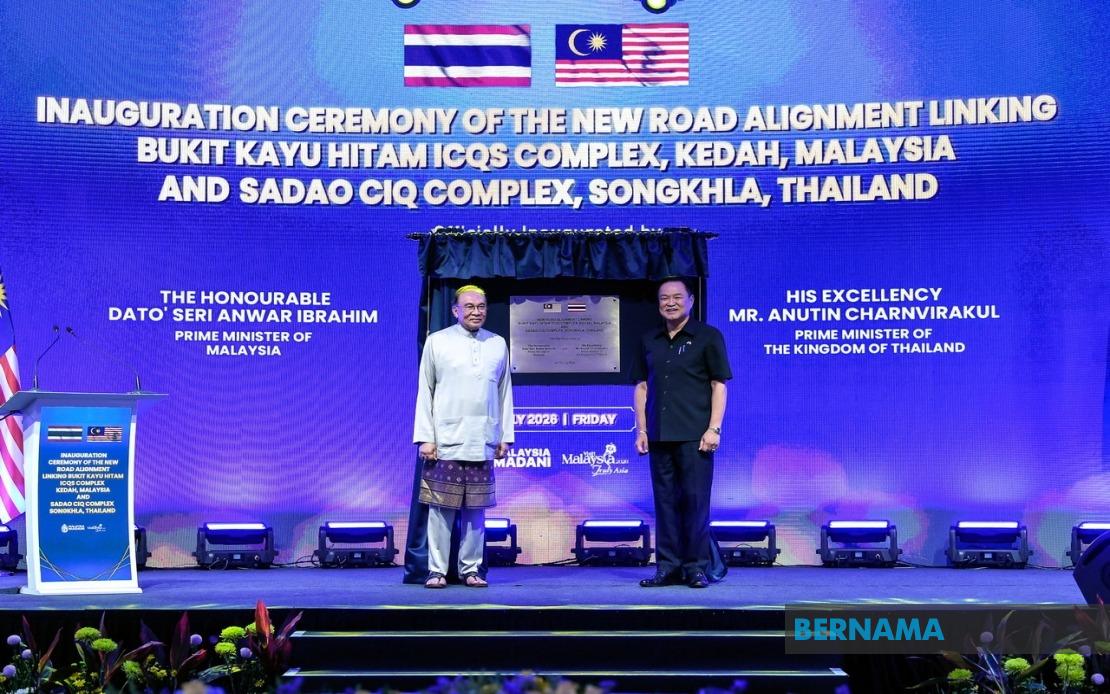
The inauguration of a revised road corridor connecting Malaysia's Bukit Kayu Hitam Immigration, Customs, Quarantine and Security Complex in Kedah with Thailand's Sadao Customs, Immigration and Quarantine Complex marks a significant step in deepening bilateral infrastructure ties between the two neighbouring nations. Prime Minister Datuk Seri Anwar Ibrahim, speaking at the launch ceremony jointly with Thailand's Prime Minister Anutin Charnvirakul, framed the project as a watershed moment that transcends conventional diplomatic gestures to forge tangible economic pathways benefiting both populations along the shared frontier.
The infrastructure initiative represents far more than a symbolic gesture between Kuala Lumpur and Bangkok. Rather, it embodies a strategic vision to harness the untapped economic potential lying dormant across northern Malaysia and southern Thailand. Anwar characterised the undertaking as part of a deliberate pivot towards establishing a special economic border zone spanning Perlis, Kedah, Kelantan, Perak and Penang on the Malaysian side, with corresponding regions on the Thai side. This framework acknowledges that border communities have historically been peripheral to national economic centres, and that targeted infrastructure improvements can fundamentally reshape opportunities for entrepreneurs and investors operating in these localities.
The road alignment project serves as the physical manifestation of broader institutional reforms both governments are pursuing to eliminate friction points that presently impede seamless cross-border commerce. Anwar disclosed that Malaysia and Thailand have committed to accelerating resolution of longstanding administrative complications spanning customs procedures, immigration protocols, fisheries management and trade regulations. These bureaucratic obstacles, which in previous years required protracted multilateral negotiations spanning years or even decades, have reportedly been substantially addressed through intensive recent consultations, reflecting the political will both leaderships are willing to invest in the relationship.
The creation of a special economic border zone carries profound implications for Malaysia's underdeveloped northern corridor. Perlis and Kedah, historically overshadowed by the economic dynamism of the Klang Valley and southern Selangor, stand positioned to emerge as gateways for Thailand-Malaysia trade flows and investment patterns. The infrastructure improvements lower transportation costs and reduce border transit times, making these states increasingly attractive for manufacturing operations seeking to leverage lower labour costs while maintaining proximity to major distribution channels. Similarly, Kelantan and Perak, which have grappled with persistent developmental challenges, gain access to Thai markets and potential joint ventures in agricultural processing, light manufacturing and tourism.
Bilateral trade ambitions underscore the economic stakes embedded in this infrastructure project. The two governments have established a target of achieving USD30 billion in annual bilateral commerce by 2027, a figure that demands substantial intensification from current levels. Enhanced border connectivity directly enables achievement of this threshold by reducing transaction costs for businesses and expanding the range of goods and services economically viable to transport across the frontier. This objective also aligns with broader regional integration imperatives, particularly within the ASEAN framework, where Malaysia and Thailand serve as anchor economies for mainland Southeast Asia and maritime Southeast Asia connectivity.
Anwar's emphasis on understanding the needs of communities beyond metropolitan centres reflects an implicit acknowledgment that previous development paradigms concentrated resources and opportunities in capital cities and established industrial zones, marginalising populations in peripheral regions. By elevating border areas as sites of economic opportunity rather than merely geographic divisions to be managed, the new framework proposes a more spatially equitable growth model. This approach carries relevance for other ASEAN member states grappling with uneven development patterns and the political implications of regional inequality.
The ceremonial presence of both Prime Ministers at the Bukit Kayu Hitam border underscores the political commitment underpinning this initiative. Anutin's acceptance of Anwar's invitation to visit the frontier region, rather than conducting engagements in Bangkok, signals that Thai leadership similarly prioritises tangible border community development. Such symbolism matters in societies where government responsiveness to local concerns shapes political legitimacy and electoral outcomes.
The infrastructure project also carries strategic implications for Malaysia's positioning within evolving regional supply chains. As companies diversify operations away from China and seek lower-cost alternatives to Vietnam or Indonesia, border regions with improved connectivity to regional markets become attractive relocation destinations. The Bukit Kayu Hitam-Sadao corridor potentially attracts manufacturing businesses seeking to serve both Malaysian and Thai consumer markets while leveraging cross-border supply chain efficiencies. This positioning gains importance as global companies reassess geographical concentration of production facilities.
However, realising the full potential of this infrastructure initiative requires sustained commitment to institutional harmonisation beyond road construction. Customs cooperation frameworks, labour mobility agreements, and regulatory alignment across product standards must evolve in tandem with physical infrastructure upgrades. The commitment both leaders expressed to accelerating administrative reforms suggests awareness of this requirement, yet implementation challenges typically emerge as bureaucratic institutions resist changes threatening established procedures and jurisdictional arrangements.
The special economic border zone framework also necessitates careful consideration of environmental and social safeguards. Accelerated cross-border commerce brings ecological implications for shared water resources, agricultural lands, and biodiversity hotspots along the frontier. Communities in border areas require mechanisms to ensure benefits accrue to local populations rather than being captured by external investors, preventing patterns whereby infrastructure improvements displace traditional livelihoods without delivering compensatory opportunities.
For Malaysian investors and entrepreneurs, particularly those in northern states, this initiative opens a previously constrained market of 70 million Thai consumers accessible through substantially improved logistics infrastructure. Small and medium enterprises operating in sectors ranging from food processing to electronics components gain feasibility for export operations previously uneconomic due to border crossing inefficiencies. The bilateral commitment to expedited customs and immigration procedures directly reduces the hidden transaction costs that previously deterred smaller businesses from cross-border engagement.
Longer term, the Bukit Kayu Hitam-Sadao corridor establishes a model for Malaysia's approach to border regions that could extend to partnerships with other neighbours. Similar frameworks leveraging improved connectivity to generate development in peripheral areas offer templates for addressing regional inequality and capturing untapped economic potential along the borders with Brunei, Indonesia, and Thailand's other provinces. The success or challenges encountered in implementing the Malaysia-Thailand special economic zone will provide empirical evidence influencing the feasibility and design of comparable initiatives elsewhere in the ASEAN region.

