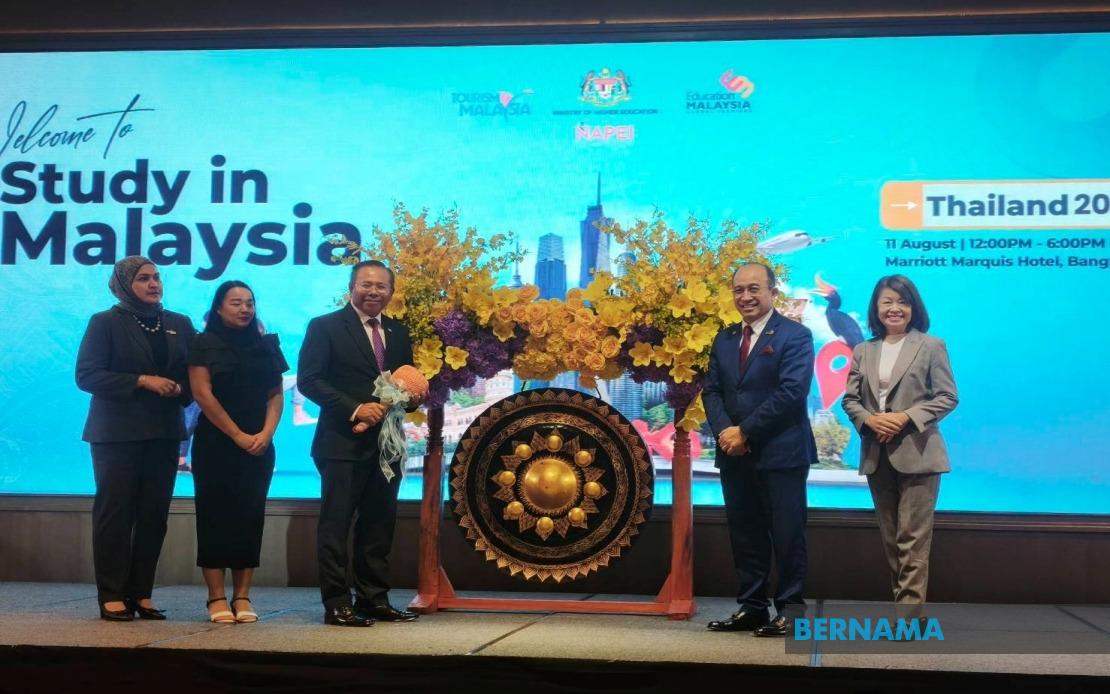
Malaysia is intensifying its campaign to attract a significantly larger cohort of Thai students to its higher education sector, recognising Thailand as a strategic market for regional talent acquisition. Education Malaysia Global Services (EMGS), the government agency tasked with promoting Malaysian institutions globally, is mobilising resources to boost enrollments across the border by more than one-fifth, leveraging structural advantages that position Malaysia as an accessible and cost-effective alternative to other regional study destinations.
The push reflects a calculated strategy to deepen educational cooperation with Thailand while addressing Malaysia's broader ambitions to position itself as a knowledge hub. Novie Tajuddin, chief executive of EMGS, outlined the agency's approach during the inaugural Study in Malaysia Education Fair, which toured three major Thai cities beginning in Chiang Mai on August 9 and spanning Bangkok on August 11 before concluding in Hat Yai on August 13. The initiative represents a collaborative undertaking involving EMGS, Tourism Malaysia, and the National Association of Private Educational Institutions (NAPEI), underscoring the whole-of-government commitment to this expansion.
Critical to the recruitment strategy is EMGS's partnership with the Thai International Education Consultants Association (TIECA), Thailand's only professional body representing education agents with 78 active members. This network provides direct access to the Thai student pipeline and enables dissemination of information about Malaysian opportunities through established channels that prospective students and their families already trust. The collaboration amplifies EMGS's reach substantially beyond what the agency could achieve through independent promotional efforts.
Current enrolment data provides the baseline for Malaysia's expansion targets. In 2025, 634 Thai students were actively pursuing degrees across Malaysian institutions, with the distribution roughly split between undergraduate and postgraduate levels. The trajectory is already positive: enrolment grew from 300 students in 2024 to 360 in 2025, representing a 20 per cent year-on-year increase. EMGS's ambition to achieve additional 20 per cent growth would push the student body toward approximately 430 to 450 Thai nationals, representing meaningful expansion within a single academic cycle.
Malaysia's competitive advantages in attracting Thai students are multifaceted. Geographic proximity eliminates the logistical challenges and costs associated with more distant study destinations, allowing students to maintain family connections while pursuing tertiary education. Tuition fees and living expenses in Malaysia remain substantially lower than comparable institutions in developed economies, a critical consideration for middle-class Thai families seeking quality education without prohibitive expenditure. Educational quality, meanwhile, has improved markedly in recent years, with several Malaysian institutions gaining regional and international recognition.
The post-study opportunity framework represents a particularly compelling attraction for Thai graduates. Malaysia's Graduate Pass programme permits international degree holders to remain in the country for one year following graduation, enabling them to secure employment in approved sectors and build professional experience within the Malaysian economy. This pathway transforms educational investment into potential career advancement and income generation, making Malaysian qualifications more immediately practical than alternatives requiring immediate return to Thailand upon completion of studies.
Ambassador Datuk Wan Zaidi Wan Abdullah, who officially launched the education fair in Bangkok, advocated for enhanced scholarship provision as a complementary recruitment mechanism. He proposed that Malaysian public and private universities establish dedicated scholarship programmes targeting Thai students, suggesting that financial support would meaningfully influence study destination decisions among prospective cross-border students. This proposition acknowledges that despite affordability advantages, removing financial barriers entirely would substantially strengthen Malaysia's competitive positioning relative to other regional options.
Coordination between Malaysian and Thai government bodies underpins the recruitment initiative's sustainability. EMGS maintains close working relationships with the Thai Embassy in Malaysia, ensuring that student engagement activities remain aligned with broader bilateral educational cooperation objectives. This institutional connection facilitates smoother visa processing, reduces bureaucratic friction, and signals governmental commitment to removing obstacles that might otherwise discourage prospective applicants.
The current 634-student cohort provides critical institutional capacity to absorb expansion. With more than 60 per cent already enrolled in undergraduate programmes, Malaysian universities have demonstrated ability to integrate Thai students effectively into mainstream academic environments. The postgraduate segment, representing approximately 40 per cent of Thai students, suggests that Malaysian institutions are competitive destinations for advanced study, indicating confidence among Thai academics and professionals regarding qualification relevance for professional advancement.
For Malaysian higher education institutions, Thai student expansion carries tangible benefits beyond demographic growth. International student diversity strengthens campus communities, enhances academic discourse across cultural perspectives, and generates revenue that supports institutional operations and scholarship provision for domestic students. From a broader regional perspective, deeper educational linkages between Malaysia and Thailand cultivate long-term diplomatic and professional networks that extend beyond the student years into career trajectories where Malaysian-trained Thai professionals serve as influential connectors between the two economies.
The education fair format employed across the three Thai cities represents a deliberate strategy to reach prospective students and parents within their existing geographic contexts rather than requiring travel to Malaysia for initial information gathering. This accessibility removes preliminary barriers to interest and engagement, creating opportunities for sustained conversation between education counsellors and prospective applicants about programme offerings, career prospects, and application procedures.
The timing of Malaysia's intensified recruitment push reflects broader Southeast Asian trends toward increased cross-border student mobility and recognition that international education represents both a cultural export and an economic opportunity. Thailand's growing middle class possesses increasing capacity to fund higher education abroad, and Malaysian institutions are positioning themselves to capture a substantial share of this demand before competitors establish stronger market positions.

