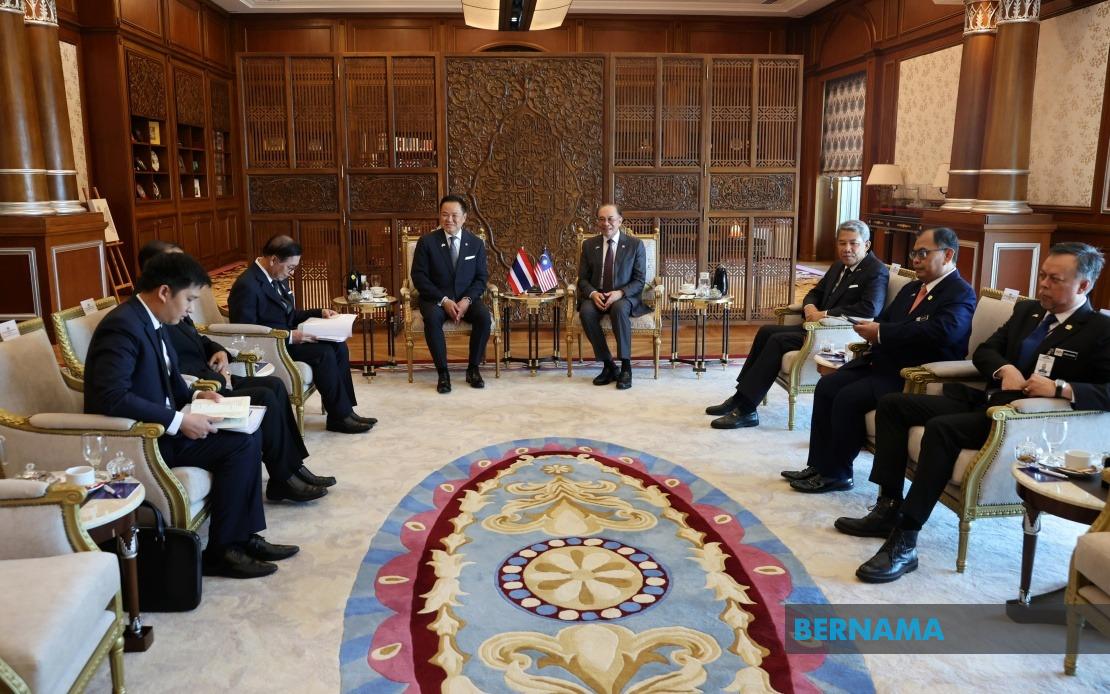
Malaysia's commitment to resolving the protracted Myanmar crisis through dialogue and constructive engagement took centre stage during Prime Minister Datuk Seri Anwar Ibrahim's bilateral meeting with Thai counterpart Anutin Charnvirakul in Putrajaya on Thursday. Speaking at a joint press conference, Anwar underscored his conviction that the conflict ravaging the Southeast Asian nation can only be meaningfully addressed when Myanmar's people are granted agency in determining their nation's trajectory, a principle that sits at the heart of Malaysia's regional diplomacy.
Anwar's emphasis on Myanmar's self-determination reflects a broader Malaysian perspective that external intervention or impositions have limited efficacy in resolving internal political upheaval. The Prime Minister articulated a vision where the Myanmar people themselves, rather than international powers or even regional bodies, serve as the ultimate arbiters of their country's political future. This stance acknowledges the sensitivities surrounding national sovereignty while simultaneously endorsing constructive regional dialogue as the mechanism through which grievances can be addressed and paths toward reconciliation established.
Crucially, Anwar identified Thailand as uniquely positioned to facilitate such engagement, given Bangkok's geographic proximity to Myanmar and its established relationships across the region. As an immediate neighbour sharing both borders and historical ties with Myanmar, Thailand possesses channels of communication and leverage that could prove instrumental in encouraging dialogue among conflicting parties. Anwar's confidence in Thailand's mediatory potential reflects a pragmatic recognition that ASEAN's success in addressing the crisis may depend heavily on individual member states' bilateral diplomacy rather than collective institutional action alone.
The Myanmar crisis has dominated ASEAN's agenda since the military coup in February 2021, testing the bloc's cohesion and capacity for decisive action. The regional organisation's Five-Point Consensus, developed to guide international response to the coup, has yielded limited tangible progress in restoring democratic governance or ceasing violence. Malaysia's continued advocacy for engagement-based approaches suggests frustration with the status quo while maintaining hope that dialogue remains viable, even as the humanitarian situation deteriorates and factional violence continues unabated across Myanmar's territories.
Acknowledging broader regional stability concerns, Anwar also addressed the Thailand-Cambodia border dispute, an issue that threatens to destabilise Southeast Asia if left unresolved. The Malaysian Prime Minister expressed appreciation for Thailand's collaborative approach in maintaining peace along the contested frontier, indicating that Malaysia views peaceful resolution of boundary disputes as integral to the region's overall tranquility. His statement reflects Malaysia's vested interest in preventing territorial conflicts from escalating into wider regional tensions that could undermine prosperity and security across the bloc.
Anur's assurance that Malaysia will continue engaging with relevant stakeholders on the border issue signals Kuala Lumpur's willingness to serve as a stabilising voice in regional disputes. Rather than taking sides in bilateral disagreements, Malaysia's approach emphasises the need for affected nations to exercise restraint and pursue negotiated settlements. This positioning allows Malaysia to maintain credibility with all parties while subtly encouraging peaceful resolution through diplomatic channels rather than through military posturing or nationalist rhetoric.
Anutin's visit marked his first bilateral trip to Malaysia since returning to office in March 2026, underscoring the significance both governments attach to their relationship. The two-day official visit encompassed substantive discussions on regional challenges as well as practical cooperation mechanisms designed to strengthen bilateral ties. Beyond the political dialogues, the visit featured concrete initiatives aimed at improving connectivity and people-to-people exchange between the two nations.
The joint plan to inaugurate a cross-border road infrastructure project connecting Bukit Kayu Hitam in Kedah with Sadao in Thailand demonstrated how Malaysia and Thailand are translating diplomatic goodwill into tangible development initiatives. The new link connecting the respective Immigration, Customs, Quarantine and Security (ICQS) and Customs, Immigration and Quarantine (CIQ) complexes promises to streamline cross-border movement, reduce transit times, and facilitate trade flows between the two countries. Such infrastructure improvements represent the practical backbone of regional integration, enabling the movement of goods, services, and people with greater efficiency.
For Malaysian stakeholders, particularly those in border states like Kedah and Perlis, improved connectivity with Thailand translates into expanded economic opportunities and enhanced access to neighbouring markets. The road project exemplifies how bilateral cooperation can generate tangible benefits for local communities while strengthening the broader partnership between Kuala Lumpur and Bangkok. Enhanced border infrastructure also reduces smuggling incentives and improves security cooperation by creating formal, monitored crossing points that facilitate legitimate commerce while deterring illicit activities.
The convergence of high-level political engagement on Myanmar's future with practical infrastructure development illustrates the multifaceted nature of modern regional diplomacy. Thailand's strategic importance in Malaysia's Myanmar strategy reflects geographic realities and historical relationships that shape ASEAN dynamics. By strengthening the Malaysia-Thailand partnership and amplifying Thailand's mediatory role, Kuala Lumpur seeks to advance regional stability on multiple fronts simultaneously, from addressing political crises to enhancing economic connectivity and security cooperation.
Looking forward, Malaysia's continued emphasis on engagement-based approaches to the Myanmar crisis will likely persist regardless of short-term breakthroughs or setbacks. This reflects Kuala Lumpur's calculation that maintaining dialogue channels remains preferable to isolation or confrontation, which could entrench positions and further reduce possibilities for eventual negotiated settlements. As ASEAN grapples with the Myanmar question and other regional challenges, Malaysia's diplomatic approach, centred on encouraging dialogue and trusting in neighbouring states' wisdom to resolve disputes peacefully, offers a middle path between activism and inaction that respects regional sensitivities while maintaining hope for eventual resolution.

