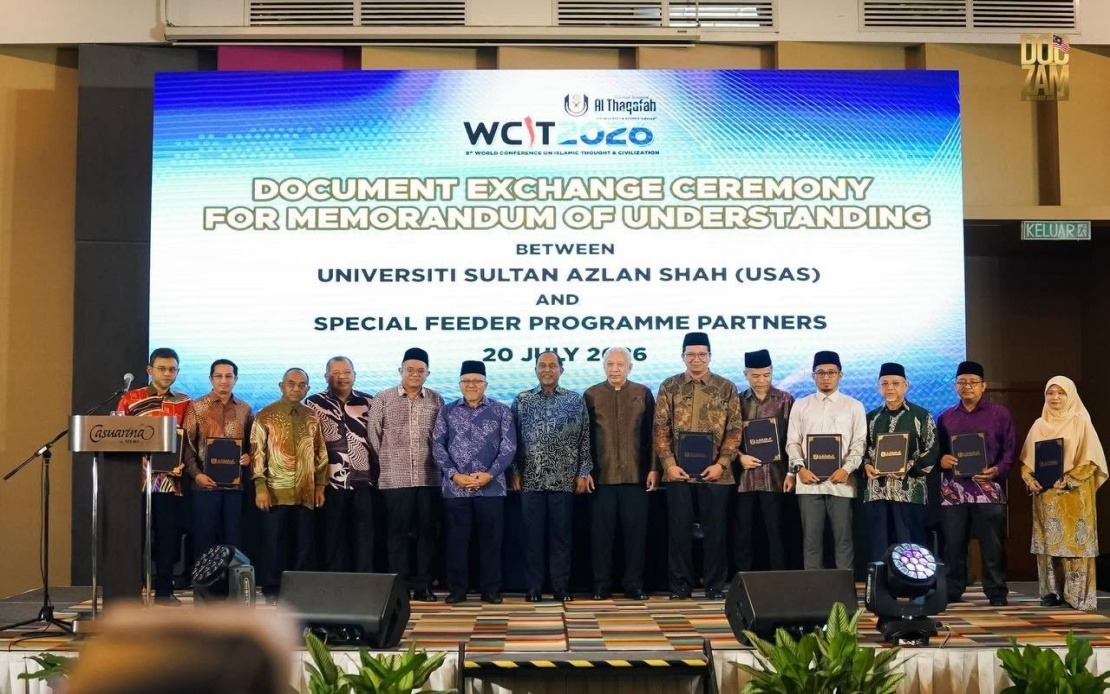
Malaysia is charting an ambitious course to establish itself as a pivotal centre for intellectual discourse and higher education advancement in the Islamic world and beyond. Higher Education Minister Datuk Seri Dr Zambry Abdul Kadir articulated this vision while addressing the 8th World Conference on Islamic Thought and Civilisation (WCIT2026), underscoring the nation's determination to foster dialogue among diverse academic and intellectual communities across borders. The three-day conference, which commenced recently, represents a significant opportunity for Malaysia to demonstrate its capacity to host large-scale international scholarly gatherings and position itself as a neutral, progressive forum for addressing contemporary challenges through the lens of Islamic scholarship.
The conference, organised by Universiti Sultan Azlan Shah in Ipoh, convened more than 180 delegates, scholars, researchers, and intellectuals from numerous countries, creating a critical mass of expertise focused on strengthening Islamic thought in response to pressing global issues. This gathering exemplifies Malaysia's broader strategic objective of becoming not merely a participant in global knowledge networks but an active architect shaping how Islamic civilisational perspectives engage with 21st-century problems. The diversity of attendees and their collective commitment to rigorous intellectual exchange signals that Malaysia recognises the value of positioning itself as a genuine intellectual meeting ground rather than a peripheral observer in international academic discourse.
Dr Zambry's remarks emphasised a fundamental principle that distinguishes Malaysia's approach: the conviction that knowledge transcends narrow national, political, and ideological boundaries. He articulated this by stressing that education must operate independently of political manipulation, sectarian conflict, and technological determinism. This stance carries particular resonance in Southeast Asia, where Malaysia's plural society and experience navigating religious and cultural diversity lend credibility to its advocacy for inclusive intellectual spaces. By framing knowledge as humanity's collective inheritance rather than any single civilisation's proprietary asset, Malaysia positions itself favourably among nations seeking to balance Islamic scholarly traditions with cosmopolitan educational values.
A cornerstone of Dr Zambry's message centred on the necessity of building the Islamic world's future on foundations of rigorous scholarship, empirical research, and technological innovation rather than romantic attachment to historical precedent. This pragmatic orientation reflects Malaysia's own development trajectory and suggests the government views higher education modernisation as inseparable from broader civilisational advancement. Rather than advocating for a retreat into historical nostalgia, the minister advocated for competitive institutions capable of generating original knowledge and training intellectuals equipped to address contemporary problems through both Islamic ethical frameworks and contemporary scientific methodologies.
The minister's invocation of historical destruction—referencing Baghdad, Granada, Sarajevo, and ongoing Palestinian suffering—served a dual rhetorical purpose. On one level, these examples underscore the catastrophic consequences when conflict destroys centres of learning and intellectual infrastructure. On another level, they implicitly argue that Malaysia's investment in stable, secure academic institutions represents not merely educational policy but an act of civilisational preservation. This framing resonates particularly in Southeast Asia, where several nations have experienced educational disruption due to conflict or political instability, making Malaysia's relative stability an asset in attracting international scholars and students.
The emphasis on integrity-driven leadership within higher education carries significant implications for Malaysian institutions themselves. By publicly championing this principle on an international stage, the Higher Education Ministry signals expectations that domestic universities must embody the values being promoted globally. This creates potential accountability mechanisms and sets benchmarks against which Malaysian universities might be evaluated both internationally and domestically. For regional observers, this represents a commitment to ensuring that Malaysia's advocacy for ethical intellectual leadership extends to its own institutional practices.
The WCIT2026 initiative also reflects Malaysia's strategic interest in leveraging its Islamic identity as a source of soft power and international influence. Unlike approaches that might emphasise Malaysia's economic or military capabilities, this strategy highlights its capacity to facilitate meaningful intellectual exchange and scholarly production. For Malaysian universities and research institutions, this creates opportunities to enhance international visibility and attract collaborative partnerships with leading Islamic scholars and institutions worldwide. It simultaneously positions Malaysia as a nation that takes Islamic intellectual traditions seriously while operating within pluralistic, democratic frameworks.
For Southeast Asia more broadly, Malaysia's positioning as a knowledge bridge carries implications beyond abstract intellectual concerns. The region faces mounting pressures from geopolitical competition, technological disruption, and environmental challenges where interdisciplinary scholarship combining multiple knowledge traditions could yield valuable insights. By establishing itself as a convening power for international intellectual communities, Malaysia potentially becomes a destination where Southeast Asian researchers and scholars can access global expertise and networks without necessarily travelling to Western universities or institutions outside the region.
The conference's focus on generating solutions benefiting both the Islamic world and the broader global community suggests Malaysia is moving beyond zero-sum frameworks where Islamic scholarship is positioned in opposition to other knowledge traditions. Instead, it advocates for synthetic approaches recognising both the distinctive contributions Islamic civilisational thought can make and the universal applicability of rigorous intellectual inquiry. This orientation has particular relevance for Malaysia's own plural society, where educational excellence increasingly requires engaging multiple knowledge traditions and perspectives within single institutions and programmes.
Looking forward, the success of WCIT2026 in producing concrete resolutions, policy recommendations, or collaborative frameworks could significantly enhance Malaysia's credibility as an international intellectual hub. Conversely, if the conference generates only abstract discussions without translatable outputs, Malaysia's ambitions may face scepticism. The minister's expressed hope that the gathering will yield substantive contributions suggests awareness that Malaysia's aspirations must be validated through demonstrable outcomes rather than symbolic gestures or rhetorical commitments alone. This practical orientation distinguishes Malaysia's approach from nations that might view such conferences primarily through ceremonial lenses.

