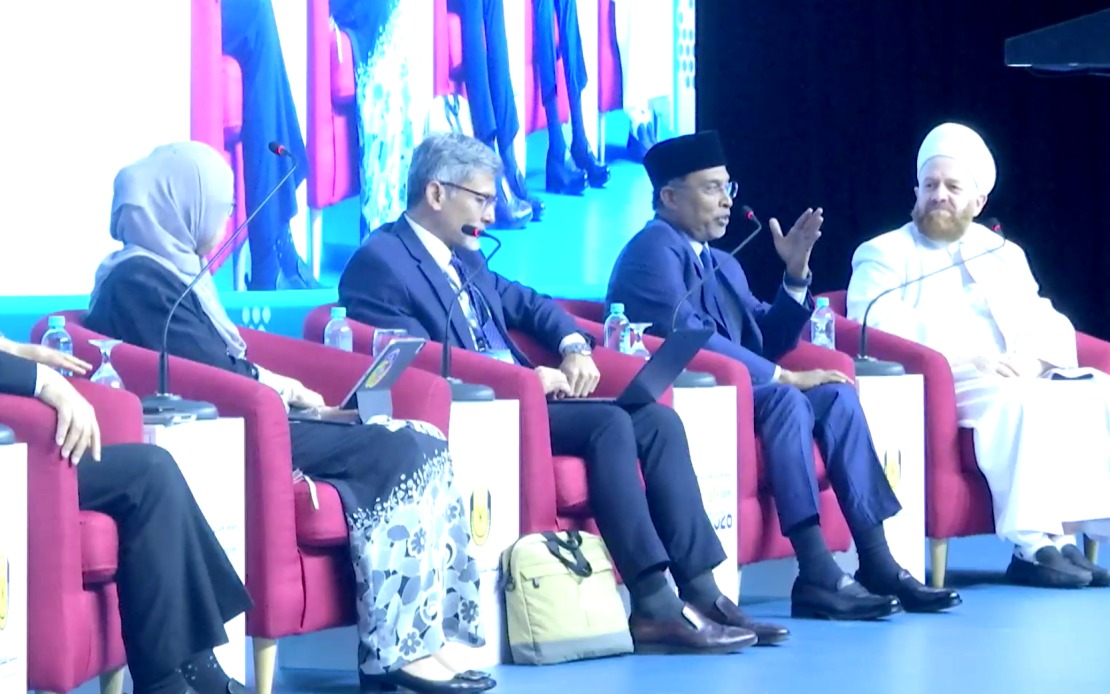
The integration of artificial intelligence and cutting-edge technologies into Malaysia's higher education system has become a strategic imperative for building a workforce capable of managing the complexities of an uncertain global landscape, according to Higher Education Minister Datuk Seri Dr Zambry Abd Kadir. Speaking during a panel session at the 8th World Conference on Islamic Thought and Civilisation in Ipoh, Zambry underscored that universities cannot simply adopt technological advancement in isolation; instead, institutions must carefully balance innovation with the cultivation of moral character and ethical reasoning among students.
The Ministry of Higher Education has responded to this challenge by formulating a comprehensive 10-year strategic blueprint spanning 2026 to 2035. This roadmap is deliberately structured to harmonise three critical dimensions: technological progress, the development of skilled human capital, and the strengthening of moral and ethical foundations. Rather than viewing these as competing priorities, the blueprint positions them as mutually reinforcing elements essential for producing graduates who not only possess technical competence but also demonstrate the wisdom and integrity required for responsible decision-making in an AI-driven world.
Zambry emphasised that as fields such as artificial intelligence, quantum computing, and planetary health continue their rapid evolution, the responsibility falls squarely on higher education institutions to ensure that ethical and moral instruction permeates every layer of academic curriculum. The challenge, he suggested, is not merely to teach students how to use these powerful technologies, but to instil in them the capacity to question when and how such tools should be deployed. This requires a fundamental rethinking of how universities structure their programmes and what competencies they prioritise in their graduates.
The minister articulated a particularly pressing concern: the algorithms and decision-making processes embedded within artificial intelligence systems can perpetuate biases, inequities, and unintended consequences if deployed without sufficient ethical guardrails. Educational institutions must therefore prepare students not simply to become proficient users of AI, but to become thoughtful custodians of its deployment. This demands that universities nurture a generation capable of grappling with complex moral dilemmas that arise when technology intersects with society, culture, and economics.
A significant element of this reformed approach involves a deliberate pivot from the traditional STEM framework—Science, Technology, Engineering, and Mathematics—towards an expanded STEAM model that incorporates the Arts and liberal studies. This shift acknowledges that technical expertise alone proves insufficient for addressing real-world challenges. By integrating humanities, philosophy, history, and social sciences into engineering and technology programmes, universities can cultivate graduates who possess both technical proficiency and broader contextual awareness. Such interdisciplinary exposure helps students understand not only how to build systems, but why certain design choices matter and what their societal implications might be.
Zambry cited Universiti Teknologi Petronas as a practical example of this integrated approach in action. The institution's engineering programmes deliberately require students to undertake coursework beyond their core disciplinary focus, deliberately structuring learning experiences to develop personality, character, and critical thinking skills alongside technical knowledge. This model recognises that engineering graduates will eventually occupy positions of influence and responsibility, making decisions that affect communities and environments; their education must therefore equip them to think beyond purely technical specifications.
The minister reinforced a fundamental philosophical point: while artificial intelligence can deliver rapid problem-solving and generate accurate answers across a vast range of domains, it fundamentally cannot shape human character, conscience, or integrity. These dimensions of development remain irreducibly dependent on intentional educational processes that centre human values and ethical reflection. The implication is clear—universities that outsource their moral and formative functions to technology platforms, or that treat character development as peripheral to their mission, will ultimately fail to prepare students adequately for the challenges they will encounter.
For Malaysia specifically, this approach carries particular strategic weight. As the nation positions itself to compete in high-value sectors and to attract knowledge-intensive industries, the quality of its human capital becomes decisive. Multinational technology companies and research institutions increasingly seek graduates not merely with coding skills or mathematical proficiency, but with the ethical reasoning capacity and cultural awareness to navigate global teams and complex stakeholder landscapes. Malaysian universities that successfully embed this holistic approach will produce graduates more attractive to premium employment opportunities and more capable of driving innovation domestically.
The 10-year blueprint also signals an intentional commitment to positioning humanity and humanistic values at the very centre of Malaysia's higher education strategy, rather than treating such concerns as secondary or decorative. This represents a philosophical stance on the purpose of university education itself—an assertion that universities exist not simply to produce workers for economic systems, but to cultivate thoughtful citizens capable of contributing meaningfully to society across multiple dimensions. In an era when technological change proceeds at accelerating pace, this anchoring in human values becomes increasingly important for preventing educational systems from becoming merely instrumental tools for economic productivity.

