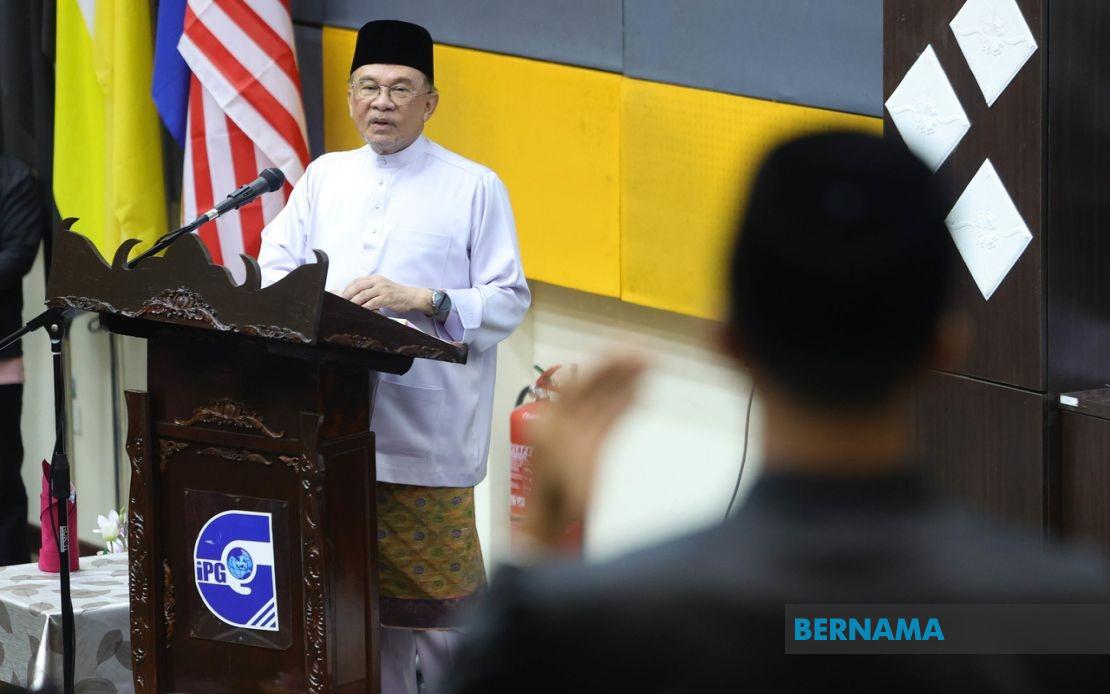
Prime Minister Datuk Seri Anwar Ibrahim has called for a fundamental shift in how Malaysia develops its teaching workforce, insisting that educators must balance technical mastery with unwavering commitment to moral principles and cultural values. Speaking at an event in Nilai, he articulated a vision of education that rejects the false choice between technological advancement and ethical grounding, arguing instead that both dimensions are equally essential to national competitiveness and social stability.
The challenge facing Malaysia's education system, Anwar suggested, extends beyond simply updating curricula to incorporate artificial intelligence, machine learning, and other cutting-edge fields. Rather, educational institutions must adopt a fundamentally dynamic approach that continuously evolves to reflect global transformations whilst ensuring the nation does not cede technological ground to more agile competitors. This requires teachers who understand not merely the tools of the digital age but can deploy them with wisdom informed by cultural sensibility and ethical reasoning.
Yet technological fluency divorced from moral foundations represents a dangerous incompleteness, the Prime Minister warned. He introduced a memorable formulation—"reach for the skies while keeping our roots on the ground"—to capture the integration he envisions. This metaphor acknowledges the necessary ambition to master cutting-edge technologies whilst simultaneously rejecting the notion that modernisation demands abandonment of religious faith, cultural heritage, moral conviction, or humanistic values. The phrase implicitly critiques a globalisation narrative that treats traditional cultures as obstacles to progress rather than resources for meaningful development.
For Malaysia specifically, this balance takes on particular urgency given the country's multicultural composition. Anwar articulated a clear warning that educational systems permeated by racial or religious animosity fundamentally fail their core mission, regardless of how sophisticated their technological infrastructure may be. An education that produces technically accomplished graduates but fails to instil mutual respect across communal lines ultimately undermines national cohesion and creates conditions for social fragmentation that no amount of economic development can overcome.
The Prime Minister positioned education as the foundation for national advancement, preceding even the capacity for rapid technological adaptation. This sequencing matters. Rather than treating education as instrumental to other goals, he framed it as the primary driver of both individual capability and collective progress. Only through education grounded in authentic human values can a society develop the discernment required to adopt new technologies wisely rather than uncritically.
Anwar's remarks also contained an implicit critique of educational approaches that reduce teaching to technical instruction. The presence of Education Minister Fadhlina Sidek and IPGKPT (Institut Pendidikan Guru Kampus Port Dickson) director Dr Kartini Abdul Mutalib at the event underscored official commitment to this vision, suggesting policy alignment at senior levels of the education establishment. This administrative backing suggests genuine institutional intent rather than rhetorical posturing.
The speech reflects growing international debate about education's role in addressing challenges posed by artificial intelligence and rapid technological change. Nations across Asia and globally grapple with questions about curriculum relevance, teacher preparation, and whether educational systems designed for industrial-era employment remain adequate for algorithmic-era economies. Malaysia's response—insisting that technical skills must remain tethered to ethical reasoning and human values—positions the country distinctly within this global conversation.
For Malaysia's diverse society, the emphasis on tolerance, mutual respect, and shared human values carries particular resonance. Religious and ethnic tensions periodically surface in Malaysian public discourse, and educational systems represent crucial sites where either divisive narratives or inclusive values can be cultivated. Teachers who approach their profession with genuine commitment to upholding human dignity across communal boundaries may prove more valuable to national development than those who excel purely in STEM instruction but carry prejudices into the classroom.
The practical implications extend to teacher training institutions and professional development programmes. Institutions like IPGKPT would need to integrate ethics modules, intercultural competence training, and reflective practice opportunities alongside technical coursework. This represents a significant expansion of teacher preparation expectations, requiring investment in instructor expertise, curriculum development, and institutional culture shifts. Yet without such integration, the aspiration remains rhetorical rather than realised in classroom practice.
Anwar's formulation also addresses a tension within Malaysian educational discourse between perceived Western technological hegemony and indigenous cultural preservation. By insisting that technology adoption need not entail cultural capitulation, he opens conceptual space for Malaysia to engage globally whilst remaining authentically rooted. This may resonate particularly with communities concerned that rapid modernisation threatens cultural continuity and spiritual dimensions of human development.
The emphasis on teachers as carriers of values rather than mere content deliverers reflects broader recognition that education encompasses far more than knowledge transmission. In an age when information becomes instantly accessible through digital means, teachers' distinctive contribution lies increasingly in moral formation, critical thinking cultivation, and the modelling of how one integrates diverse knowledge with ethical principle. This conception elevates the teaching profession conceptually whilst also raising performance expectations.
Regionally, Malaysia's articulation of this position may influence neighbouring education systems grappling with similar questions about technology adoption and cultural preservation. Southeast Asian nations generally share Malaysia's multicultural realities and concerns about educational relevance to rapidly changing economies. The Prime Minister's integrated approach—neither technophobic nor ethically indifferent—offers a potentially influential model for how developing nations can engage with global technological transformation on their own terms.
Moving forward, the central challenge involves translating these stated principles into systemic change. Teacher recruitment standards would need revision to identify candidates combining technical aptitude with demonstrated ethical maturity. Professional development must create continuous opportunities for educators to deepen both technological competence and reflective practice around values education. School leadership training should emphasise creating cultures where ethical reasoning is modelled and expected rather than marginalised. Without such structural alignment, even eloquent statements about balancing technology and human values risk remaining aspirational rather than becoming lived educational reality.

