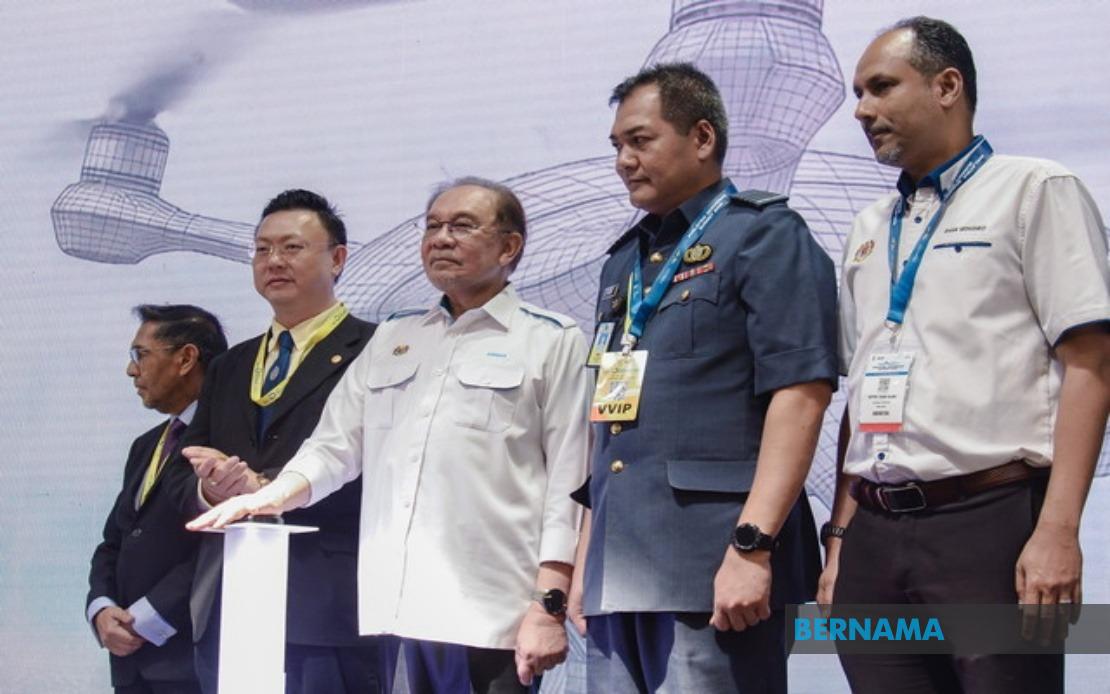
Prime Minister Datuk Seri Anwar Ibrahim has urged Malaysia to move with urgency in developing drone technology and unmanned aerial vehicle capabilities, arguing that this emerging sector represents a significant opportunity for economic expansion and technological advancement. Speaking at the closing ceremony of the MyDrone Expo 2026 in Sepang on June 27, Anwar emphasised that countries seeking to strengthen their global economic position cannot afford to fall behind in adopting and nurturing cutting-edge technologies, particularly in the rapidly evolving unmanned systems field.
The drone industry occupies a unique position within Malaysia's broader digital economy strategy, as it bridges multiple technological domains simultaneously. Anwar highlighted the interconnectedness between UAV development, artificial intelligence applications, and digital transformation, characterising drones as a convergence point where innovation, enhanced productivity, and economic growth intersect. This integrated approach reflects a strategic understanding that isolated technology initiatives yield limited returns; instead, the government views drone capabilities as part of a comprehensive ecosystem that elevates Malaysia's technological maturity across sectors.
The MyDrone Expo 2026, co-organised by the World UAV Federation Malaysia Chapter and the Malaysia UAV Development Association, demonstrated substantial market appetite and international engagement. The three-day event exceeded organisational expectations by hosting more than 100 exhibition booths and drawing thousands of visitors alongside industry representatives from 46 countries. This international participation underscores the global significance of the drone sector and positions Malaysia as an emerging hub within the regional unmanned systems landscape, presenting opportunities for knowledge transfer, partnership development, and export market expansion.
Global market dynamics present a compelling case for Malaysia's investment in this space. Industry projections indicate the worldwide UAV market will exceed USD55 billion by 2030, representing nearly a tripling of current valuations. Beyond commercial applications, the broader low-altitude economy—encompassing the airspace and operational frameworks below traditional aviation domains—is increasingly attracting venture capital, corporate investment, and government funding from developed nations. Malaysia's early entry and rapid capability development could position domestic companies to capture regional market share before the sector matures globally.
Anwar has directed Cabinet ministers, policymakers, scientific research institutions, and relevant government agencies to provide comprehensive regulatory and ecosystem support to drone industry stakeholders. This top-level commitment signals that drone development has transitioned from a niche technological interest to a priority component of Malaysia's industrial strategy. The directive encompasses not merely rhetorical backing but tangible policy implementation across multiple government machinery levels, indicating a whole-of-government approach to sector development.
The government's commitment extends to multiple infrastructure and support dimensions critical for industry maturation. Regulatory framework improvements are essential to create predictable operating conditions for companies navigating airspace management, data protection, and safety compliance requirements. Enhanced research funding mechanisms will enable universities and research institutions to conduct advanced studies in UAV design, autonomous systems, battery technology, and artificial intelligence integration. Streamlined testing and certification pathways will accelerate the transition from prototype development to commercial deployment, reducing time-to-market for Malaysian innovators.
Military and defence applications represent only one dimension of Malaysia's drone strategy. Anwar explicitly acknowledged civilian uses, citing agricultural applications as a specific example where drone technology substantially improves productivity and resource efficiency. Plantations, particularly those managing large territorial areas, stand to benefit from aerial crop monitoring, pest surveillance, irrigation management, and yield optimisation facilitated by unmanned systems. Broader adoption across agriculture, forestry, infrastructure inspection, and disaster management could generate substantial economic multiplier effects across rural and semi-rural regions.
Building a sustainable talent pipeline represents a critical prerequisite for long-term sector development. Anwar advocated for enhanced collaboration linking private sector companies, government research establishments, and universities in coordinated workforce development initiatives. He referenced Malaysia's existing strength in artificial intelligence and quantum computing education as a model for how dedicated academic focus could establish Malaysia as a centre of excellence. Establishing dedicated drone engineering programmes, certifications, and specialisations across Malaysian universities would ensure steady graduate flows into the expanding industry while building local expertise that reduces dependence on foreign talent.
The private sector's role in this ecosystem remains essential and complementary to government support. Malaysian companies operating across engineering, manufacturing, software development, and systems integration possess capabilities relevant to drone production and deployment. Government support mechanisms should facilitate these companies' participation in the value chain rather than creating redundant state-owned alternatives. Public-private partnerships, preferential procurement policies, export financing, and intellectual property protection frameworks can effectively mobilise private sector capabilities toward national sector development objectives.
Regional competitive dynamics add urgency to Malaysia's drone industry push. Several Southeast Asian neighbours have already initiated significant unmanned systems programmes, and global technology leaders from North America, Europe, and China maintain substantial research and manufacturing operations throughout the region. Malaysia's geographic location, established aerospace and technology infrastructure, regulatory sophistication, and educated workforce provide comparative advantages, but these must be activated through decisive policy and investment decisions. Delaying action risks allowing the initiative to shift toward rival jurisdictions within Southeast Asia.
The drone sector's convergence with artificial intelligence particularly attracts long-term strategic importance. As unmanned systems become increasingly autonomous and intelligent, the boundary between hardware manufacturing and software intelligence blurs. Malaysian companies developing AI algorithms for autonomous flight, collision avoidance, threat detection, and data analysis will participate in capturing value from the global artificial intelligence economy. Government support for R&D in these dual-technology areas positions Malaysia for participation in high-value segments rather than relegation to basic manufacturing roles.
International partnerships and technology transfer represent additional avenues for accelerating Malaysian capability development. Strategic collaborations with established UAV manufacturers, research institutions, and technology companies worldwide could compress Malaysia's learning curve while building local capacity. Government support for joint ventures, licensing arrangements, and technology sharing agreements—particularly with regional partners and developed economies with whom Malaysia maintains good relations—could enable leapfrogging of intermediate development stages. Such partnerships, managed strategically, transfer knowledge while building local expertise and manufacturing capacity.
For Malaysian investors and entrepreneurs, the government's clear drone sector commitment provides a policy foundation for venture decisions. Private capital seeking emerging technology opportunities increasingly follows government signals of sustained support. Regulatory clarity, research funding availability, and demonstrated commitment to the sector from the highest political levels reduce investment risk and attract both domestic and foreign capital toward Malaysian drone companies. This virtuous cycle of policy commitment, private investment, technological advancement, and economic value creation has animated successful technology sectors globally and could similarly transform Malaysia's drone industry prospects.

