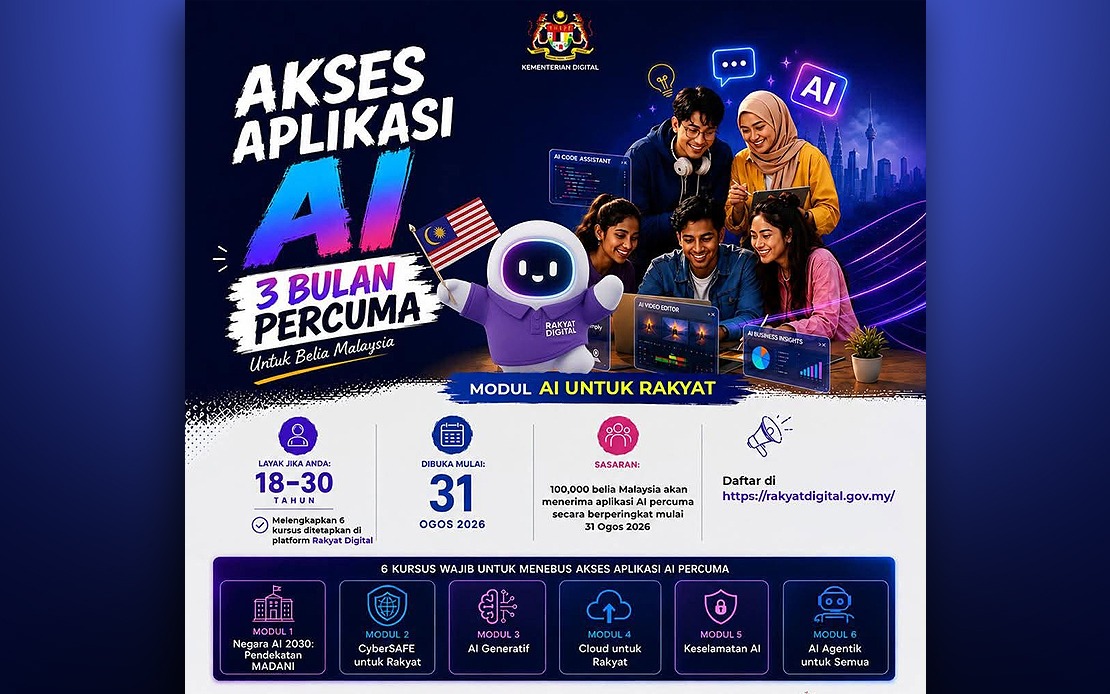
Malaysia's government has introduced an ambitious initiative designed to democratise access to artificial intelligence tools and training among the nation's youth population. The AI for the People (AI Untuk Rakyat) programme, announced by Prime Minister Datuk Seri Anwar Ibrahim during a special address at the Putrajaya International Convention Centre, represents a significant component of the government's broader strategy to develop an inclusive digital economy ahead of 2030.
The programme targets 100,000 Malaysians between the ages of 18 and 30, with enrolment continuing until 2027. Interested participants can register through the Rakyat Digital portal at rakyatdigital.gov.my, with the initiative launching in phases to manage capacity and ensure quality delivery. This phased rollout approach reflects the scale of ambition behind the project, as the government attempts to reach a substantial portion of Malaysia's youth demographic with practical AI competency training.
To qualify for tangible benefits, participants must successfully complete and pass six structured educational modules that form the core curriculum. The Digital Ministry has designed these courses to cover essential competencies in the contemporary AI landscape. The designated modules are AI Nation 2030: The MADANI Approach, CYBERSAFE for the People, Generative AI, AI Security, Agentic AI for All, and Cloud for the People. This curriculum design suggests a holistic approach, combining strategic national context, security considerations, and practical technical skills across different AI domains and deployment environments.
Successful programme participants will receive a free three-month subscription to carefully curated artificial intelligence applications and software platforms. This reward structure directly addresses a key barrier to AI adoption among young Malaysians: the cost of premium tools. Initial offerings include access to YTL AI Labs' IlmuChat, Alibaba's Wonderclip and MuleRun, and Google's Gemini Enterprise. The involvement of both local technology providers like YTL AI Labs and international giants such as Alibaba and Google demonstrates the government's pragmatic approach to assembling resources, leveraging existing partnerships while promoting domestic innovation.
The Digital Ministry has signalled plans to expand the range of available tools progressively. Rather than limiting participants to a static set of applications, the government intends to introduce additional AI software and tools from various technology companies in successive phases. This expansion strategy serves multiple purposes: it allows for iterative refinement based on participant feedback, accommodates emerging technologies and innovations, and strengthens relationships with diverse technology stakeholders. The approach suggests flexibility in execution despite the programme's long-term 2027 timeline.
Digital Ministry secretary-general Datuk Fabian Bigar framed the initiative as a critical component of broader national digital transformation goals. He emphasised that the programme aimed not merely to impart theoretical knowledge about AI technology, but to provide genuine hands-on access to tools that young Malaysians could deploy for learning, creative pursuits, and productivity enhancement. This practical orientation distinguishes the programme from purely educational interventions; participants gain tangible exposure to technologies they might otherwise encounter only in academic or professional settings.
The timing and framing of the announcement connect this youth-focused initiative to Malaysia's larger strategic ambitions. The initiative aligns with Malaysia Digital 2030, the government's comprehensive digital transformation framework, and reinforces the stated objective of building an inclusive AI Nation by 2030. By specifically targeting young adults aged 18 to 30, the programme addresses a population cohort that will shape Malaysia's technological and economic trajectory over the coming decades. This demographic focus also acknowledges demographic reality: Malaysia has a relatively young population where digital adoption and technological literacy carry disproportionate importance for future competitiveness.
The programme reflects the Prime Minister's broader policy direction regarding digital opportunity distribution. Announced alongside five other youth-focused digital initiatives, the AI for the People programme sits within a coordinated government effort to expand digital opportunity beyond traditional centres of economic activity and educational advantage. For Malaysian policymakers, the implicit recognition is that AI competency will increasingly determine economic participation and social mobility in coming years, necessitating proactive government intervention to prevent digital divides from deepening.
Rakyat Digital, the national digital learning portal through which participants will access the programme, operates as a government-managed infrastructure for digital skills dissemination. Managed by MyDIGITAL Corporation under the Digital Ministry, the portal represents institutional machinery specifically created to deliver such national digital upskilling initiatives. The choice to route the AI for the People programme through this existing infrastructure suggests lessons learned from previous digital adoption initiatives and reflects institutional consolidation around digital transformation goals.
For Malaysian youth, the programme offers tangible value that extends beyond the three-month tool subscription period. Participants gain formal credentials in increasingly valuable domains: AI literacy, cybersecurity awareness, and cloud computing. These qualifications carry weight in contemporary job markets, particularly as Malaysian employers increasingly seek staff with practical AI exposure. The emphasis on security and responsible AI use, reflected in dedicated cybersecurity and AI Security modules, indicates government awareness of risks accompanying rapid AI adoption and integration.
The involvement of regional technology providers like Alibaba alongside Western platforms such as Google reflects geopolitical and commercial realities in Asian technology markets. Malaysian participants gain exposure to AI tools prevalent in regional markets, not merely Western-developed systems, preparing them for participation in increasingly integrated Asian technology ecosystems. This pluralistic approach to tool access avoids over-dependence on any single technology provider while acknowledging that different platforms serve different purposes and user needs.
The programme's structure positions AI competency as a public good deserving government investment rather than a private commodity. By removing cost barriers for 100,000 young Malaysians, the government signals that broad-based AI literacy constitutes national infrastructure investment comparable to traditional education and transportation spending. This ideological positioning may have implications for future government technology policy, potentially justifying similar interventions across other emerging technology domains where adoption gaps threaten to widen social and economic disparities.

