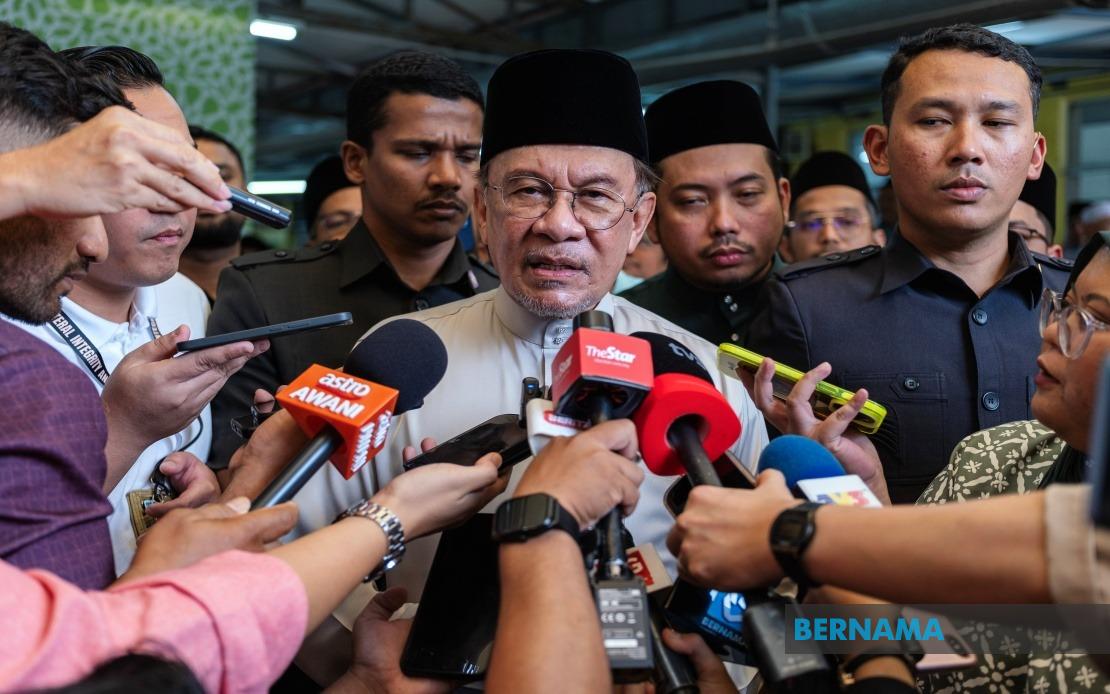
Prime Minister Datuk Seri Anwar Ibrahim has reiterated Malaysia's resolute stance on the fugitive financier Low Taek Jho, commonly known as Jho Low, insisting that the country will not deviate from its principled position regardless of developments in Washington. Speaking to journalists after Friday prayers at Masjid As-Sodiqin in Taman Kobena on July 3, Anwar underscored that Malaysia's commitment to the rule of law remains paramount and unshakeable, even as international media outlets have speculated that Jho Low ranks among approximately 250 individuals being considered for potential clemency by United States President Donald Trump as part of Fourth of July Independence Day celebrations.
The Prime Minister's statement carries significant weight given the international dimensions of the Jho Low case, which has captivated global attention due to the scale of alleged financial impropriety and the high-profile individuals implicated across multiple jurisdictions. Anwar's comments reflect Malaysia's determination to pursue accountability through its domestic legal mechanisms without external interference or influence. By explicitly stating that Malaysia will not be swayed, disturbed, or affected by any decision emanating from the United States, Anwar sent a clear message both domestically and internationally that Malaysia's judicial processes and national interests supersede considerations of foreign policy expediency or diplomatic pressure.
The timing of Anwar's remarks is particularly noteworthy, occurring precisely when speculation about Trump's potential pardons reached a crescendo in international media coverage. The Fourth of July traditionally provides American presidents with an opportunity to exercise executive clemency, and the sheer scale of individuals purportedly under consideration—around 250 individuals—suggests that the Trump administration has cast a remarkably wide net in evaluating potential pardons. For Malaysia, however, such developments at the highest levels of American governance do not alter the fundamental commitment to investigating and prosecuting individuals implicated in financial crimes within Malaysian jurisdiction.
Jho Low's case remains emblematic of Malaysia's broader efforts to address large-scale corruption and financial malfeasance that characterized the previous administration. The alleged misappropriation of funds connected to 1Malaysia Development Berhad has become a defining feature of Malaysia's recent political and economic history, with ramifications extending far beyond the country's borders. From a Malaysian perspective, any development suggesting potential leniency toward individuals accused of crimes that allegedly harmed the nation's treasury and reputation represents a matter of profound national concern, warranting the strongest possible reassertion of Malaysia's commitment to accountability and justice.
The constitutional framework governing Malaysia's approach to such matters prioritizes domestic sovereignty and the rule of law as foundational principles. Anwar's statement operationalizes these principles by rejecting any notion that foreign executive decisions should influence or constrain Malaysia's own investigative and prosecutorial frameworks. This position aligns with broader international law principles that emphasize each nation's responsibility to pursue justice within its own legal system while respecting the legitimate authority of other states to manage their internal affairs.
In parallel developments reflecting the breadth of Malaysia-US bilateral engagement, Anwar indicated that Malaysia has acknowledged a proposed contribution of RM1 million from the United States directed toward the restoration of Tugu Negara, the National Monument, in conjunction with Malaysia's forthcoming National Day celebrations. While this gesture of cultural and infrastructural cooperation demonstrates the continuing warmth of bilateral relations, it simultaneously illustrates how Malaysia manages to maintain diplomatic relationships while firmly declining to compromise on matters touching national sovereignty and judicial integrity. The Cabinet will deliberate on this matter during its next weekly convening, indicating that Malaysia views such cooperative initiatives as worthy of consideration within its standard governance procedures.
The distinction Anwar drew between respecting American autonomy on internal matters while maintaining Malaysia's own independent position reflects sophisticated diplomatic positioning. Malaysia neither presumes to dictate American executive decisions nor accepts that such decisions should constrain Malaysian policy. This approach respects the principle of mutual non-interference that underpins international relations while simultaneously protecting Malaysia's legitimate interests in prosecuting individuals accused of harming national economic interests.
For regional observers and Southeast Asian nations monitoring Malaysia's handling of high-profile international cases, Anwar's pronouncement signals that despite broader geopolitical considerations and bilateral relationships with powerful nations, Malaysia prioritizes legal consistency and institutional integrity. This messaging proves particularly important given Southeast Asia's ongoing struggle with corruption and capital flight, phenomena that the Jho Low case exemplifies at an extraordinary scale. Other nations in the region facing similar challenges regarding fugitive individuals with international connections will likely view Malaysia's resolute stance as an encouraging precedent.
The broader context of Malaysia-US relations encompasses numerous dimensions beyond the Jho Low matter, including defense cooperation, trade arrangements, and regional security partnerships. Anwar's careful calibration of Malaysia's position—neither hostile nor deferential—suggests a mature diplomatic approach that acknowledges bilateral importance while refusing to subordinate domestic legal imperatives to considerations of international relationship management. This balance proves essential for a country like Malaysia, which must navigate complex relationships with multiple powerful actors while maintaining credibility with its own citizens regarding the pursuit of justice.
Moving forward, Malaysia's continued emphasis on the rule of law and institutional independence will be tested as developments unfold in Washington and elsewhere. The nation's leadership has made abundantly clear that whatever clemency decisions the United States ultimately reaches regarding Jho Low or others, Malaysia will maintain its own independent course. This posture strengthens Malaysia's long-term institutional credibility and demonstrates to the international community that Malaysian justice mechanisms operate according to principle rather than expediency, a message with implications extending well beyond the specific case in question to the broader health and functioning of Malaysia's democratic institutions.

