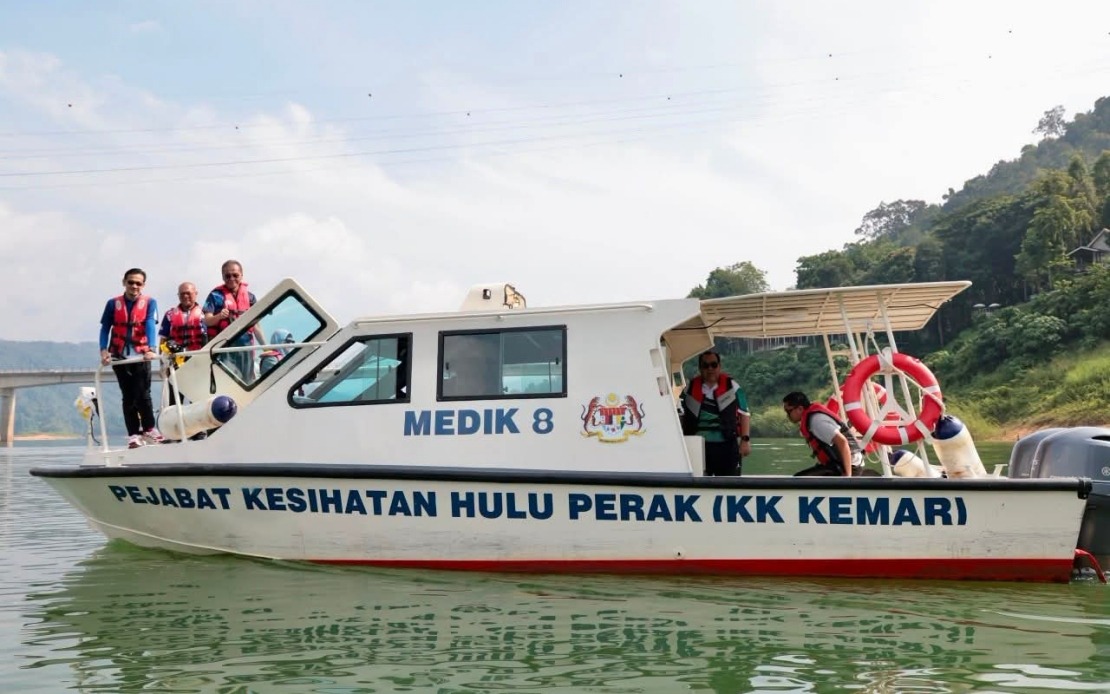
The Ministry of Health has taken a significant step towards bridging healthcare disparities in peninsular Malaysia's interior by commissioning Medic Boat 8, a RM350,000 purpose-built vessel designed to serve remote Orang Asli communities in Hulu Perak. Health Minister Datuk Seri Dr Dzulkefly Ahmad formally launched the service at Belum Rainforest Resort's jetty during a working visit to the region, underscoring the government's commitment to extending essential medical services to populations where geography and infrastructure present formidable obstacles to conventional healthcare delivery.
The 12-passenger multipurpose boat represents an addition to the Ministry's existing operational fleet of six vessels already serving these waterway-dependent settlements. The introduction of this eighth boat is not merely a logistical upgrade but a critical infrastructure investment reflecting the unique challenges faced by approximately 4,500 Orang Asli residents within the Kemar Resettlement Scheme near Gerik, who rely almost exclusively on river passages for transportation and access to external services. For these communities, waterways function as their primary lifelines, and inadequate medical transport had previously created dangerous delays in emergency care delivery.
Dr Dzulkefly's remarks during the launch emphasised that possession of sophisticated government assets holds limited practical value without the human commitment underlying their deployment. He acknowledged the extraordinary dedication of healthcare personnel—encompassing physicians, nursing staff, and skilled boat operators—who willingly contend with unpredictable river dynamics and harsh weather patterns to fulfil their professional obligations. These workers routinely navigate challenging conditions that would deter many, demonstrating a commitment to service that extends beyond standard occupational expectations.
The initiative aligns with Malaysia MADANI, the government's overarching policy framework prioritising inclusive development and equitable access to public services. Within this context, the Health Ministry has articulated a clear principle: healthcare accessibility must transcend geographic limitations and must reach all Malaysian citizens regardless of where they reside. The challenging terrain of Hulu Perak's interior and the remoteness of these settlements present obstacles that government policy explicitly refuses to accept as justifications for inferior healthcare provision.
For context, Orang Asli communities have historically experienced significant gaps in healthcare access compared to urban and suburban populations. Limited transportation infrastructure, sparse medical facility distribution, and communication barriers have contributed to higher maternal mortality rates, delayed diagnosis of serious conditions, and reduced preventive care uptake among these populations. The Kemar Resettlement Scheme represents an ongoing government effort to improve living conditions for Orang Asli groups, though such initiatives require accompanying investments in service delivery mechanisms.
The deployment of additional medical boats directly addresses one of the most critical bottlenecks: emergency transportation. When a community member requires urgent medical intervention, access to reliable water transport becomes quite literally a matter of life and death. Faster boat response times can mean the difference between successful treatment outcomes and preventable mortality, particularly for obstetric emergencies, acute infections, and traumatic injuries.
This expansion of maritime medical services reflects broader Southeast Asian trends in addressing healthcare equity in geographically challenging regions. Several neighbouring countries face analogous difficulties in serving interior and island-based populations, making Malaysia's approach potentially instructive for regional health policy discussions. The investment in purpose-built medical vessels rather than reliance on repurposed general transport demonstrates prioritisation of specialist infrastructure for health emergencies.
The Belum Rainforest area where these services operate exists within one of Malaysia's most ecologically significant regions, characterised by dense forest cover, complex hydrology, and limited road infrastructure. Rather than waiting for extensive road development—which would be environmentally problematic and economically inefficient—the Health Ministry has opted for targeted investments in water-based medical logistics. This pragmatic approach acknowledges both environmental constraints and community needs simultaneously.
Operationally, the introduction of Medic Boat 8 implies expanded capacity for regular health screenings, scheduled medical appointments, and emergency evacuations to higher-level facilities. The boat's multipurpose design enables it to transport medical personnel, equipment, and patients with appropriate safety provisions, transforming waterways from access barriers into functional components of the healthcare delivery network. Training and maintenance protocols for such specialised vessels demand continuous investment beyond initial procurement costs.
The Minister's working visit and ceremonial launch carry symbolic significance beyond the immediate practical implications. Political acknowledgement of Orang Asli healthcare challenges at ministerial level signals institutional commitment and helps elevate these issues within broader policy conversations. Public recognition of frontline health workers' sacrifice and dedication can improve staff morale and retention in demanding postings.
Moving forward, the sustainability of expanded boat services depends upon adequate funding for fuel, maintenance, repairs, and staff remuneration. Operating marine vessels in river environments with challenging seasonal variations demands specialised expertise and contingency planning. The Health Ministry's demonstrated willingness to invest substantially in this infrastructure—evidenced by the RM350,000 expenditure on a single boat—suggests institutional confidence in long-term service viability.
For Malaysian policymakers and development planners, the Medic Boat 8 initiative offers valuable lessons regarding creative problem-solving for service delivery in geographically disadvantaged regions. Rather than insisting on standardised urban-model healthcare systems ill-suited to local conditions, the Ministry has adapted delivery mechanisms to existing community circumstances. This flexibility in approach, combined with sustained resource commitment, represents a pragmatic framework for advancing healthcare equity across Southeast Asia's diverse and challenging topographies.

