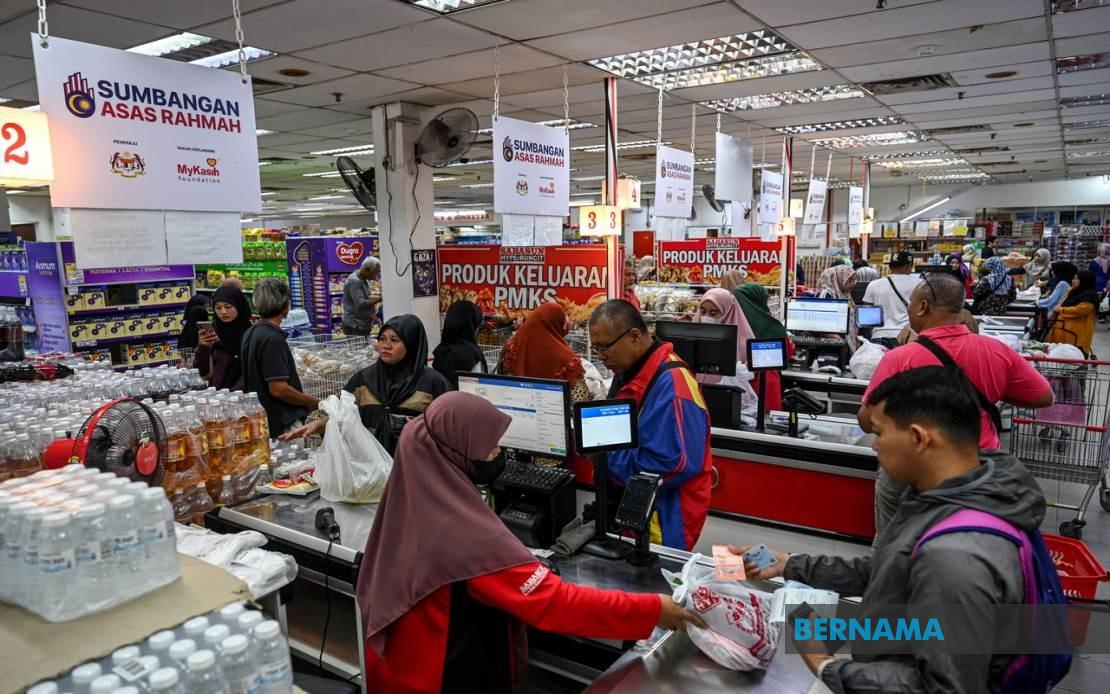
Prime Minister Datuk Seri Anwar Ibrahim has signalled that the MADANI government is actively evaluating whether it can expand its social safety net by raising benefit levels under two key cash assistance programmes, contingent on stronger economic performance. Speaking during a community engagement event in Ipoh, Anwar outlined preliminary discussions with senior Treasury officials about the viability of boosting the Sumbangan Tunai Rahmah (STR) and Sumbangan Asas Rahmah (SARA) schemes, both of which have become cornerstone components of Malaysia's approach to household income support.
The announcement represents a measured commitment rather than a firm pledge, reflecting the government's careful balancing act between welfare expansion and fiscal prudence. Anwar, who simultaneously holds the Finance Ministry portfolio, framed any enhancement as dependent on Malaysia's macroeconomic trajectory, suggesting that policymakers are monitoring growth metrics closely. The conversation with Treasury secretary-general Tan Sri Johan Mahmood Merican represents the preliminary stage of an internal deliberation process that will likely crystallise during the budget formulation exercise, offering recipients of these programmes a potential window of opportunity in the coming financial allocation.
For Malaysian households dependent on STR and SARA—two schemes that collectively reached millions of lower-income recipients since their introduction—this statement carries tangible significance. The STR scheme, launched in 2022, provides targeted cash injections to vulnerable populations, while SARA operates as a foundational assistance mechanism. Both programmes have functioned as critical stabilisers during periods of economic uncertainty and inflation, helping eligible families manage rising living costs. An increase to benefit levels would directly enhance purchasing power for some of the country's most economically stressed segments, potentially easing pressure on household budgets stretched thin by elevated food, energy, and transport expenses.
The government's conditional approach reflects Malaysia's ongoing economic recovery narrative and the constraints inherent in a developing economy managing public finances amid competing demands. While domestic growth has shown resilience in recent quarters, structural economic challenges and global uncertainties necessitate cautious fiscal management. By tying benefit increases explicitly to economic performance, Anwar signals that the government views programme expansion as contingent upon revenue generation and sustainable fiscal space rather than borrowing-financed stimulus. This framing also demonstrates awareness of the delicate equilibrium between welfare ambitions and macroeconomic stability that Southeast Asian policymakers must maintain.
Beyond the immediate social assistance component, Anwar's remarks also underscored the government's commitment to security sector welfare, allocating RM3 million for RELA (Malaysian Volunteer Corps) member support. This dual-track emphasis—simultaneously addressing civilian household assistance and security personnel welfare—reflects a governance philosophy that recognises interconnected vulnerabilities across different segments of the population. RELA members, who operate in lower-visibility security and disaster response roles, have historically faced resource constraints, making dedicated welfare allocation a recognition of their operational importance and sacrifice.
The RM3 million RELA welfare allocation, while the same figure as the previous year, takes on symbolic importance as a maintained commitment during a period of broader fiscal constraint. Anwar's acknowledgement that this funding remains insufficient hints at ongoing internal debates about appropriate resourcing levels for volunteer security forces. The consistency of allocation suggests governmental continuity in supporting these personnel, even as the Finance Ministry navigates competing budget priorities across defence, infrastructure, public services, and social programmes.
The timing of these announcements during the Ipoh community programme demonstrates intentional political messaging aligned with the MADANI (Mengukuhkan Demokrasi Arus Baru Inklusif) governing framework, which emphasises inclusive prosperity and democratic renewal. By publicly discussing welfare expansion possibilities in a grassroots setting rather than through formal parliamentary channels, the government amplifies its connection to everyday voter concerns while maintaining flexibility about implementation timelines and parameters. This approach allows for narrative development without over-committing to specific timescales or quantum increases.
From a regional perspective, Malaysia's deliberation on cash assistance enhancement reflects broader Southeast Asian trends in social protection expansion. Countries across the region have increasingly recognised that targeted cash transfers represent cost-effective poverty alleviation mechanisms compared to universal subsidies. Thailand, Vietnam, and the Philippines have similarly implemented or expanded cash assistance schemes in recent years, suggesting a regional convergence on this policy approach. Malaysia's cautious evolution of such programmes, while economically constrained, positions it within this wider trajectory of social policy development across ASEAN economies.
The parliamentary budget process will ultimately determine whether these exploratory discussions translate into concrete benefit increases. The Finance Ministry's capacity to identify fiscal space, combined with political will and sectoral advocacy from implementing agencies, will shape outcomes. For recipients of STR and SARA, the coming budget presentation in October will provide the decisive answer about whether economic performance has improved sufficiently to permit the expansion Anwar referenced. This creates anticipation and uncertainty simultaneously—hope anchored to conditional economic metrics beyond most households' direct influence.
Government officials' public acknowledgement of welfare programme limitations and ongoing cost-of-living pressures experienced by beneficiaries signals recognition that current support levels remain contested terrain in Malaysia's social policy discourse. Rather than dismissing calls for enhancement, the administration has opted for transparent engagement with the possibility, framing it through responsible fiscal language while maintaining political credibility with vulnerable constituencies. The interplay between economic growth performance and welfare benefit levels thus becomes a critical variable in both macroeconomic management and social cohesion narratives for the remainder of the MADANI government's tenure.
The government's willingness to examine STR and SARA enhancement options, even conditionally, reflects understanding that social stability and economic recovery are mutually reinforcing. Households with improved cash support spend more on local goods and services, stimulating domestic demand and supporting small businesses, particularly in lower-income communities. This multiplier effect creates economic rationale beyond humanitarian considerations for welfare programme expansion when fiscal conditions permit. Simultaneously, maintaining social peace through responsive welfare policy reduces externalities that might otherwise drain government resources through crisis management or instability responses.

