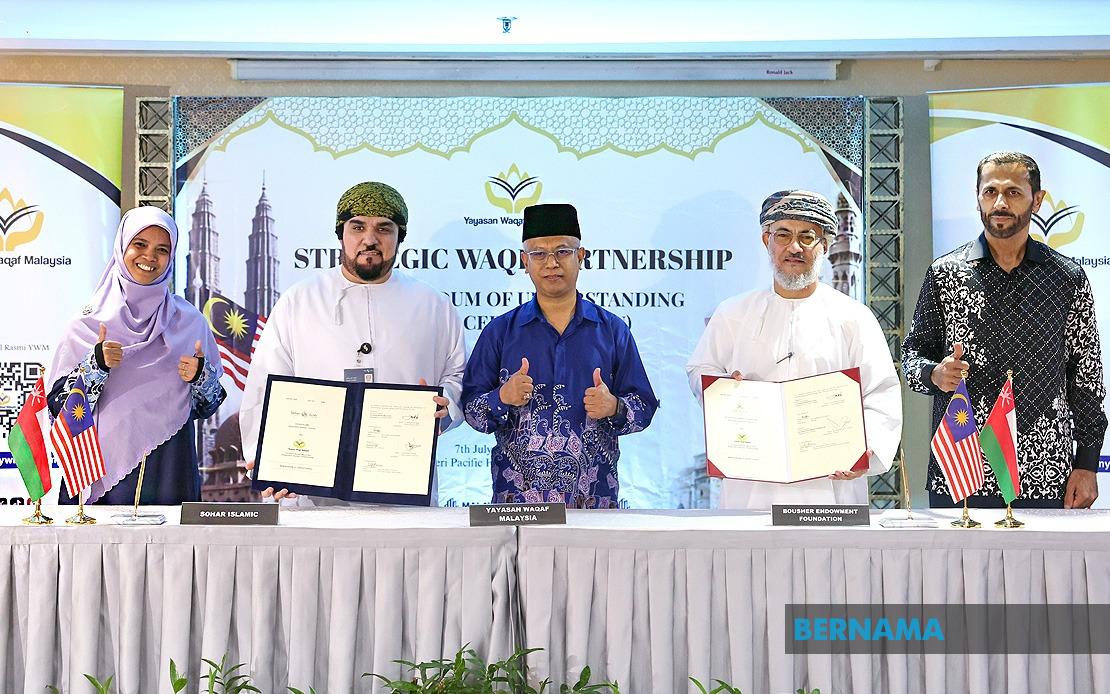
Malaysia's growing credentials as an authority on waqf development received a significant boost this month when the Malaysian Waqf Foundation (YWM) formalised partnerships with two major Omani financial institutions—Sohar Islamic and the Boushar Endowment Foundation—to collaborate on Islamic social finance and asset management strategies. The signing of the memorandum of understanding marks a watershed moment for a nation increasingly recognised as a regional leader in structuring innovative approaches to religious endowments, an area where Malaysia's track record and institutional frameworks have begun attracting attention from Gulf Cooperation Council economies seeking to modernise their own waqf sectors.
The strategic partnership was witnessed by Marhamah Rosli, Deputy Minister in the Prime Minister's Department (Religious Affairs), who underscored how the collaboration underscores international validation of Malaysia's capabilities in building a robust and efficient waqf ecosystem. Her remarks highlighted a broader shift in how Malaysia positions itself on the Muslim world stage—no longer primarily as an importer of expertise, but increasingly as an exporter of knowledge and best practices in areas where it has developed genuine competitive advantages. The focus of the Oman collaboration extends across multiple dimensions, encompassing knowledge transfer, governance frameworks, technological innovations, and management protocols that have proven effective in Malaysia's domestic context.
Central to the partnership is the appointment of Dr Ridzwan Bakar, chief executive officer of YWM, as Waqf Adviser to both Sohar Islamic and the Boushar Endowment Foundation. This appointment represents more than a symbolic gesture; it reflects the confidence these Omani institutions place in Malaysian expertise and their willingness to engage Malaysian professionals in designing systems that could reshape how waqf assets generate returns and serve broader social purposes across the sultanate. For Malaysia, the arrangement signals that its institutional innovations in waqf management have achieved sufficient maturity to attract international implementation contracts from established financial players in neighbouring markets.
The initiative represents the continuation of relationship-building efforts that began in earnest during 2023 and 2024, when YWM leadership made exploratory visits to Oman to assess potential cooperation opportunities. What began as preliminary consultations has evolved into a formal institutional arrangement, demonstrating the receptiveness of Gulf-based Islamic finance practitioners to collaborative approaches with Southeast Asian partners. Ridzwan acknowledged that Malaysia essentially took the initiative in approaching Omani counterparts, identifying them as institutions capable of serving as regional anchors for waqf innovation and then persisting until those initial overtures matured into binding commitments.
The Oman partnership fits within a broader internationalisation strategy that YWM has pursued across multiple Gulf markets. Concurrent relationships with counterparts in Kuwait, Qatar, and the United Arab Emirates position Malaysia as a nodal point in a emerging network of waqf-focused institutions across the Islamic world. This constellation of partnerships creates multiple channels through which Malaysian approaches to waqf governance can influence how Arab economies structure endowment frameworks, while simultaneously opening pathways for capital flows from wealthy Gulf investors seeking to participate in Islamic asset development vehicles managed from or based in Malaysia.
A crucial aspect of the collaboration focuses on developing productive waqf assets that generate economic returns before distributing benefits to beneficiaries. This represents a significant conceptual shift from traditional understandings of waqf as primarily distributive institutions. By emphasising asset development and capital appreciation, the partnership positions waqf structures as engines for wealth creation that can sustain longer-term social support mechanisms. Ridzwan articulated this vision explicitly, noting that strengthened waqf assets create foundations for expanded community support extending beyond the traditional classification of asnaf recipients to encompass broader segments of the B40 and M40 income groups experiencing economic vulnerability.
A key mechanism for attracting international capital lies in investment products that YWM has developed in collaboration with Kenanga Investors. These three structured investment vehicles serve as conduits through which both regional and international capital can flow into Malaysian waqf-linked asset development projects. For Gulf investors seeking Shariah-compliant investment vehicles with genuine social impact dimensions, such platforms offer an alternative to conventional investment channels while supporting Malaysia's positioning as a hub for Islamic financial innovation. The existence of these products enhances Malaysia's appeal to international institutional investors eager to align capital allocation with religious and social objectives.
The timing of this partnership reflects broader dynamics reshaping Islamic finance across Asia and the Middle East. Many Gulf economies are reconsidering how traditional wealth accumulation and distribution mechanisms function within contemporary economic contexts. Malaysia's willingness to engage with institutional innovation and technological application in waqf management addresses a genuine gap that Gulf practitioners have identified in their own systems. By formalising these relationships through binding institutional agreements, both Malaysian and Omani partners signal their commitment to developing frameworks that can accommodate modern financial instruments while maintaining the core principles underlying Islamic endowment traditions.
For Malaysian policymakers, the Oman collaboration demonstrates how expertise developed in domestic Islamic finance contexts can generate soft power and diplomatic influence when translated into international partnerships. The arrangement strengthens Malaysia's positioning within broader conversations about Islamic financial architecture without requiring substantial government expenditure or diplomatic pressure. Instead, institutional relationships and professional credibility drive the engagement, creating durable partnerships that can expand over time as trust deepens and both parties identify additional areas for collaboration.
The partnership also carries implications for Malaysia's regional standing within ASEAN and among broader Islamic economies. As the country positions itself as a credible advisor on Islamic social finance to Gulf institutional players, it reinforces narratives about Malaysia's capacity to serve as a bridge between Southeast Asian economies and Middle Eastern capital and expertise. This role as intermediary and knowledge translator enhances Malaysia's attractiveness to investors and practitioners across both regions seeking cross-regional partnerships that can leverage comparative advantages inherent to different geographic and institutional contexts.
Moving forward, the success of the Oman partnership will largely depend on the practical outcomes emerging from collaboration between YWM and its Omani counterparts. Whether the relationship evolves into substantive capital flows, implementation of Malaysian-designed systems within Omani institutions, or merely generates continued dialogue and knowledge exchange will become clearer over the coming two to three years. Regardless, the formalisation of this partnership has already achieved an important objective for Malaysia—demonstrating to regional and international audiences that its expertise in Islamic finance has achieved sufficient recognition to warrant institutional collaboration with established players in some of the world's wealthiest Islamic economies.

