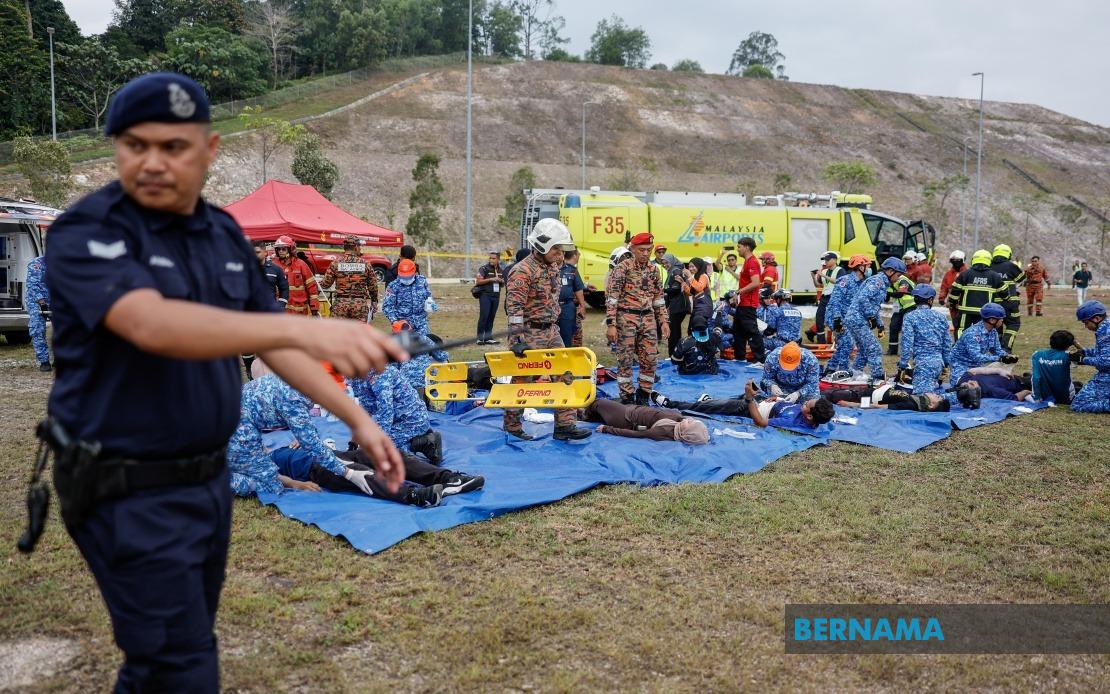
Malaysia's civil aviation authorities have taken a significant step in enhancing national disaster preparedness by conducting Ex Urban Falcon 2026, a comprehensive full-scale simulation of an aircraft accident occurring well beyond the boundaries of an active airport. Held at the Denai Alam Rest and Service Area along the Damansara-Shah Alam Elevated Expressway near Shah Alam on July 16, the exercise mobilised more than 450 personnel drawn from over 20 enforcement and emergency response agencies across both public and private sectors. The drill marked a pivotal moment in Malaysia's approach to aviation safety by testing response mechanisms to a scenario that has traditionally received less attention than incidents occurring within airport confines.
According to Muhammad Hidayat Ismail, general manager of Airport Fire and Rescue Services, the exercise simulated an ATR72 turboprop aircraft going down approximately six kilometres from Sultan Abdul Aziz Shah Airport in Subang. This distance is crucial because it places the hypothetical incident within the eight-kilometre radius of responsibility that the AFRS maintains around airport locations under the National Aeronautical Search and Rescue Manual. However, the simulation's significance extends beyond merely staying within operational boundaries; it represents the first occasion when Malaysian authorities have deliberately tested response capacity to such an off-airport scenario at full scale, whereas previous drills typically focused on crashes occurring near airport fringes.
The exercise was orchestrated through a collaborative framework involving Malaysia Airports Holdings Berhad, the National Disaster Management Agency, the Selangor state government, and PROLINTAS-DASH, the expressway operator. This multi-stakeholder approach underscores a recognition that aviation emergencies extending beyond airport zones require coordination across jurisdictions and operational domains that traditionally function in separate spheres. The choice of location along a major highway corridor highlighted one of the most pressing logistical challenges identified by response teams: the difficulty of reaching accident scenes swiftly when terrain becomes constrained by urban development, residential areas, and toll infrastructure. Muhammad Hidayat emphasised that navigating narrow roads and passing through multiple toll plazas presented obstacles that airport-based exercises rarely encounter.
The distinction between airport and off-airport crash scenarios carries sobering implications for casualty outcomes. Muhammad Hidayat noted that survival rates typically diminish significantly when aircraft come down in non-airport locations characterised by uneven terrain and less predictable ground conditions. This reality demands a fundamentally different approach to disaster victim identification operations, a function ordinarily led by the Royal Malaysia Police. The exercise provided participating teams with realistic exposure to situations where survivors might substantially outnumber casualties or vice versa, requiring flexible resource allocation and protocol adaptation. The exposure to such varied conditions during simulation allows responders to anticipate bottlenecks and refine coordination mechanisms before an actual emergency occurs.
From a technological perspective, Malaysia's aviation authorities appear adequately equipped with modern aircraft firefighting vehicles meeting specifications and standards established by the International Civil Aviation Organisation and Malaysia's Civil Aviation Authority. Yet technology alone cannot substitute for the human coordination and strategic planning that exercises like Ex Urban Falcon 2026 develop. The participation of 450 personnel across multiple agencies created opportunities for responders from different organisations to understand how their counterparts operate, identify potential communication gaps, and establish working relationships that prove invaluable when genuine disasters unfold. This human dimension of emergency preparedness often receives insufficient emphasis compared to hardware and equipment specifications.
Muhammad Hidayat's assessment of the exercise recognised that response teams executed their assigned duties competently and that firefighting and rescue operations proceeded according to established procedures. However, he explicitly connected the exercise to future improvements, noting that Malaysia rarely subjects off-airport air disaster scenarios to realistic testing. The acknowledgment that such incidents represent an underexamined area of national preparedness reflects a commendable willingness to identify and address gaps before they translate into operational failures. This approach contrasts sharply with reactive strategies that emerge only after incidents occur, when lessons prove costly and recommendations carry an unfortunate air of hindsight.
The planned follow-up assessment represents a critical component of the exercise's value. Muhammad Hidayat indicated that findings and challenges would be examined during a special workshop on July 26 and 27, with the explicit aim of developing improvement measures and strengthening coordinated disaster response efforts. This commitment to structured review means that the exercise will generate actionable outcomes rather than remaining a mere demonstration of current capabilities. By systematically documenting observations and translating them into procedural refinements, Malaysia's authorities can progressively elevate their disaster response architecture.
For Malaysian aviation stakeholders and the broader Southeast Asian region, the Ex Urban Falcon 2026 exercise carries implications extending beyond technical readiness. International air travellers increasingly expect that airports and surrounding nations maintain robust safety frameworks encompassing all conceivable accident scenarios. When Malaysia demonstrates through public exercises that authorities take off-airport disasters seriously and subject response plans to rigorous testing, such actions enhance confidence in the nation's aviation system. This confidence translates to tangible benefits including airline operational confidence, insurance considerations, and public perception of safety competence.
The sustained commitment evidenced by participating agencies signals that Malaysia regards aviation safety not as an occasional priority but as a continuous operational concern. Muhammad Hidayat explicitly connected the exercise to enhanced public trust in the nation's aviation safety framework, suggesting that authorities recognise how visible preparedness efforts contribute to broader confidence in institutional competence. This linkage between behind-the-scenes disaster drills and public confidence underscores why exercises merit investment and visibility, even when they consume significant resources and personnel time.
Looking forward, Malaysia's approach to off-airport disaster readiness may serve as a model for other regional aviation authorities contending with similar challenges of coordinating responses across multiple jurisdictions and navigating complex urban terrain. The collaborative framework involving airport operators, disaster management agencies, state governments, and infrastructure providers provides a template that other nations might adapt to their specific circumstances. As global air traffic continues expanding and aircraft increasingly operate in proximity to populated areas, the scenarios addressed by Ex Urban Falcon 2026 will likely become increasingly relevant across the Asia-Pacific region.

