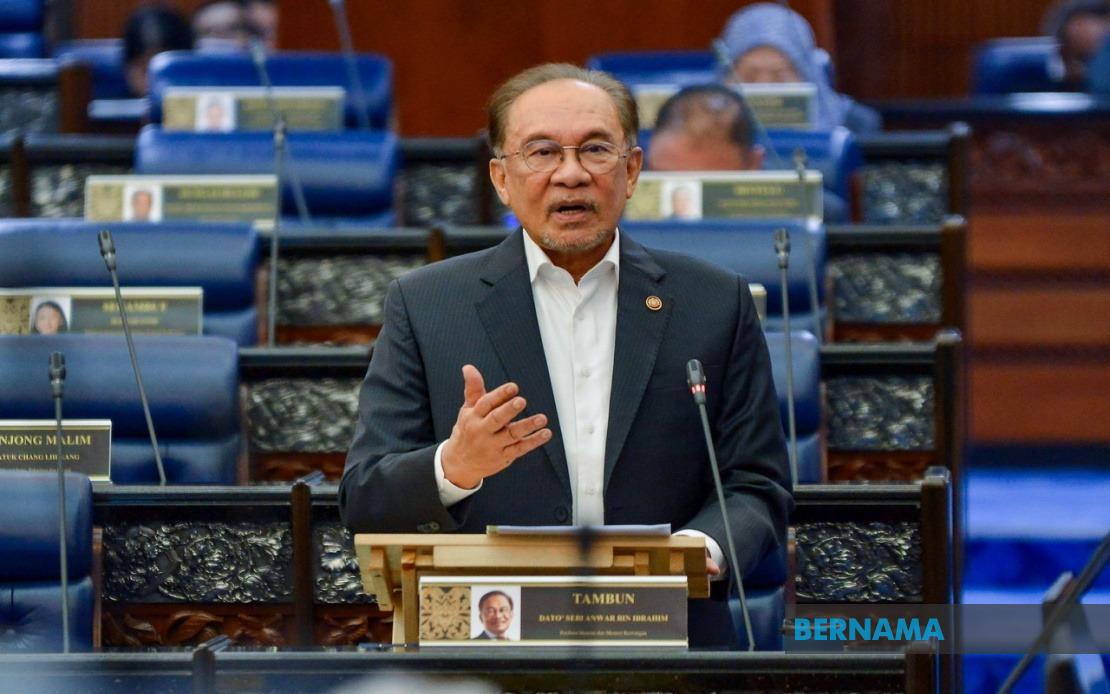
Malaysia will anchor its approach to maritime boundary disputes in diplomatic negotiations and the 1982 United Nations Convention on the Law of the Sea (UNCLOS), Prime Minister Datuk Seri Anwar Ibrahim said in Parliament this week. The commitment reflects a long-standing Malaysian preference for resolving complex territorial questions through structured dialogue rather than confrontation, a posture that has become increasingly significant as regional competition for maritime resources intensifies across Southeast Asia and beyond.
While acknowledging the International Maritime Organization's legitimate role in maritime governance, Anwar emphasised that even the IMO itself operates within the constraints established by UNCLOS 1982. This formulation suggests Malaysia views the international maritime framework as a hierarchical system, with UNCLOS providing the foundational legal architecture upon which all other mechanisms and agreements must rest. The position underscores Kuala Lumpur's preference for rules-based arrangements that can be invoked to maintain stability and predictability in contested waters.
Yet Anwar recognised a fundamental tension that complicates maritime relations across the region: while UNCLOS provides indispensable legal scaffolding, its provisions are interpreted differently by various nations based on their geographic positions, historical records, and strategic interests. This interpretive variance means the convention, standing alone, cannot resolve every dispute that arises between neighbours sharing waters. The Prime Minister's acknowledgment of this limitation suggests Malaysia understands the need to complement legal frameworks with pragmatic accommodation and creative problem-solving mechanisms.
In the context of the South China Sea, Malaysia's position reflects the broader ASEAN consensus that has taken shape over years of exhausting negotiations. Member states within the bloc have collectively endorsed UNCLOS as the negotiating foundation, while simultaneously pursuing a Code of Conduct with China designed to forestall military escalation and reduce the risk of accidental confrontation. This dual-track approach—anchoring claims in international law while negotiating practical conflict-prevention measures—represents ASEAN's attempted middle path between maintaining sovereignty assertions and avoiding open confrontation with Beijing.
Anwar noted that the Philippines situation introduces complications absent elsewhere, largely because the Sabah territorial question remains unresolved and intersects with maritime claims in complex ways. This particular dispute, rooted in historical sovereignty claims stretching back to colonial arrangements, demonstrates how maritime boundary questions often cannot be neatly separated from terrestrial territory disputes. The Philippine government's pursuit of International Court of Justice mechanisms on the Law of the Sea differs from the approach favoured by most other ASEAN members, illustrating how divergent national interests can fragment regional unity on maritime governance.
Malaysia's negotiating philosophy, as Anwar articulated it, embraces protracted dialogue and tactical retreats when discussions reach impasse. Rather than viewing deadlock as failure, Malaysian diplomacy treats it as a temporary pause—an opportunity for positions to evolve, new administrations to reconsider approaches, or shifting regional circumstances to create openings. This patient, iterative methodology contrasts sharply with more confrontational strategies that have occasionally surfaced in regional disputes, reflecting Malaysia's assessment that time often favours persistent diplomacy over escalatory brinkmanship.
The Prime Minister pointed to Malaysia's joint development arrangements with Thailand and Vietnam as proof-of-concept for his thesis that economic cooperation need not require resolving underlying sovereignty disputes. In the Vietnam case particularly, Malaysia negotiated a framework allowing both nations to extract resources from disputed waters while explicitly preserving each side's legal claims, neither party yielding ground on the substantive question of maritime boundaries. This pragmatic decoupling of sovereignty recognition from economic benefit-sharing offers a model that potentially could apply elsewhere in Southeast Asia, though cultural and political factors make replication uncertain.
Malaysia's maritime boundary portfolio is notably complex, encompassing disputes with six separate neighbours: Brunei, Thailand, Indonesia, Singapore, the Philippines, and China. Managing negotiations with such a diverse set of interlocutors, each with distinct claims and strategic perspectives, demands considerable diplomatic bandwidth. The Foreign Ministry's ability to maintain parallel negotiating tracks, each operating under different assumptions and frameworks, exemplifies the bureaucratic sophistication required to navigate Southeast Asia's contested waters.
Progress with Brunei has advanced significantly, Anwar noted, with only limited outstanding issues remaining—most involving the Sarawak state government rather than federal authorities. This compartmentalisation of negotiations, delegating certain discussions to state-level actors, reflects Malaysia's federal structure but also complicates Beijing's capacity to achieve comprehensive regional settlements. Indonesia discussions concentrate on Sabah-related maritime zones, conducted in consultation with the state government, acknowledging the particular sensitivity surrounding Sabah's special constitutional status and autonomy in foreign relations affecting its territory.
The consistent choice of diplomatic rather than military or juridical avenues reflects Malaysia's calculation about its relative strategic weight and its vulnerability to escalatory spirals in contested waters. As a maritime trading nation dependent on freedom of navigation and stable regional conditions, Malaysia benefits enormously from rules-based order and loses proportionately more from conflict. This structural position incentivises the pursuit of negotiated settlements even when Malaysia's legal claims appear robust, and explains the emphasis on frameworks that allow adversaries to cooperate economically despite unresolved territorial questions.
For Malaysian regional observers, the Prime Minister's restatement of negotiation-first principles carries particular significance given recent rhetoric elsewhere suggesting more assertive posturing on maritime claims. Malaysia's deliberate choice to remain committed to UNCLOS and diplomatic channels reflects a strategic judgment that regional stability—and Malaysia's prosperity within that stable framework—outweighs the satisfaction of maximalist sovereignty assertions. Whether this patient approach continues to serve Malaysian interests amid shifting regional power dynamics and rising nationalist sentiment across Southeast Asia remains an open question that future governments may revisit.

