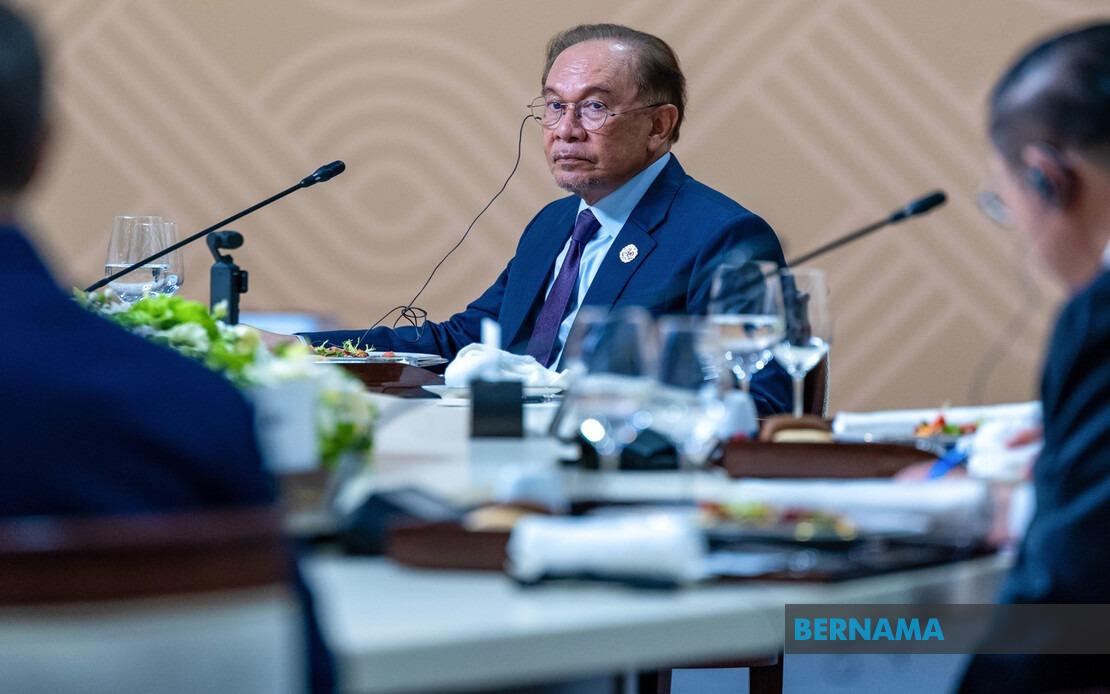
Malaysia is recalibrating its economic strategy by deepening engagement across Central Asia and the Caucasus, with Prime Minister Datuk Seri Anwar Ibrahim's recent visits to Tashkent, Kazan, and Ashgabat signalling a calculated shift toward multi-directional partnerships. The compressed four-day itinerary accomplished far more than ceremonial diplomacy, cementing tangible commitments in energy, trade, and technology cooperation that reflect how a middle power must adapt to an increasingly fragmented global order.
The timing of these engagements carries particular weight as the international economic architecture undergoes profound transformation. Since the Cold War's conclusion, no period has witnessed such rapid realignment of trade flows, strategic alignments, and competitive dynamics among major powers. The deployment of tariffs, sanctions regimes, and export restrictions as routine policy instruments has fundamentally altered how smaller economies must calculate their external relationships. For Malaysia, insulated by neither size nor geographic remoteness from these shifts, the stakes are measurably higher than for larger neighbours.
The strategic imperative driving this outreach transcends conventional trade metrics. Malaysia's prosperity has historically depended on unobstructed access to global markets and the seamless integration of its supply chains into international networks. Yet the current environment threatens both assumptions. Economic coercion between superpowers creates friction points that divert commerce and inflate transaction costs. Supply chain vulnerabilities exposed during recent disruptions underscore how concentrated dependencies can become liabilities. In this context, broadening Malaysia's partnership base becomes not merely advantageous but essential for long-term national resilience.
The Uzbekistan stopover, initially scheduled as courtesy protocol with President Shavkat Mirziyoyev, evolved into substantive negotiations on economic cooperation frameworks initiated during Malaysia's previous 2024 visit. This evolution illustrates how diplomatic momentum can be leveraged when leadership engages directly with counterparts. The discussions encompassed multiple sectors and identified concrete deliverables requiring follow-up implementation, demonstrating that even brief encounters can generate measurable outcomes when properly prepared.
Malaysia's participation in the ASEAN-Russia Commemorative Summit in Kazan positioned the nation at the intersection of regional solidarity and wider Eurasian engagement. While Russia represents a comparatively modest trade partner for ASEAN individually, the summit itself acknowledged substantial untapped potential across energy, agricultural exports, digital innovation, advanced manufacturing, and food security sectors. The adoption of the ASEAN-Russia Strategic Programme on Trade and Investment Cooperation 2026-2035 formalises this recognition, embedding commitment mechanisms into bilateral and multilateral frameworks extending over a decade.
Parallel discussions with the Republic of Tatarstan deserve particular attention, as they exemplify an evolving dimension of modern economic statecraft. Tatarstan has emerged as one of Russia's most technologically sophisticated and industrially advanced regions, yet often remains peripheral to Moscow-centric foreign policy analysis. Malaysian engagement with this subnational actor opened pathways for cooperation in biotechnology, halal certification systems, maritime technologies, Islamic financial instruments, and industrial manufacturing. This bottom-up approach recognises that economic opportunity increasingly flows through specialised clusters and innovation hubs rather than exclusively through capital-city bureaucracies.
The Ashgabat segment underscored Malaysia's deepening commitment to energy security diversification through its longstanding Turkmenistan partnership. Petronas has maintained continuous operations there for three decades, investing approximately USD12 billion in exploration and production activities. This relationship transcends transactional energy trading; it encompasses infrastructure development, technological capability transfer, workforce training, and local economic spillovers accumulated across generations. The landmark agreements concluded during the visit grant Petronas expanded stakes in one of the world's largest natural gas reserves, securing new production-sharing arrangements and exploration rights that cement multi-decade cooperation frameworks.
The strategic rationale for fortifying energy partnerships extends beyond commercial considerations into systemic risk mitigation. Recent geopolitical disruptions have vividly demonstrated how localised conflicts propagate instantaneously through global energy markets, transportation networks, and manufacturing cost structures. By cultivating multiple energy partnerships across geographically dispersed suppliers, Malaysia reduces vulnerability to any single supply interruption or price volatility shock. Turkmenistan's geographic position and reserve scale make it a strategically valuable counterbalance to existing hydrocarbon relationships concentrated in conventional Middle Eastern sources.
Economic diplomacy at Malaysia's level now operates simultaneously across multiple interconnected domains rather than in siloed trade negotiations. Food security concerns intersect with agricultural technology transfer. Energy infrastructure development creates opportunities for engineering services and manufacturing supply chains. Digitalisation initiatives raise simultaneous questions about technological standards, governance frameworks, and long-term dependency management. This complexity demands that national leaders engage with conceptual breadth rather than narrowly circumscribed commercial interests, recognising that trust-building and relationship consolidation have become integral to closing meaningful agreements.
The geographical and sectoral diversity of Malaysia's recent diplomatic activity reflects hard-learned lessons about resilience in contested international environments. Rather than viewing economic partnerships through zero-sum frameworks where new relationships necessarily displace existing ones, Malaysia's approach expands the total portfolio of external options. A trading nation whose wealth creation fundamentally depends on market access and cross-border connectivity benefits disproportionately from maintaining multiple viable partnership pathways. Should disruption occur within any single relationship, alternative channels preserve economic momentum and allow swift reorientation of commerce.
This strategic perspective aligns with ASEAN's historical positioning as a region committed to engaging diverse external partners while maintaining institutional autonomy. Rather than bifurcating the international system into exclusive blocs demanding binary allegiance, Southeast Asian states have consistently preserved capacity to interact constructively across competing spheres of influence. Malaysia's Central Asian engagement extends this principle beyond the immediate region, demonstrating how smaller powers can navigate multipolar competition through deliberate relationship diversification.
The substantive outcomes from Tashkent, Kazan, and Ashgabat collectively signal Malaysia's recognition that future prosperity depends less on singular dependency relationships and more on flexibility embedded within diversified networks. Energy security, food systems, technological capability, financial services, and skills development all featured in these discussions, reflecting how contemporary economic statecraft necessarily encompasses holistic national development rather than isolated sectoral transactions. Leadership's personal commitment to these engagements carries underestimated weight; the demonstrated willingness to invest time and political capital in relationship-building generates reciprocal commitment from counterparts, facilitating downstream commercial realisation of negotiated frameworks.