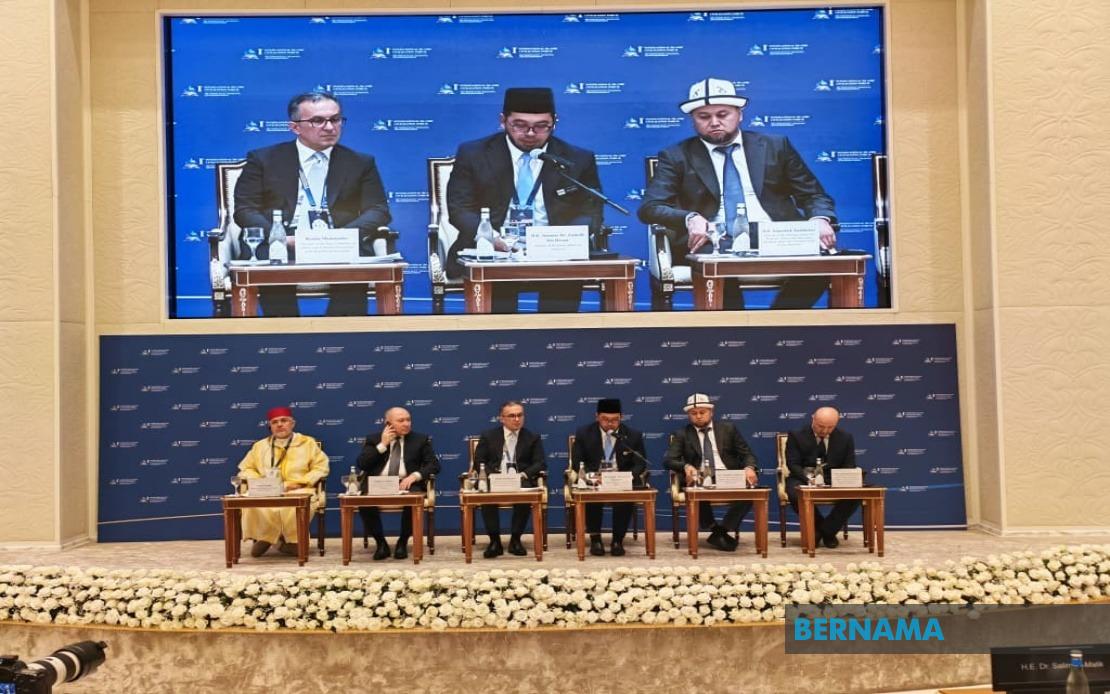
At the International Islamic Civilisation Forum in Tashkent, Uzbekistan, Malaysia's Minister in the Prime Minister's Department (Religious Affairs) Datuk Dr Zulkifli Hasan has issued a pointed challenge to the Muslim world: to rise above reactive posturing and become a transformative force in human affairs. Speaking during a plenary session on July 8, the minister framed the humanitarian catastrophe unfolding in Gaza not merely as a tragedy demanding immediate relief, but as a watershed moment requiring the Islamic civilisation to recalibrate its identity and purpose in an increasingly fractured world.
The suffering of civilians caught in the Gaza conflict has penetrated global consciousness in ways that demand serious reckoning, Zulkifli argued. Beyond the immediate human toll, the crisis has exposed fundamental contradictions in how international law and principles of justice are applied across different geopolitical contexts. Rather than allowing this dissonance to breed cynicism or perpetual grievance, Malaysia's position suggests that the Muslim world possesses both the moral authority and intellectual resources to pioneer a new framework for global engagement—one grounded in consistency, compassion, and genuine commitment to human dignity.
Central to Zulkifli's thesis is a deliberate pivot away from what he characterised as backward-looking nostalgia. While acknowledging Islam's extraordinary historical achievements in science, architecture, governance, and scholarship, he posed a question that cuts to the heart of contemporary Muslim identity: what unique contributions can Islamic civilisation make to the challenges of the twenty-first century? This framing represents a significant rhetorical shift from defensive narratives about past glories toward proactive engagement with urgent present-day dilemmas.
The minister identified a critical vacuum in the modern world: despite unprecedented material and technological advancement, humanity searches for something intangible yet irreplaceable—moral clarity, principled leadership, and grounding in enduring values. These, he suggested, are precisely the domains in which Islamic civilisation has historically excelled and where it retains distinctive capacity. From cultivating just governance structures to producing leaders animated by ethical commitment and honouring the inherent dignity embedded in Islamic anthropology, the tradition offers resources often marginalised in secular liberal discourse.
Zulkifli outlined a vision of civilisational renewal rooted not in isolationism but in active, confident participation in shaping the technological and ethical frontiers of the coming decades. He highlighted artificial intelligence, biotechnology, and quantum computing as spheres where Islamic ethical frameworks could offer vital guidance, ensuring that innovation serves humanity rather than undermining it. This represents a significant departure from patterns where Muslim-majority societies often appear as consumers of technologies designed and governed by others. Instead, Malaysia advocates for Muslim scholars and societies to assume leadership roles in architecting ethical guardrails around transformative technologies.
A distinctive feature of Zulkifli's argument centres on historical eclecticism as a template for contemporary engagement. He noted that the Islamic golden age was characterised by remarkable intellectual openness—Muslim scholars freely absorbed knowledge from Greek, Persian, Indian, and Chinese sources, synthesising these inputs into novel frameworks. This precedent supports his case for modern Islamic societies to become active partners in global knowledge production rather than custodians of sealed tradition. Environmental stewardship emerged as another pillar of his vision, grounded in Islam's conception of humanity's trusteeship responsibilities toward creation.
Crucially, Zulkifli framed the anticipated renaissance of Islamic civilisation not as zero-sum competition but as contribution to broader human flourishing. He cautioned against interpreting civilisational renewal through the lens of rivalry or confrontation with other traditions. This positioning is particularly significant for Malaysia, which has long cultivated an image as a Muslim-majority nation capable of maintaining robust Islamic identity while sustaining pragmatic engagement with partners across religious and ideological boundaries. The minister emphasised that Malaysia's commitment to alliance-building among Muslim nations proceeds simultaneously with constructive engagement with non-Muslim partners on shared global challenges—an approach that inverts the false dichotomy often presented in international discourse.
Zulkifli positioned Malaysia-Uzbekistan bilateral relations as a microcosm of this vision. Both nations, he noted, inherit rich Islamic intellectual and civilisational legacies, yet they embody different expressions of how Islam can infuse governance and society. Uzbekistan's formidable contributions to Islamic scholarship complement Malaysia's practical experience in Islamic finance, multicultural governance, and peaceful coexistence across religious lines. By positioning the two nations as potential bridges between Central Asia and Southeast Asia, Zulkifli implicitly argued that Muslim-majority regions possess distinct regional strengths that, when networked effectively, can advance shared developmental and intellectual objectives.
The thrust of Malaysia's intervention at Tashkent reflects a broader strategic calculation facing the Muslim world in an era of shifting geopolitical alignments and mounting transnational challenges. Rather than allowing reactions to conflicts or expressions of victimhood to define Islamic civilisation's posture, Malaysia advocates for ownership of a future-oriented agenda centred on ethical innovation, sustainable development, and wisdom-informed leadership. This positioning carries particular resonance for Southeast Asian audiences, where Malaysia's track record of navigating religious pluralism and maintaining developmental momentum offers a tangible model distinct from narratives of civilisational conflict dominating international discourse.
The call for intellectual and moral renewal reverberates against the backdrop of Gaza and broader instability in the Middle East, yet Zulkifli's framing deliberately transcends reactive positioning. By emphasising the Muslim world's capacity to shape frameworks governing artificial intelligence, environmental governance, and biotechnology—rather than merely responding to external impositions—Malaysia articulates a vision where Islamic civilisation reasserts agency as a proactive force. This approach implicitly suggests that genuine responses to Gaza's tragedy lie not primarily in diplomatic denunciations or humanitarian appeals, though these matter, but in demonstrating through concrete intellectual and ethical leadership that the Muslim world remains indispensable to humanity's future.
For Malaysian audiences and Southeast Asian observers, this intervention underscores the strategic importance that Kuala Lumpur assigns to its positioning within the broader Muslim world. Malaysia neither retreats into provincial insularity nor abandons its distinctive multicultural model to align with more ideologically rigid interpretations of Islamic governance. Instead, the country projects itself as a custodian of a particular vision—one that sees Islamic civilisational renewal as compatible with pluralism, technological engagement, and global partnership. As the world confronts interconnected crises spanning climate change, artificial intelligence governance, and geopolitical instability, Malaysia's argument carries implicit appeal: the Muslim world possesses ethical and intellectual resources essential to navigating these challenges, provided it moves beyond defensive reactions toward confident, principled engagement in shaping humanity's shared future.

