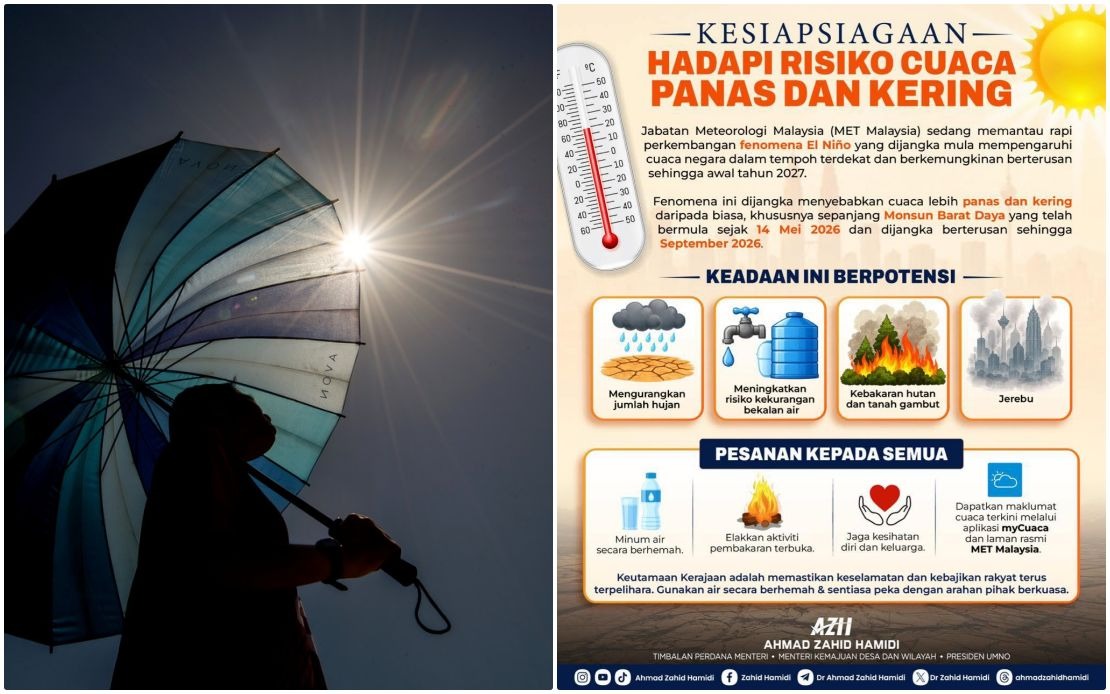
The Malaysian government has issued a timely warning to citizens to prepare for sustained hot and dry weather conditions as the El Niño phenomenon takes hold across the nation. Deputy Prime Minister Datuk Seri Dr Ahmad Zahid Hamidi, speaking in his capacity as chairman of the Central Disaster Management Committee, outlined the anticipated climatic challenges that could persist well into the coming years, with projections suggesting continued impacts through early 2027. The alert underscores growing concern within federal agencies about the compounding effects of this global weather pattern on the country's water resources, agricultural productivity, and public health.
El Niño, a periodic warming of ocean temperatures in the tropical Pacific that drives weather patterns globally, is expected to intensify conditions during Malaysia's Southwest Monsoon season, which commenced on May 14 and will run through September. During this typically drier season, El Niño's influence amplifies existing moisture deficits, creating conditions where several regions across Peninsular Malaysia and beyond could experience significantly below-average rainfall. The convergence of seasonal dry patterns and El Niño effects creates a compounding risk scenario that authorities are now flagging for public awareness and preparedness.
The implications of this extended dry spell extend well beyond mere temperature discomfort. Ahmad Zahid specifically highlighted interconnected risks including acute water shortages that could strain urban and rural supply systems, an elevated danger of forest and peatland fires that threaten both ecosystems and air quality across the region, and the potential resurgence of transboundary haze that has plagued Southeast Asia during previous El Niño events. Peatland fires, in particular, represent a critical concern for Malaysia given the carbon-intensive nature of these fires and their severe environmental consequences. The 2015 El Niño event triggered massive peatland fires in Indonesia that created hazardous air quality conditions across Malaysia, demonstrating the cross-border nature of these climate-driven crises.
In response to these forecasted challenges, the Deputy Prime Minister issued a comprehensive set of behavioural recommendations aimed at reducing individual and collective vulnerability. Citizens are being urged to adopt water conservation practices in their daily routines, from household consumption to commercial and industrial applications. Simultaneously, authorities are discouraging open burning activities, whether for agricultural land clearance or waste disposal, recognizing that such practices during dry conditions can rapidly escalate into uncontrollable fires. The message also emphasised health precautions, particularly for vulnerable populations including the elderly, young children, and individuals with pre-existing respiratory or cardiovascular conditions who face heightened risk during prolonged heat exposure.
Meteorolological guidance has been positioned as critical to public preparedness. Ahmad Zahid directed Malaysians to utilise the myCuaca application, the Malaysian Meteorological Department's digital platform, as their primary source for real-time weather updates and forecasting information. This recommendation reflects a broader government strategy to leverage technology for public information dissemination and early warning capabilities. MetMalaysia director-general Dr Mohd Hisham Mohd Anip corroborated the warning, confirming that El Niño conditions are indeed anticipated to generate weather patterns significantly hotter and drier than seasonal norms, particularly during the Southwest Monsoon window.
The government's posture on this issue demonstrates recognition that climate-driven weather extremes increasingly require whole-of-society response frameworks rather than top-down interventions alone. By positioning this warning as a call for shared responsibility and public vigilance, authorities are attempting to distribute risk management across government agencies, commercial entities, and individual households. This approach acknowledges that while the Central Disaster Management Committee and MetMalaysia can provide forecasting and coordination, the actual mitigation of harms depends substantially on collective behavioral change at the community level.
For Malaysia's broader regional context, this El Niño warning carries implications extending beyond national borders. Southeast Asia's interconnected systems—from shared atmospheric patterns to trade relationships dependent on agricultural output—mean that drought conditions affecting Malaysia simultaneously impact neighboring countries. The water stress anticipated across Malaysia could reverberate through regional trade networks and transnational environmental systems. Additionally, the heightened fire risk reinforces longstanding concerns about regional haze, an issue that has repeatedly strained diplomatic relations within ASEAN as smoke from fires in Indonesia and Malaysia drifts across the region.
The economic dimensions warrant attention as well. Extended dry periods constrain hydroelectric generation in regions dependent on rainfall-fed reservoirs, potentially affecting electricity supply stability. Agricultural sectors face reduced productivity as irrigation demands surge against constrained water availability. Tourism, particularly nature-based tourism in forested areas, could suffer if fire risks materialize. The hospitality and retail sectors may also experience disruptions from haze events that discourage outdoor activities and reduce visitor numbers. These cascading economic effects underscore why the government has framed this as requiring "early preparations and responsible action by all parties."
Ahmad Zahid's commitment that the government will "continue to monitor the situation closely and take appropriate measures" signals institutional readiness but also implicitly acknowledges the limits of governmental capacity to fully control outcomes driven by global climate systems. Effective response will require sustained coordination between federal and state authorities, cooperation from private sector actors, and genuine public participation in conservation and fire prevention measures. The months ahead will test whether Malaysia's early warning systems and public education efforts translate into meaningful behavioral shifts that reduce the anticipated harms from this extended El Niño episode.