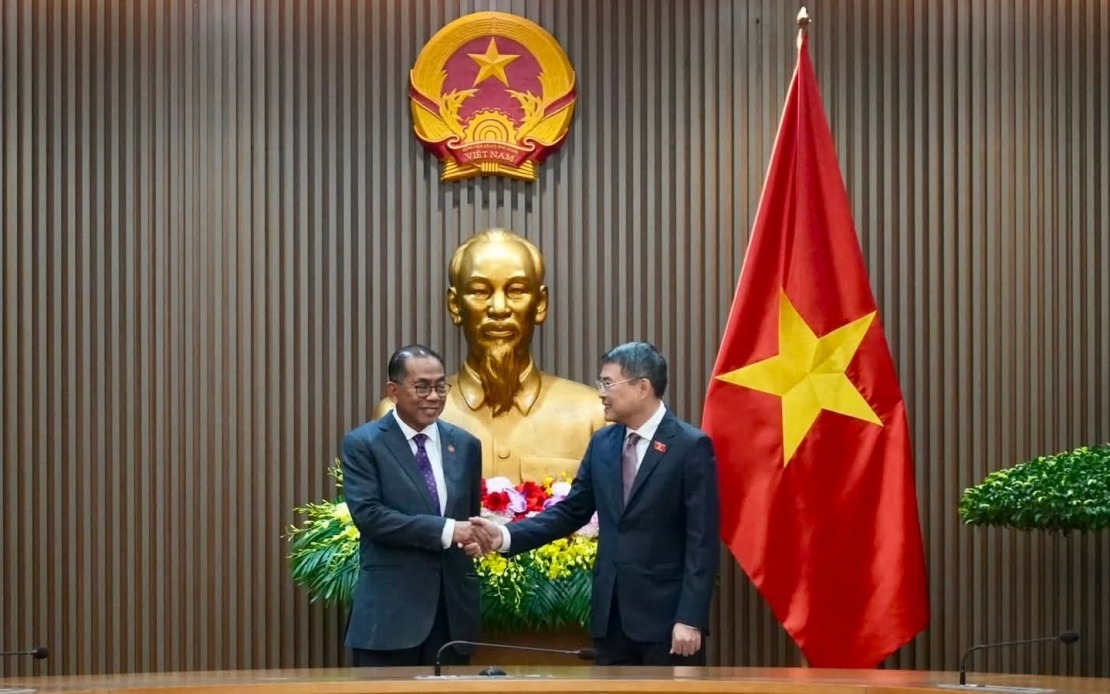
Malaysia and Vietnam are moving to substantially broaden their defence relationship, with an emphasis on maritime security operations, technological advancement and industrial collaboration. The commitment emerged from discussions between Defence Minister Datuk Seri Mohamed Khaled Nordin and Vietnamese Prime Minister Lê Minh Hưng during an official visit to Hanoi, signalling renewed momentum in bilateral military ties between the two Southeast Asian neighbours.
The partnership between Kuala Lumpur and Hanoi has grown into one of the region's most significant defence relationships, underpinned by mutual strategic interests and shared commitment to regional stability. Mohamed Khaled characterised Vietnam as a partner of proven reliability and trust, reflecting the maturation of defence links that have developed steadily over recent years. This positioning carries particular weight given Vietnam's growing role as a maritime power and its increasing defence modernisation efforts across the region.
A key institutional foundation for this expanding cooperation is the Memorandum of Understanding on Defence Cooperation signed in 2023, which now serves as the strategic roadmap guiding both nations' military engagement. Rather than representing merely ceremonial gestures, this framework is being operationalised to tackle concrete areas of mutual interest and concern. The emphasis on maritime security cooperation is particularly significant given the strategic importance of sea lanes through Southeast Asia and the South China Sea, through which trillions of dollars in global trade transit annually.
Capability development ranks prominently among the partnership's objectives, reflecting a shared interest in modernising armed forces to meet contemporary threats. Both Malaysia and Vietnam face similar pressures to upgrade military equipment and training standards while managing defence budgets prudently. Technology transfer and collaborative development initiatives offer cost-effective pathways for both nations to enhance their operational capacity without bearing the full expense of independent programmes. This approach aligns with broader ASEAN trends toward pooling resources and expertise for mutual benefit.
The defence industry collaboration element addresses both immediate security needs and longer-term economic considerations. Deepening industrial partnerships can foster local manufacturing capabilities, reduce dependence on external suppliers and generate economic opportunities within each nation. For Malaysia, with its established defence manufacturing sector, and for Vietnam, with its expanding industrial base, such cooperation creates pathways for knowledge exchange and business development that extend beyond purely military dimensions.
The bilateral discussions also reflected broader strategic preoccupations affecting the entire region. Great power competition, increasingly evident in Southeast Asia as major powers vie for influence and strategic positioning, presents challenges requiring coordinated regional responses. Grey zone activities—the grey area between peace and open conflict involving measures like intimidation, propaganda and economic coercion—have become more prevalent and sophisticated. These developments necessitate closer intelligence sharing and coordinated diplomatic strategies among regional partners.
Cyberspace has emerged as a contested domain where both conventional and unconventional threats proliferate. Artificial intelligence presents simultaneously opportunities and risks, from enhancing military capabilities to enabling new forms of disinformation and cognitive warfare. The latter concept—deliberate attempts to manipulate perception and decision-making through information operations—represents an evolving threat landscape that demands coordinated defence measures. Supply chain disruptions, whether through geopolitical tensions or other causes, affect military procurement and operational readiness across the region.
Mohamed Khaled's emphasis on ASEAN collective resilience reflects recognition that individual nations cannot effectively address these multifaceted challenges in isolation. The bloc must strengthen internal coordination mechanisms, deepen defence partnerships among member states and present a unified position in negotiations with external powers. Malaysia-Vietnam cooperation serves as a model for this inter-ASEAN defence deepening, demonstrating how bilateral relationships can contribute to broader regional security architecture.
Both nations share adherence to ASEAN principles including non-interference in internal affairs, peaceful resolution of disputes and consensus-based decision-making. These shared values provide a stable foundation for defence partnership, distinguishing the Malaysia-Vietnam relationship from arrangements that might be more transactional or conditional. The commitment to dialogue and diplomacy as mechanisms for maintaining peace reflects a deliberate choice to navigate strategic competition through established channels rather than escalatory measures.
For Malaysia specifically, the Vietnam partnership represents a strategic hedge against uncertainty and a means of strengthening its voice within regional security discussions. Vietnam's geographic position, economic dynamism and military modernisation make it an increasingly important player in Southeast Asian strategic calculations. Deepening ties with Hanoi enhances Malaysia's capacity to shape regional responses to security challenges and positioning within multilateral forums.
The timing of this partnership deepening occurs against a backdrop of intensifying great power competition in Southeast Asia, with multiple external actors seeking to expand their influence and strategic footprint. By strengthening intra-regional defence cooperation, Malaysia and Vietnam are asserting agency and autonomy in their security arrangements, resisting pressures to align exclusively with any single external power. This balancing approach reflects both nations' interests in maintaining strategic flexibility and preserving ASEAN centrality in regional security architecture.

