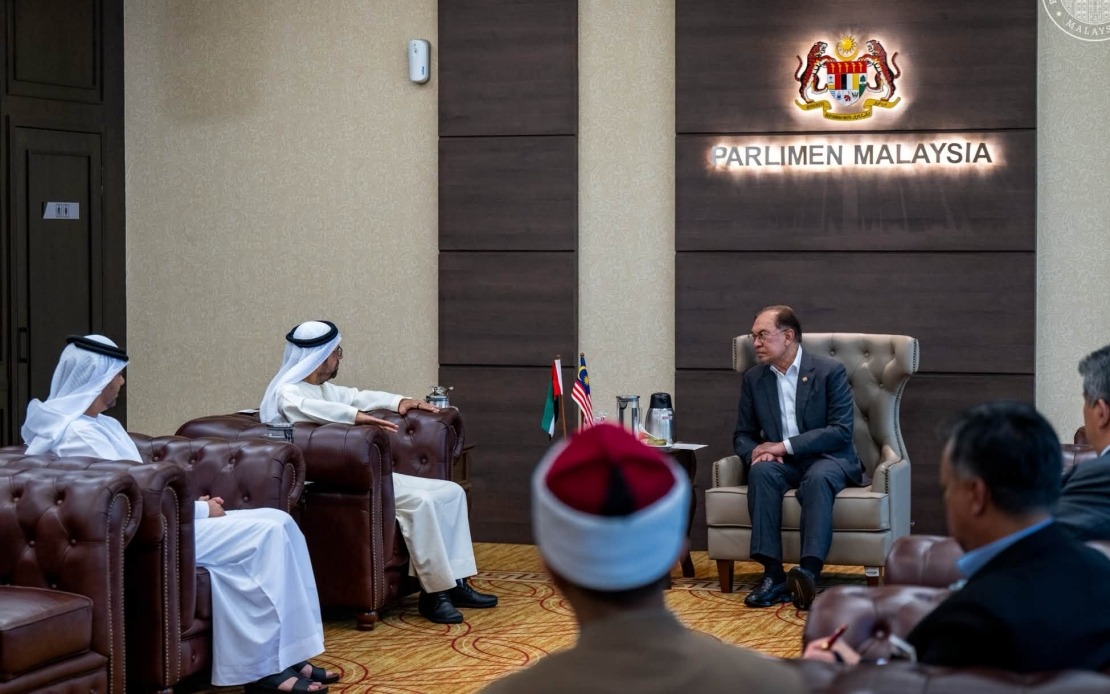
Prime Minister Datuk Seri Anwar Ibrahim has signalled Malaysia's determination to deepen its partnership with the United Arab Emirates, emphasising the two nations' shared commitment to exploring new avenues of cooperation that would serve the mutual interests of both countries and contribute to broader regional objectives. The commitment was reinforced during a formal meeting at Parliament House between Anwar and Dr Ali Rashid Al Nuaimi, chairman of the Defence, Interior and Foreign Affairs Committee of the UAE's Federal National Council, with both delegations acknowledging the importance of sustained engagement between Kuala Lumpur and Abu Dhabi.
The bilateral discussion ranged across multiple contemporary policy areas, reflecting the depth of Malaysia-UAE relations beyond traditional trade and diplomatic channels. Among the substantive topics examined during the meeting were current shifts in the global geopolitical landscape, with particular focus on the ongoing tensions between the United States and Iran and the repercussions those developments carry for Southeast Asia and the broader Middle East region. For Malaysia, understanding the trajectory of such conflicts carries significance given the country's position as a Muslim-majority nation with interests in regional stability and its own strategic partnerships across the Gulf and beyond.
A notable dimension of the discussions centred on the evolving role of artificial intelligence in modern statecraft and security frameworks. Anwar expressed particular interest in the UAE's pioneering approach to integrating AI literacy and training into the professional development of government ministers and senior officials. The UAE's initiative to make AI training mandatory for the country's top-tier leadership represents an attempt to ensure that decision-makers across the apparatus of governance remain equipped to navigate the complexities and opportunities presented by rapid technological transformation.
This emphasis on AI governance reflects a broader recognition among policymakers in the region that technological competency is no longer a peripheral concern but rather a central determinant of national capacity and competitive advantage. For Malaysia, which aspires to be a leader in digital innovation within Southeast Asia, the UAE's model offers valuable lessons on how to systematically elevate technological awareness throughout the bureaucracy. The integration of mandatory AI training for ministers and senior government personnel ensures that policy decisions account for technological realities and opportunities, rather than being formulated in isolation from the digital transformation reshaping economies and societies.
The meeting also underscored the practical dimensions of Malaysia-UAE cooperation in the defence and security sphere. As two strategically positioned nations with significant roles in their respective regions, Malaysia and the UAE share common interests in maritime security, counterterrorism, and the maintenance of freedom of navigation in critical sea lanes. The participation of the UAE Federal National Council's Defence, Interior and Foreign Affairs Committee chairman in the discussions signals the seriousness with which both governments view defence cooperation as a cornerstone of their bilateral relationship.
Regional peace and stability emerged as an overarching theme throughout the engagement. Anwar reiterated Malaysia's principled commitment to working alongside the UAE to strengthen cooperative frameworks that would contribute not only to the prosperity of both nations but also to the broader goal of regional security and peaceful coexistence. This framing is significant because it positions the Malaysia-UAE relationship as part of a larger ecosystem of regional partnerships aimed at preventing conflict and fostering inclusive prosperity across the Middle East and Southeast Asia.
The timing of this high-level bilateral engagement carries particular resonance given the current trajectory of Middle Eastern politics and the increasing interconnectedness between regional security challenges and Southeast Asian interests. Iran's regional activities, the broader competition for influence among major powers in the Gulf, and the rise of non-state actors all have potential ripple effects across maritime Southeast Asia. Malaysia's engagement with the UAE on these matters reflects a proactive diplomatic approach designed to ensure that Malaysian perspectives are heard and Malaysian interests are considered in discussions about regional security architecture.
For Malaysia's corporate and technology sectors, the deepening relationship with the UAE also presents concrete opportunities. The UAE is home to regional innovation hubs, investment funds, and technology companies that could potentially collaborate with Malaysian counterparts on joint ventures spanning everything from fintech and artificial intelligence applications to renewable energy and smart city development. The UAE's position as a bridge between East and West, North and South, makes it an attractive partner for Malaysian businesses seeking to expand their regional footprint.
The emphasis on AI training and governance innovation also hints at a shared recognition between Malaysia and the UAE that the twenty-first century competitive advantage increasingly depends on the quality of human capital and institutional capacity to harness technological tools effectively. By learning from the UAE's experience in building AI competency among senior government officials, Malaysia can potentially accelerate its own institutional transformation and ensure that its policymakers are equipped to make informed decisions about technology regulation, digital infrastructure investment, and innovation policy.
Looking ahead, the trajectory of Malaysia-UAE relations appears poised for expansion beyond the conventional pillars of bilateral engagement. The explicit discussion of artificial intelligence governance suggests that future cooperation may encompass joint research initiatives, technical training exchanges, and possibly collaborative development of AI applications for public administration. Such initiatives would align with Malaysia's own aspirations to position itself as a regional technology hub and demonstrate the country's commitment to adopting best practices in governance innovation from proven models elsewhere.

