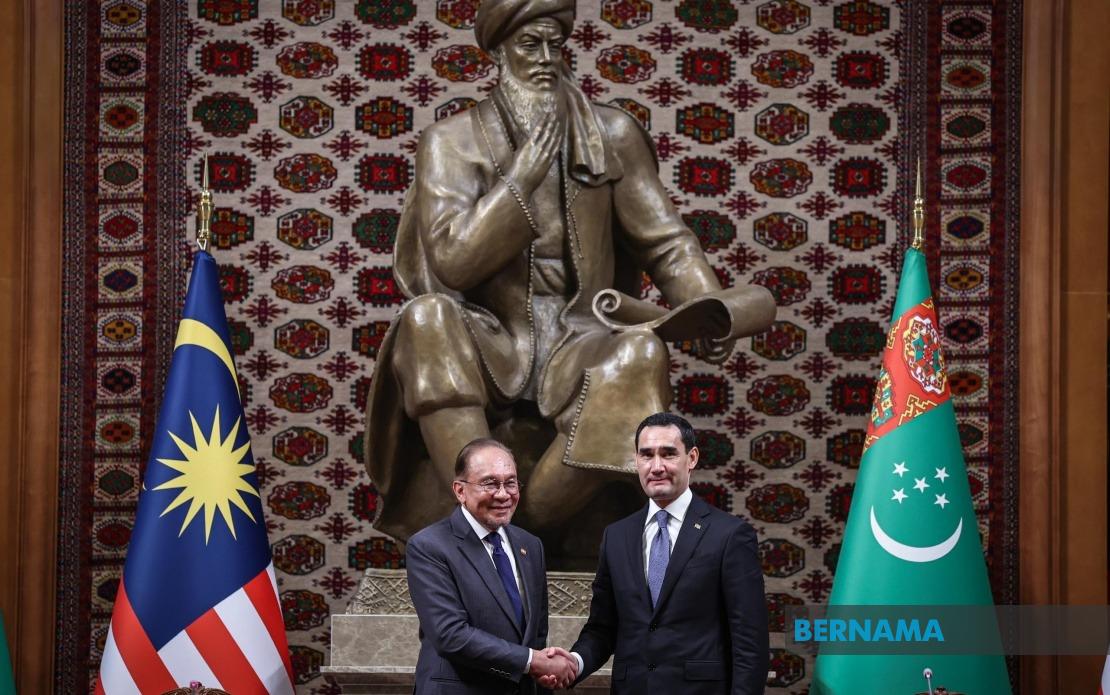
Prime Minister Datuk Seri Anwar Ibrahim has announced a significant deepening of Malaysia's ties with Turkmenistan, following his bilateral engagement with President Serdar Berdimuhamedov at the Presidential Palace in Ashgabat on Friday. The two leaders committed to forging a more structured and progressive partnership anchored in strategic interests and mutual long-term prosperity. The announcement came during a joint press conference following their high-level discussions, underscoring both nations' intention to move beyond traditional diplomatic courtesies toward concrete, mutually beneficial cooperation frameworks.
The commitment took tangible form through the simultaneous exchange of four key documents between the two countries. These included an Air Services Agreement establishing aviation connectivity between Malaysia and Turkmenistan, alongside three separate memoranda of understanding covering critical institutional and sectoral partnerships. The breadth of these instruments suggests both governments view their relationship as multi-dimensional rather than transactional, spanning infrastructure, governance, and knowledge-sharing mechanisms that will facilitate deeper engagement across multiple layers.
Among the exchanged documents was a bilateral MoU between Malaysia's Institute of Diplomacy and Foreign Relations, operating under the purview of the Ministry of Foreign Affairs, and Turkmenistan's Institute of International Relations. This partnership is particularly significant as it establishes a dedicated channel for diplomatic dialogue and foreign policy coordination between two nations seeking to navigate an increasingly complex Central and Southeast Asian geopolitical landscape. Such institutional partnerships often serve as early-warning systems and confidence-building mechanisms during periods of regional flux.
Transport and logistics infrastructure also featured prominently in the bilateral agenda. Malaysia's Ministry of Transport and Turkmenistan's State Service signed an MoU designed to facilitate cooperation in transportation development and connectivity solutions. This agreement carries particular relevance for Malaysia's broader regional integration strategy, potentially opening new transit routes and logistics opportunities linking Southeast Asia with Central Asian markets. For Turkmenistan, the partnership offers access to Malaysia's sophisticated port infrastructure and established shipping networks.
Scientific and technological collaboration received equivalent attention through an MoU between the Academy of Sciences Malaysia and Turkmenistan's Academy of Sciences. This dimension of the partnership reflects recognition that contemporary bilateral relationships increasingly rest on knowledge production and research capacity. Both nations stand to benefit from shared research initiatives in fields ranging from energy efficiency to materials science, particularly given Turkmenistan's prominence as an energy producer and Malaysia's advanced industrial capabilities.
Anwar outlined the substantive scope of discussions with President Berdimuhamedov, revealing that conversations encompassed energy cooperation, trade and investment flows, halal industry development, Islamic banking architecture, educational exchanges, research collaboration, scientific and technological advancement, tourism expansion, and enhanced air connectivity. This comprehensive agenda indicates that Malaysian officials approached the visit with a sophisticated understanding of Turkmenistan's economic profile and development priorities. Energy cooperation likely dominated discussions given Turkmenistan's status as a major natural gas exporter and Malaysia's energy requirements, though neither side released specific details regarding potential energy arrangements or pricing mechanisms.
The explicit emphasis on halal industry cooperation and Islamic banking presents a distinctive dimension of this partnership. Turkmenistan, despite its secular governance structure, shares with Malaysia a significant Muslim-majority population and recognition of the commercial opportunities inherent in global halal markets. Islamic banking cooperation could facilitate access to shariah-compliant financing instruments for bilateral trade, technology transfer, and investment projects, potentially unlocking new capital flows between the two nations.
Prime Minister Anwar stressed that both governments committed to implementing all agreed cooperation areas with disciplinary rigour, transparency, and operational effectiveness. This language suggests awareness of past bilateral initiatives that may have languished due to inadequate follow-through mechanisms or bureaucratic obstacles. The emphasis on implementation architecture indicates Malaysian officials have learned from experience and intend to establish accountability frameworks ensuring the various MoUs translate into substantive outcomes rather than symbolic gestures.
The visit marked Anwar's first official journey to Turkmenistan since assuming Malaysia's premiership in November 2022, occurring at President Berdimuhamedov's formal invitation. This timing carries significance beyond diplomatic protocol. Nearly eighteen months into his term, Anwar has positioned himself as an active architect of Malaysia's international engagement, particularly across Islamic-majority nations and emerging markets. The Turkmenistan visit demonstrates commitment to broadening Malaysia's diplomatic footprint beyond traditional Southeast Asian and Middle Eastern focus areas into Central Asia, a region offering nascent opportunities for Malaysian business and investment.
The prime minister's delegation composition reflected the economic dimensions of the visit. Minister of Investment, Trade and Industry Datuk Seri Johari Abdul Ghani and Minister of Economy Akmal Nasrullah Mohd Nasir accompanied Anwar, signalling that commercial and investment considerations formed the visit's core rather than peripheral concerns. The inclusion of senior government officials further indicated comprehensive inter-agency coordination, suggesting Malaysia's bureaucratic apparatus views the Turkmenistan relationship as sufficiently important to warrant coordinated engagement across multiple government departments and ministries.
The two-day visit, commencing on June 18, represents a measured diplomatic investment in a relationship that, while historically cordial, has remained relatively underdeveloped compared to Malaysia's engagement with other regions. Turkmenistan's geographic position as a bridge between Europe, Asia, and the Middle East, combined with its energy wealth and emerging economic diversification efforts, offers Malaysia strategic advantages. For Malaysian companies, Turkmenistan represents an entry point into Central Asian markets. For Malaysian policymakers, stronger ties with Turkmenistan enhance regional diplomatic influence and contribute to a more balanced foreign policy architecture.
The joint statement signed by both leaders during the visit encapsulates their shared vision for this partnership trajectory. Beyond the immediate agreements, the statement likely articulated longer-term aspirations and underlying principles guiding bilateral engagement. Such documents typically establish regular consultation mechanisms, high-level exchange visits, and periodic reviews of partnership implementation, creating institutional continuity that survives individual political transitions and bureaucratic personnel changes.
Looking forward, the concrete nature of these agreements suggests both nations intend to move expeditiously toward implementation. The Air Services Agreement, in particular, could meaningfully enhance people-to-people connectivity within months rather than years, facilitating business travel, tourism, and cultural exchange. Institutional partnerships between diplomatic and scientific bodies should facilitate smoother policy coordination and collaborative research initiatives. Success in these initial cooperation areas could establish momentum for expanding bilateral engagement into additional sectors, potentially including manufacturing partnerships, educational scholarships, and cultural programming that deepens mutual understanding between Malaysian and Turkmenistan populations.

