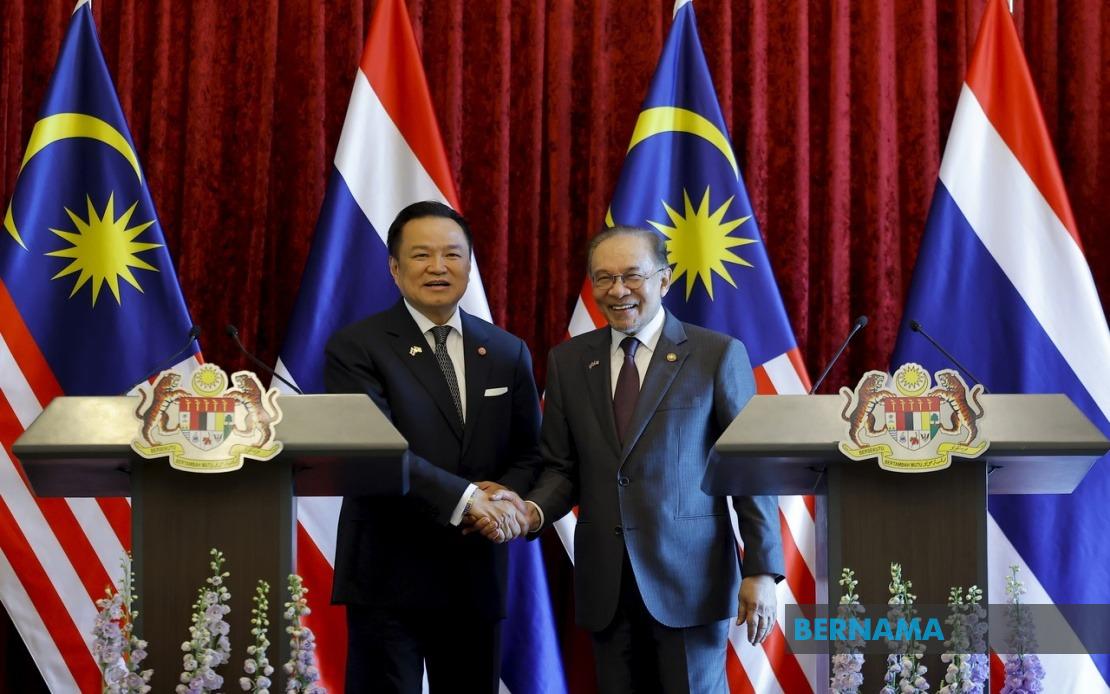
Malaysia and Thailand have set an ambitious timeline to significantly expand their economic partnership, with both nations agreeing to fast-track several connectivity initiatives along their shared border while targeting a bilateral trade value of US$30 billion by 2027. The agreement, sealed during a high-level meeting in Putrajaya between Prime Minister Datuk Seri Anwar Ibrahim and Thai Prime Minister Anutin Charnvirakul, represents a major thrust to deepen economic integration and resolve long-standing cooperation challenges between the two Southeast Asian neighbours.
The bilateral relationship has historically been constrained by geographical and administrative barriers, but both leaders see the border region not as a dividing line but as an opportunity for shared prosperity. Anwar emphasized during a joint press conference that Malaysia and Thailand share deep historical, cultural, and economic ties that remain underutilized. He underscored that despite their proximity and complementary economic structures, considerably more effort is needed across all sectors to unlock the full potential of their relationship. The acknowledgment reflects a recognition that previous cooperation frameworks had not yielded sufficient economic benefits relative to the nations' geographical adjacency.
A cornerstone of the new framework involves developing special border economic zones that would create dedicated commercial spaces for bilateral trade and investment. These zones are designed to provide investors with streamlined regulatory environments, reduced tariffs, and integrated logistics infrastructure that would facilitate the movement of goods and services across the border. Similar models have proven effective in other border regions within Southeast Asia, where special economic zones have attracted manufacturing clusters and regional distribution hubs. For Malaysia, such zones offer opportunities to leverage its position as a logistics hub connecting Southeast Asia with global markets, while Thailand can benefit from enhanced access to Malaysian ports and regional networks.
Critical to the success of this economic ambition is the modernization of customs and immigration procedures at border crossing points. Both nations have committed to simplifying documentation requirements, implementing digital systems for clearance processing, and potentially establishing joint immigration facilities that would reduce transit times. The initiative addresses a persistent complaint from traders and logistics operators who have cited lengthy border procedures as a competitive disadvantage compared to other Southeast Asian trade corridors. Expedited clearance processes could reduce supply chain costs significantly, making bilateral trade more competitive and attractive to regional manufacturers.
The planned visit to Bukit Kayu Hitam in Kedah and Sadao in Songkhla province marks an unusual diplomatic gesture, with the Thai Prime Minister choosing to conduct bilateral discussions beyond capital-city protocols. This deliberate inclusion of border communities signals that the agreement is not merely aspirational but grounded in the realities and needs of frontier regions. Local businesses, agricultural producers, and manufacturing operators in these areas have long advocated for improved cross-border connectivity. The visit demonstrates political commitment to translating high-level agreements into tangible improvements for communities living along the boundary.
The US$30 billion trade target by 2027 represents a substantial increase from current bilateral trade volumes and reflects confidence in the growth potential of the relationship. For context, current trade between Malaysia and Thailand remains well below potential given the size of their respective economies and regional importance. Achievement of this target would require not only policy reforms but also genuine engagement from the private sector in both nations. Industry associations, chambers of commerce, and trading companies will need to identify specific sectors where comparative advantages exist and where bilateral partnerships can create value chains.
Key sectors likely to benefit include manufacturing, where Malaysia's petrochemicals and electronics industries complement Thailand's automotive and food processing capabilities. Agricultural trade also presents significant opportunities, with both nations producing complementary crops and processed food products. Regional manufacturing networks increasingly operate on a sub-regional basis, with components and semi-finished goods moving across borders multiple times before final assembly. Removing friction from this process through better border management could enable both countries to participate more effectively in Asian supply chains.
From a broader Southeast Asian perspective, improved Malaysia-Thailand economic integration carries implications for the entire region. The two nations anchor the land-based Asean economy and represent crucial transit points for intra-regional trade. Enhanced bilateral cooperation could create demonstration effects for other border relationships within the region and strengthen the economic coherence of mainland and maritime Southeast Asia. The initiative also reflects a maturation of regional economic thinking, moving beyond national protectionism toward recognition that prosperity requires seamless cross-border movement of goods, capital, and increasingly, skilled labor.
The diplomatic emphasis on bilateral resolution of outstanding issues suggests that both governments have agreed to set aside or actively address contentious matters that previously complicated cooperation. Historical tensions over maritime boundaries and bilateral disputes have occasionally strained relations, but the tone of recent high-level meetings indicates a willingness to compartmentalize disagreements while pursuing tangible economic gains. For Malaysia, closer economic ties with Thailand strengthen its position as a regional economic anchor and diversify its trade partnerships beyond traditional patterns.
Implementing the agreed projects will require sustained political will and coordinated institutional arrangements on both sides. Malaysia will need to mobilize resources for border infrastructure upgrading, while Thailand must ensure that its side of the border developments align with Malaysian initiatives. Bilateral joint committees and working groups will likely be established to oversee project implementation, monitor progress toward the trade target, and address implementation challenges. The success of similar initiatives elsewhere in Asia demonstrates that bureaucratic alignment and regular high-level oversight are essential for translating agreements into operational reality.
For Malaysian businesses, particularly those in logistics, manufacturing, and trade services, the initiative presents opportunities to expand operations into Thailand's market and to establish themselves as regional players. Conversely, Thai investors may find new opportunities in Malaysia's financial services, technology, and petrochemical sectors. The phased implementation of border improvements should create first-mover advantages for companies that prepare early to capitalize on reduced trade barriers and improved connectivity.
The timeline to 2027 is ambitious but feasible if political commitment remains strong and implementation proceeds systematically. It reflects the understanding that in an increasingly integrated regional economy, Malaysia and Thailand cannot afford to allow administrative and infrastructural deficiencies to undermine their bilateral relationship. The emphasis on special economic zones and streamlined procedures indicates that both governments have learned from successful models elsewhere in Asia and are determined to apply those lessons to their border region.

