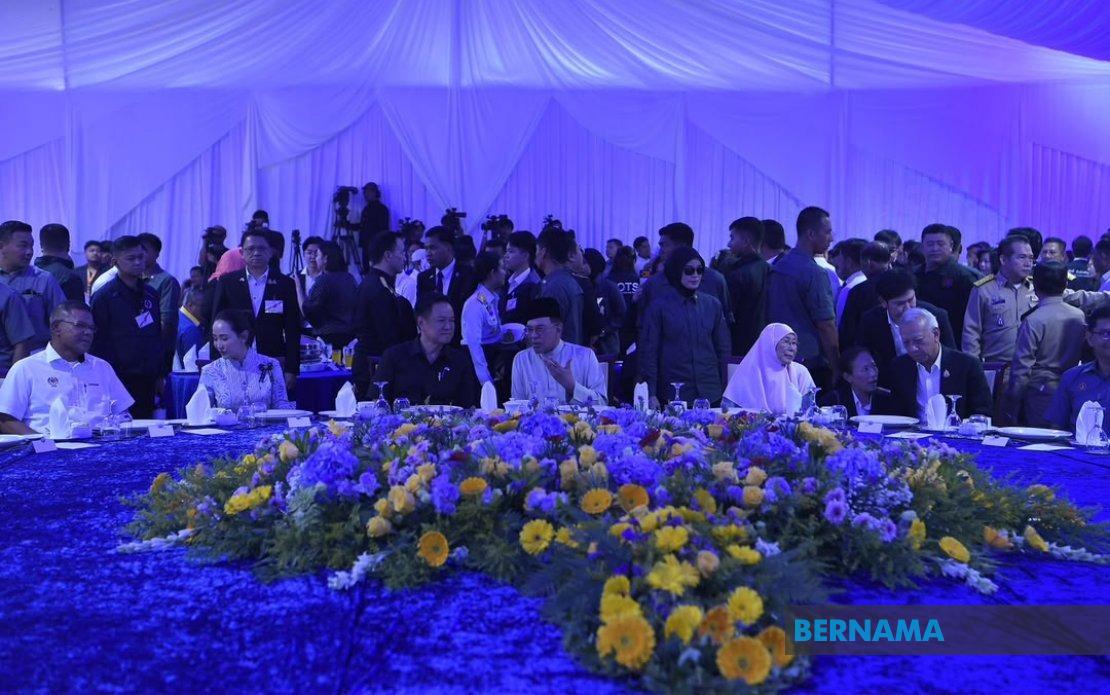
Prime Minister Datuk Seri Anwar Ibrahim joined Thai Prime Minister Anutin Charnvirakul in formally opening a new road infrastructure linking Malaysia's Bukit Kayu Hitam Immigration, Customs, Quarantine and Security (ICQS) Complex directly to Thailand's Sadao Customs, Immigration and Quarantine (CIQ) Complex. The ceremonial launch, held in Bukit Kayu Hitam on July 10, marks a significant infrastructure milestone for both nations and signals deepening bilateral cooperation on border management and regional integration.
The new thoroughfare represents a fundamental restructuring of how travellers and goods move between Malaysia and Thailand at this critical juncture. Beginning at 6 am Malaysia time the following day, the road became fully operational for all users, while the decades-old Danok crossing—which had served as the primary entry point between the two countries—was permanently decommissioned at midnight that same day. This transition reflects a deliberate shift towards consolidated, modernised border infrastructure capable of handling contemporary traffic volumes and security requirements.
According to Malaysia's Home Ministry (KDN), the project embodies both nations' determination to fortify their diplomatic relationship and deepen strategic cooperation across their shared frontier. Officials framed the development as instrumental to advancing the broader ASEAN Connectivity agenda, which seeks to knit together the region's economies through improved physical and logistical networks. The road opening thus transcends bilateral significance, positioning itself as a building block in Southeast Asia's push towards seamless intra-regional movement of people, capital, goods and services.
From an economic perspective, the new crossing promises tangible benefits for border communities and national supply chains. The integrated facility is designed to expedite customs clearance, reduce bottlenecks that have historically constrained commerce, and create efficiencies in logistics operations that serve manufacturers and retailers across both countries. The modern infrastructure incorporates integrated control systems and transparent border procedures, addressing long-standing pain points that have hindered the free flow of trade along the Malaysia-Thailand corridor, a vital artery for industrial production and distribution networks serving broader Southeast Asia.
The initiative also carries geopolitical weight within Malaysia's MADANI framework, which prioritises national security alongside prosperity. By centralising border operations within a single, technologically advanced complex, both governments enhance their capacity to screen entrants, detect irregularities and maintain security integrity while simultaneously improving traveller experience. This dual mandate—balancing openness with vigilance—has become increasingly important as countries navigate post-pandemic normalisation and rising concerns over transnational challenges ranging from organised crime to irregular migration.
The closure of the Danok crossing represents a symbolic end to a chapter in Malaysia-Thailand relations, as that route had functioned as the primary overland gateway for decades. Its retirement underscores how border infrastructure, often taken for granted, carries historical weight and reflects evolving bilateral priorities. The decision to consolidate operations at a single, purpose-built facility signals confidence in modern technology's capacity to enhance efficiency without sacrificing accessibility or cooperation.
For Malaysian readers and businesses, the development carries direct implications. Traders reliant on Thai supply chains, tourists planning overland journeys and families with cross-border ties will navigate a newly designed crossing with fresh protocols and facilities. Initial disruption may occur as users adapt to the relocated infrastructure and updated procedures, but the longer-term efficiency gains promise reduced transit times and lower transaction costs. Industries heavily dependent on just-in-time manufacturing networks—such as automotive and electronics—stand to benefit from smoother goods movement.
Thailand's parallel interest in the project reflects its own regional ambitions and economic ties with Malaysia. For Bangkok, improved connectivity with its southern neighbour strengthens trade links, supports tourism flows and reinforces Thailand's role as a key node in Southeast Asian commerce. The collaborative approach to border management also positions both nations as partners in regional stability, countering perceptions of the Malaysia-Thailand frontier as a contested or problematic zone.
The Home Ministry's emphasis on international strategic cooperation and technology adoption hints at future developments along the border. The integrated control systems referenced in official statements likely include digital customs platforms, biometric screening and real-time information sharing between Malaysian and Thai authorities. Such technologies, increasingly standard at major crossings worldwide, reduce human discretion, lower corruption risks and accelerate processing times—benefits that extend beyond commerce to security and administrative efficiency.
Within the broader context of ASEAN's infrastructure push, the Bukit Kayu Hitam-Sadao road exemplifies a growing trend towards rationalising and modernising land borders across Southeast Asia. As regional economies become more integrated and supply chains more interdependent, border infrastructure has evolved from static checkpoints into dynamic, multi-functional gateways. Malaysia's investment in this facility signals its commitment to participating fully in regional economic integration while maintaining the security controls necessary for a modern state.
The appreciation extended by Malaysian authorities to partner agencies and departments underscores the complexity of such cross-border projects. Coordinating with Thai counterparts, managing construction logistics, redesigning security protocols and managing the transition from an old to a new crossing requires sustained diplomatic engagement and inter-agency collaboration. The successful completion reflects both nations' political will and technical capacity to execute infrastructure projects of strategic importance.
Looking forward, the new crossing is likely to become a model for other Malaysia-Thailand border developments and potentially for regional initiatives elsewhere in Southeast Asia. As ASEAN members grapple with ageing infrastructure and the imperative to boost connectivity, integrated border complexes such as this offer proven templates. The road's operational success or challenges in coming months will be closely watched by policymakers throughout the region contemplating similar investments in border infrastructure modernisation.

