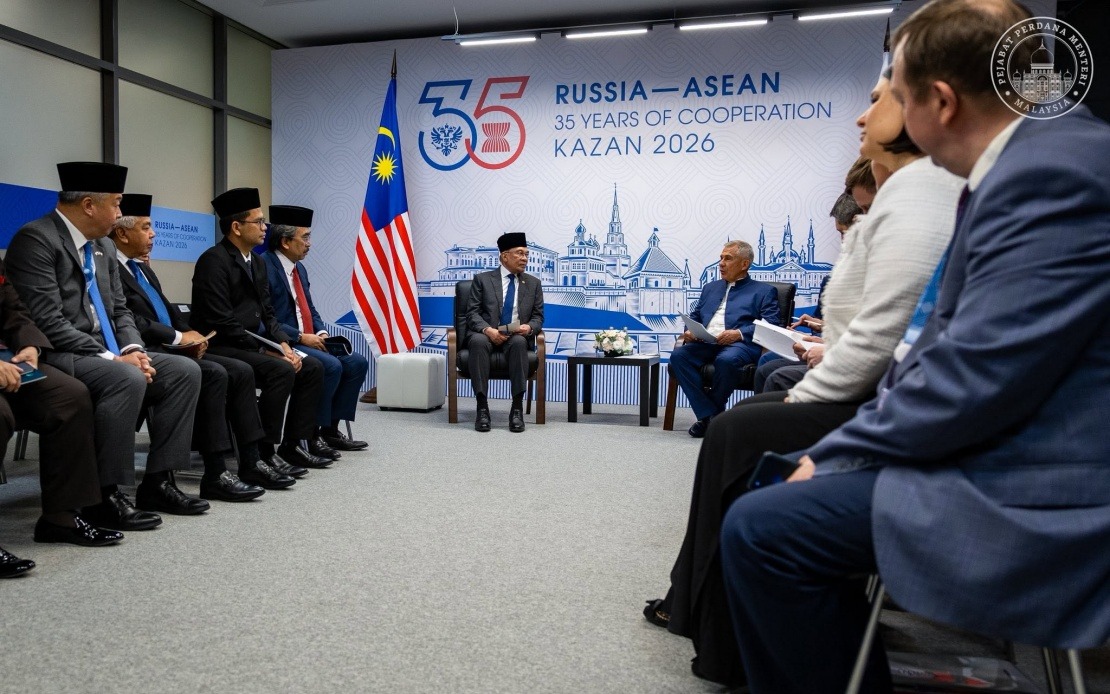
Prime Minister Datuk Seri Anwar Ibrahim has flagged substantial scope for Malaysia to strengthen bilateral relations with the Republic of Tatarstan across multiple economic and cultural domains. The remarks came during a meeting with Tatarstan leader Rustam Minnikhanov in Kazan, where Anwar stressed the complementary strengths of both regions and outlined shared priorities that could drive mutual prosperity.
Anwar, who holds the additional portfolio of Finance Minister, identified energy cooperation as a cornerstone of the potential partnership. Tatarstan's position as one of Russia's principal oil-producing jurisdictions aligns squarely with Malaysia's longstanding interests in downstream petroleum activities, refining capabilities and petrochemical expansion. The two leaders explored ways to harness this synergy, recognising that Malaysia's established expertise in these sectors could be paired with Tatarstan's resource endowment and infrastructure development ambitions. Such collaboration would extend beyond crude extraction to encompass value-added processing and manufacturing opportunities that benefit both economies.
Beyond hydrocarbons, the bilateral discussions encompassed a diverse portfolio of cooperation pathways. Trade and investment featured prominently, reflecting Malaysia's role as a Southeast Asian economic hub with established capital and trading networks. Educational partnerships and talent development initiatives also emerged as priority areas, enabling knowledge exchange and capacity-building between academic and professional communities. The halal industry—a sector where Malaysia holds significant global market share and expertise—was identified as a particularly promising avenue, given Tatarstan's sizeable Muslim population and emerging interest in halal-certified products and services. Tourism cooperation, underpinned by cultural and religious ties, presents another mutual opportunity for visitor flows and hospitality sector growth.
The role of the Kazan Forum in anchoring commercial and strategic dialogue was highlighted as instrumental to translating bilateral goodwill into tangible business partnerships. Anwar and Minnikhanov discussed how the forum could catalyse innovation networks, digital economy initiatives and cross-border investments that create tangible economic returns for both nations' populations. This institutional framework provides the convening power and credibility necessary to attract private sector participation and facilitate infrastructure projects that neither country could readily execute alone.
Anwar extended congratulations to Kazan on its designation as the Islamic World Cultural Capital 2026 by the Islamic World Educational, Scientific and Cultural Organisation, underscoring the city's standing as a beacon of Islamic scholarship, culture and contemporary innovation. The recognition is particularly significant for Malaysia, which positions itself as a global leader in Islamic finance, education and cultural diplomacy. The designation amplifies the convergence between Malaysia's own strategic positioning and Kazan's emerging profile, creating natural alignment for cultural and institutional partnerships.
The Prime Minister also acknowledged President Vladimir Putin's vision in establishing the Strategic Vision Group, characterising it as a vital bridge between Russia and the Islamic world. This framework, which channels dialogue and cooperation between Moscow and Islamic nations, creates an enabling context for Malaysia-Tatarstan engagement and signals broader Russian willingness to deepen ties with Muslim-majority societies beyond traditional security and energy dimensions. For Malaysia, engaging through this mechanism reinforces its diplomatic weight within the Islamic bloc whilst opening pathways to continental European markets and partnerships.
Anwar's visit to Kazan is part of a two-day working engagement centred on Malaysia's participation in the ASEAN-Russia Commemorative Summit, which commenced following his arrival. The delegation, which included Investment, Trade and Industry Minister Datuk Seri Johari Abdul Ghani and Economy Minister Akmal Nasrullah Mohd Nasir, reflects the high-level commitment Malaysia assigns to the bilateral and multilateral dimensions of the engagement. The presence of these ministerial counterparts signals readiness to move discussions from diplomatic courtesy to operational implementation across their respective portfolios.
The ASEAN-Russia relationship has matured considerably since dialogue relations commenced in 1991, with Russia elevated to Strategic Partner status in 2018. This framework positions the bilateral Malaysia-Tatarstan initiative within a broader architecture of Southeast Asian-Russian engagement, enabling the partnership to benefit from institutional support, precedent and diplomatic momentum generated at the summit level. For Malaysia specifically, deepening Tatarstan ties provides an entry point to Russia's federal structure and regional economies, diversifying the country's strategic partnerships beyond traditional ASEAN and Western engagement.
Kazan itself, strategically positioned at the confluence of the Volga and Kazanka rivers some 800 kilometres east of Moscow, serves as Russia's third-largest city by cultural significance and economic weight, with a population approaching 1.3 million. The city's millennial-long history as a centre of Islamic culture and heritage creates resonance for Malaysian engagement, particularly around halal certification, religious tourism and scholarly exchange. Its location within European Russia also positions it as a potential gateway for Malaysian businesses seeking to establish presence in the broader Russian and Central Asian markets, offering both logistical advantages and cultural proximity to key demographics.
The bilateral engagement reflects broader strategic calculus on Malaysia's part to cultivate diversified great-power relationships that transcend traditional blocs. Whilst China and the United States remain significant partners, engagement with Russia and its constituent republics provides ballast against over-reliance on any single external power. Tatarstan's relative autonomy within the Russian federation offers Malaysia's businesses and investors potential flexibility in negotiation and operational arrangements, distinguishing it from dealings with Moscow's centralised bureaucracy. This layered approach to external partnerships aligns with Malaysia's longstanding doctrine of strategic autonomy and non-alignment.
Looking forward, operationalising the cooperation frameworks discussed in Kazan will require movement beyond diplomatic overture to binding commercial and institutional agreements. The energy sector offers the most immediately tangible opportunity, given clear resource complementarity and established bilateral trade structures. Educational and cultural initiatives may proceed more gradually but offer deeper, longer-term foundations for societal-level engagement that endures beyond shifts in political leadership or commodity cycles. The halal industry, positioned at the intersection of economics, culture and religious identity, presents distinctive opportunity for Malaysia to export its regulatory frameworks, certification expertise and value-chain governance to an emerging market, establishing first-mover advantage before competitors establish foothold.

