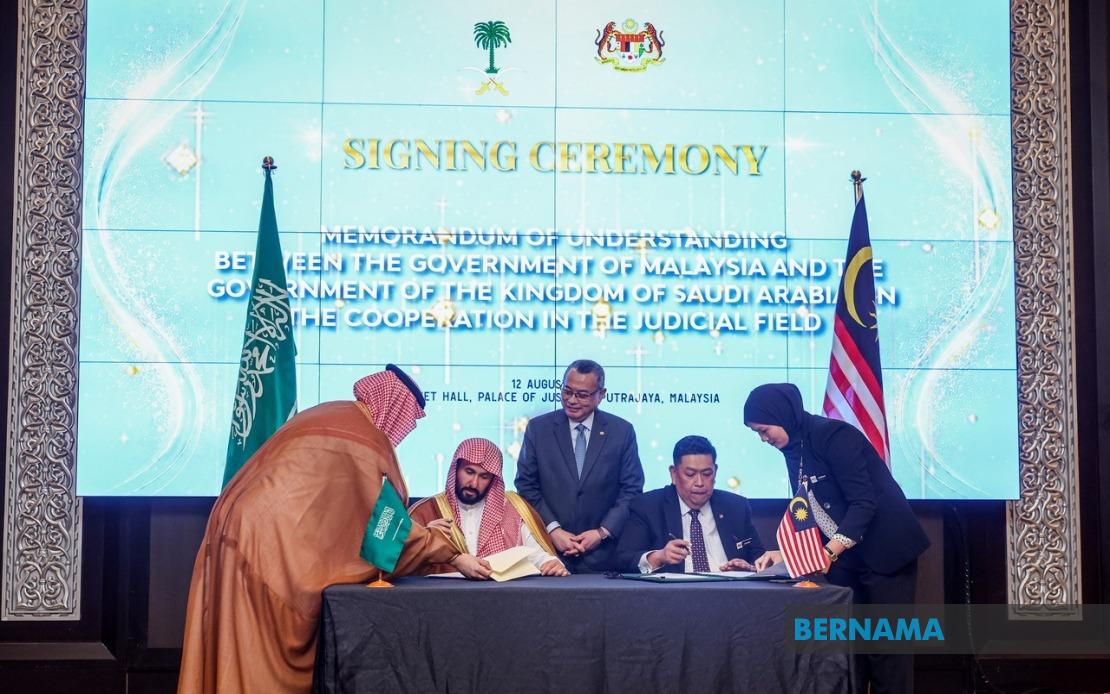
Malaysia and Saudi Arabia have taken a significant step toward closer institutional ties by formalising a comprehensive judicial partnership through a memorandum of understanding signed at the Palace of Justice in Putrajaya. The agreement, inked by Chief Registrar of the Federal Court Azhaniz Teh Azman Teh and Saudi Arabian Minister of Justice Sheikh Dr Waleed Mohammed Alsmani, represents a deliberate effort by both nations to create structured mechanisms for advancing their respective judicial systems. Chief Justice Tun Wan Ahmad Farid Wan Salleh witnessed the signing, underscoring the ceremonial weight both countries accord to the arrangement.
The MoU establishes a broad framework encompassing multiple dimensions of judicial cooperation that extend well beyond traditional diplomatic courtesies. Civil case management practices, a cornerstone of efficient court administration, form a central pillar of the agreement, allowing both judiciaries to study methodologies for streamlining legal proceedings and reducing backlogs. This dimension is particularly relevant to Malaysia, where court congestion has occasionally drawn criticism from legal practitioners and civil society observers seeking faster dispute resolution.
Digitalisation and judicial technology constitute another critical component of the partnership, reflecting global trends toward modernising court operations through digital infrastructure. Malaysia's experience with its e-Court system, which has progressively transformed how cases are filed, tracked, and managed, positions the country as a valuable knowledge partner for Saudi Arabia's own digitalisation initiatives. The exchange of practical expertise in this domain could accelerate Saudi Arabia's judicial modernisation while simultaneously strengthening Malaysia's position as a regional leader in legal technology adoption.
The agreement explicitly includes provisions for sharing publicly available judicial information and institutional knowledge, creating channels through which both nations' judges, administrators, and legal professionals can observe and learn from each other's operational approaches. Formal institutional visits and regular exchanges will provide personnel from both countries with direct exposure to contrasting judicial philosophies and administrative methods, fostering professional networks that extend beyond government-to-government relations.
A particularly noteworthy element of the partnership involves focused dialogue on Malaysia's judicial approach to sexual offences against children, a subject of mounting international concern across the Muslim-majority world. By sharing its specialised expertise in this sensitive area, Malaysia contributes to capacity-building efforts in a neighbouring nation while potentially gaining insights from Saudi Arabia's own child protection frameworks. This exchange carries implications for regional child welfare standards and demonstrates how judicial cooperation can address transnational social challenges affecting vulnerable populations.
The timing of Saudi Arabian Justice Minister Sheikh Dr Waleed Mohammed Alsmani's official visit to Malaysia reflects broader patterns of deepening bilateral engagement between the two predominantly Muslim nations. Beyond the judicial sphere, such high-level visits typically encompass discussions on security cooperation, trade, investment, and cultural exchange, suggesting that the MoU should be understood as part of a larger strategic dialogue between Kuala Lumpur and Riyadh.
For Malaysia, this partnership carries several implications for the country's regional standing. The agreement reinforces Malaysia's role as a centre of judicial excellence within Southeast Asia and the broader Islamic world, positioning the nation's legal innovations as models worth studying. The Malaysian Judiciary's emphasis on technological advancement and evidence-based approaches to complex legal matters can inspire confidence among regional and international partners regarding the sophistication of Malaysia's institutional frameworks.
The structured platform created by the MoU also serves Malaysia's long-term interests in building networks of legal professionals across the Muslim world, networks that can prove valuable for harmonising approaches to cross-border disputes, family law matters, and religious jurisprudence questions that frequently involve stakeholders from multiple countries. Such cooperation networks strengthen the practical utility of Islamic law principles across different jurisdictions while promoting legal predictability for businesses and individuals engaged in intra-Islamic commerce and relations.
Saudi Arabia's investment in learning from Malaysia's judicial systems reflects the kingdom's own modernisation agenda under Vision 2030, which encompasses substantive reform of government institutions. By engaging with Malaysia's experiences in judicial transformation, Saudi Arabia signals its commitment to enhancing institutional efficiency and transparency, objectives that increasingly matter to both domestic audiences and international investors evaluating the kingdom's governance standards.
The e-Court system deserves particular attention given its centrality to the bilateral dialogue. Malaysia's gradual transition toward digital court proceedings has enhanced transparency, reduced case processing times, and improved accessibility for parties unable to attend physical courtrooms. Saudi Arabia's potential adoption of comparable systems could yield similar benefits while increasing confidence in the judicial system among citizens and international stakeholders.
Looking forward, the success of this MoU will depend on sustained commitment from both judicial hierarchies to implement the planned exchanges and translate shared knowledge into concrete institutional improvements. Regular monitoring mechanisms and clear benchmarks for evaluating the partnership's impact will be essential to ensure that the agreement produces tangible outcomes rather than remaining a symbolic gesture.
This judicial partnership arrives at a moment when both nations face growing demands for effective, transparent, and technologically sophisticated court systems capable of serving diverse populations and complex economies. By collaborating on these challenges, Malaysia and Saudi Arabia position themselves to build judicial institutions that command public confidence while maintaining the flexibility to adapt to evolving legal and social demands.

