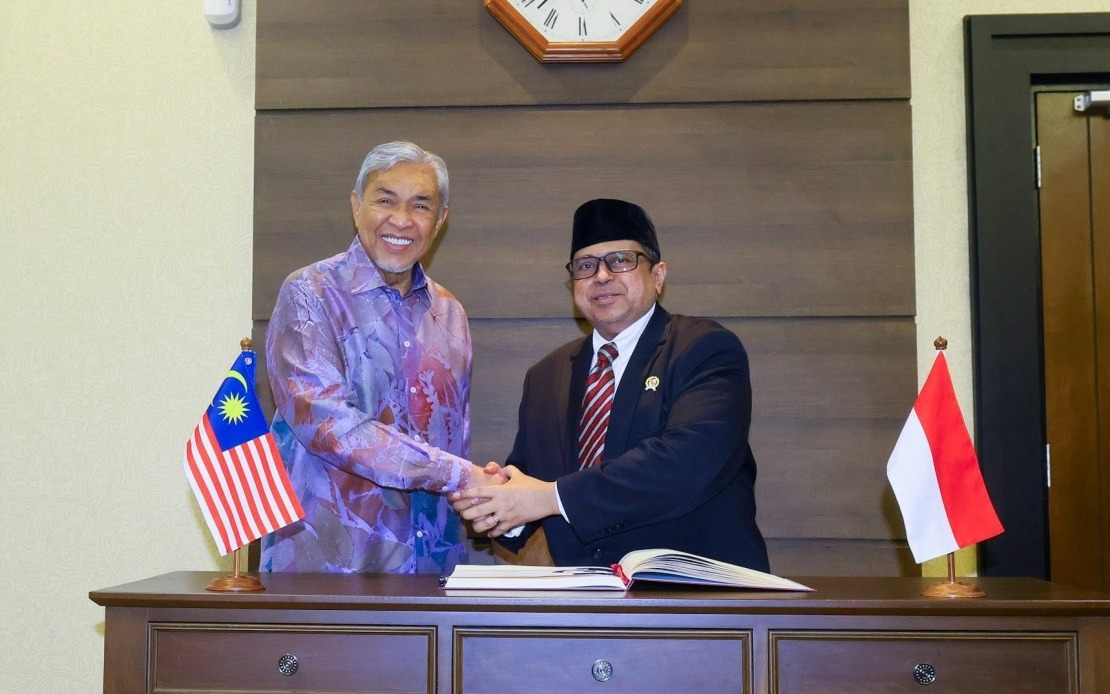
Malaysia and Indonesia are moving to expand their strategic partnership across multiple economic sectors, with particular emphasis on positioning themselves as global halal leaders. During a parliamentary meeting on June 25, Deputy Prime Minister Datuk Seri Dr Ahmad Zahid Hamidi and officials from Indonesia's halal regulatory bodies discussed an ambitious agenda that extends far beyond bilateral trade, signalling deepening integration in one of Southeast Asia's most dynamic growth sectors.
The discussions involved Indonesia's Ambassador to Malaysia, Raden Datuk Mohammad Iman Hascarya Kusumo, and Dr Ahmad Haikal Hassan, head of Indonesia's Halal Product Assurance Organising Body (BPJPH). Their conversation at Parliament building highlighted the urgency both nations feel in harmonizing their approaches to halal certification, standards, and market development as global demand for halal products accelerates beyond traditional Muslim markets.
Central to the bilateral agenda is the proposed establishment of the Malaysia-Indonesia Halal Council (MIHC), which would serve as a dedicated platform for coordinating industry development between the region's two largest halal markets. This council would function as an operational bridge, facilitating dialogue on regulatory alignment, investment opportunities, and supply chain integration across sectors ranging from food and beverages to pharmaceuticals and cosmetics.
Beyond bilateral arrangements, both nations are contemplating larger regional architecture. The proposed ASEAN Halal Council would extend cooperation across Southeast Asia's ten member states, creating a unified framework for standard-setting and market access. This represents a significant structural evolution, potentially allowing smaller halal producers across the region to access certification and distribution networks previously fragmented by competing national requirements. For Malaysian enterprises, such regional coordination reduces compliance costs and expands addressable markets simultaneously.
The ambition extends globally through the envisioned World Halal Development Council, positioning Malaysia and Indonesia as driving forces in establishing international benchmarks rather than merely adopting them. This forward-looking approach acknowledges that halal certification and standards increasingly influence trade negotiations, investment flows, and supply chain decisions in non-Muslim majority nations where halal products command premium positioning in mainstream retail channels.
Ahmad Zahid, speaking in his capacity as chairman of the Malaysia Halal Industry Development Council, emphasized that historical ties between the two nations provide an exceptional foundation for this cooperation. Both countries possess established halal certification infrastructure, significant manufacturing capacity, and strong domestic demand that creates natural competitive advantages. Malaysia's reputation as a halal standard-setter, built over decades of institutional development, complements Indonesia's position as a massive producer and consumer market, creating complementary rather than competing interests.
The proposed initiatives address a genuine market need. Global halal product demand is projected to exceed USD 2 trillion annually across all sectors, yet fragmented certification systems, varying standards interpretations, and duplicative compliance requirements impose substantial costs on producers seeking to serve multiple markets. By harmonizing standards, the Malaysia-Indonesia partnership would streamline access for both nations' companies while establishing reference points that other countries and trading blocs increasingly recognize as authoritative.
For rural development and human capital advancement—identified as additional cooperation pillars—the halal industry provides particular leverage. Halal production standards often favour smallholder farmers, traditional processing methods, and community-based enterprises that might struggle with competing certifications. Enhanced bilateral cooperation could strengthen value chains that currently deliver limited returns to rural producers, whilst training programmes coordinated between both nations would develop the technical expertise required for premium halal production.
Trade implications warrant serious consideration. Indonesia and Malaysia currently represent approximately 40 percent of global halal product manufacturing capacity, yet their combined export penetration in non-Muslim markets remains lower than potential suggests. Coordinated marketing, joint certifications, and integrated supply chains would amplify their competitive position against rising halal competition from Turkey, Australia, and other emerging suppliers seeking to capture growth in Muslim-majority nations and diaspora markets worldwide.
The timing reflects strategic awareness. Global supply chain reconfiguration following pandemic disruptions has prompted manufacturers to diversify sourcing away from distant suppliers, whilst geopolitical tensions encourage businesses to reduce dependence on single-source suppliers. Malaysia and Indonesia's geographical proximity, complementary production capabilities, and established trade relationships position them advantageously to capture reshoring opportunities within halal sectors.
Institutionally, creating dedicated councils at bilateral, regional, and global levels signals commitment beyond rhetoric. Such bodies require secretariats, budget allocations, technical working groups, and enforcement mechanisms—investments suggesting both nations view halal industry development as core strategic priority rather than ancillary opportunity. This institutional seriousness distinguishes these proposals from earlier rhetorical commitments that yielded limited concrete outcomes.
However, success depends on navigating genuine complexities. Different regulatory philosophies, competing commercial interests within each nation, and bureaucratic coordination challenges across multiple government agencies could impede progress. Whether both nations genuinely prioritize harmonization over protecting domestic producers from regional competition remains an open question that early implementation will reveal.
For Malaysian stakeholders, the developments offer expanded market access and investment partnership opportunities, particularly for manufacturers seeking to diversify beyond saturated domestic markets. For Indonesia, clearer standards and Malaysian expertise in certification infrastructure could accelerate formalization of its vast informal halal production sector, unlocking economic value currently dispersed across unregistered producers.

