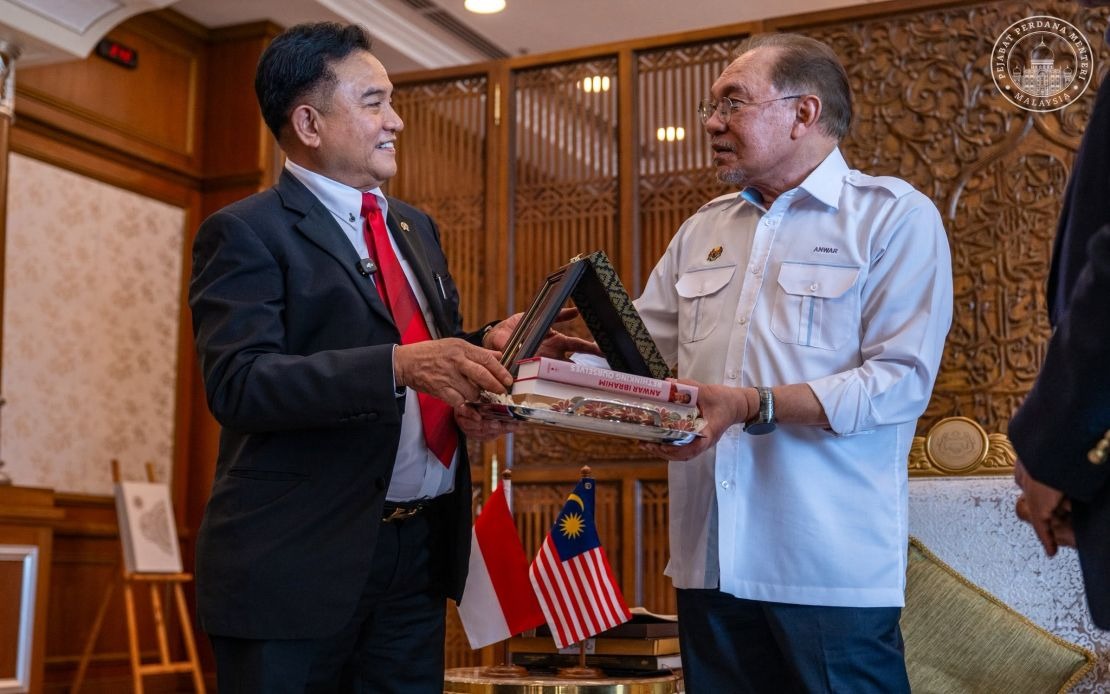
Prime Minister Datuk Seri Anwar Ibrahim has underscored Malaysia's commitment to deepen institutional cooperation with Indonesia across legislative frameworks and governance mechanisms, marking a significant step in regional integration efforts. The affirmation came during a courtesy call at the Prime Minister's Office in Putrajaya, where Anwar received Prof Dr Yusril Ihza Mahendra, Indonesia's Coordinating Minister for Legal, Human Rights, Immigration and Correction, to discuss avenues for enhanced bilateral engagement.
The bilateral meeting represents a continuation of high-level diplomatic exchanges between Southeast Asia's two largest economies, both of which face analogous governance challenges and legislative priorities. Malaysia and Indonesia share historical, cultural, and linguistic foundations that provide natural scaffolding for deepened institutional collaboration. The focus on legislative and governance cooperation reflects a pragmatic recognition that harmonising legal frameworks and administrative practices can yield tangible benefits for citizens and facilitate smoother cross-border interactions in commerce, security, and people-to-people exchanges.
During the engagement, both leaders exchanged perspectives on mechanisms to reinforce cooperation within these designated spheres. The emphasis on "strategic areas of mutual interest" indicates a broader aperture for collaboration extending beyond the immediate legislative agenda, potentially encompassing security cooperation, counter-terrorism coordination, and regulatory alignment in sectors such as maritime governance and labour mobility. Anwar, who concurrently holds the Finance Minister portfolio, is positioned to champion economic dimensions of bilateral cooperation as part of this institutional strengthening.
The timing of this diplomatic engagement carries significance within regional contexts. Both nations continue navigating complex challenges related to human rights frameworks, immigration management, and judicial reform—areas where Prof Dr Yusril Ihza Mahendra's portfolio carries considerable influence. Indonesia's position as chair of ASEAN through 2024 adds weight to bilateral initiatives, as mechanisms developed between Jakarta and Kuala Lumpur often serve as templates for broader regional integration. Malaysia, as a major ASEAN stakeholder, stands to benefit from collaborative approaches that can subsequently be advocated within regional forums.
Cooperation in legislation specifically addresses a longstanding gap in Southeast Asian integration. While the region has made strides in trade facilitation and security coordination, legal harmonisation remains patchy. Differences in common law traditions, constitutional frameworks, and Islamic jurisprudence in Malaysia's case create friction points that bilateral engagement can gradually address. Developing parallel legislative approaches to challenges such as digital governance, environmental protection, and financial crime detection serves both nations' strategic interests and positions the region competitively against external powers seeking to influence regional regulatory standards.
The governance dimension encompasses administrative capacity-building and institutional best practices sharing. Both nations contend with similar pressures around digitalisation of public services, anti-corruption efforts, and civil service reform. By systematising knowledge transfer and comparative institutional learning, Malaysia and Indonesia can accelerate their respective modernisation programmes while building human capital in public administration. This approach acknowledges that governance challenges transcend borders and that peer learning among regional counterparts often yields more contextually appropriate solutions than external prescriptions.
From Malaysia's perspective, strengthened cooperation with Indonesia carries particular salience given the nations' intricate bilateral relationship encompassing shared maritime boundaries, substantial cross-border populations, and complex historical narratives. Enhanced legislative coordination can address practical matters such as labour rights for migrant workers, maritime boundary demarcation, and transnational crime prevention. The emphasis on "fraternal relations" in Anwar's statement underscores the relational character of this cooperation—grounded in shared identity and mutual respect rather than mere transactional exchange.
The strategic partnership also reflects broader Southeast Asian trends toward deepening institutional integration amidst geopolitical uncertainties. As major powers compete for influence in the region, Malaysia and Indonesia's deliberate cultivation of bilateral institutional frameworks serves as a stabilising force and reinforces the autonomy of Southeast Asian states in charting their development trajectories. This cooperation potentially strengthens ASEAN's internal cohesion and reduces vulnerabilities to external pressure or division.
Looking forward, the substantive outcomes of this commitment will depend on translating diplomatic declarations into concrete institutional mechanisms. Establishing joint legislative committees, creating technical working groups on governance matters, and designing personnel exchange programmes would give operational substance to the stated intentions. The involvement of Indonesia's coordinating minister suggests that implementation will be coordinated across multiple Indonesian agencies, potentially yielding a comprehensive rather than siloed approach to bilateral cooperation.
For Malaysian stakeholders—whether in business, civil society, or government—this deepened institutional relationship offers practical opportunities. Regulatory alignment can reduce compliance costs for enterprises operating across both markets. Enhanced judicial and law enforcement cooperation strengthens security and predictability. For citizens, improved administrative coordination facilitates smoother navigation of bilateral processes from visa arrangements to professional credential recognition. The framework also creates space for civil society dialogue on governance innovations and human rights protections.
The broader context suggests that Malaysia and Indonesia recognise governance and legislative cooperation as foundational to other forms of integration. Rather than beginning with trade or security arrangements, both nations are intentionally building robust institutional foundations that can support and sustain deeper partnerships across multiple domains. This sequencing reflects diplomatic maturity and long-term strategic thinking.

