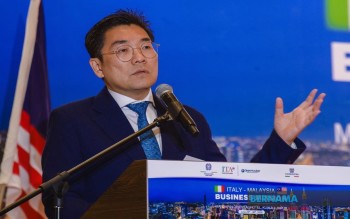
Negotiations between Malaysia and the European Union on their comprehensive free trade agreement are advancing steadily, with negotiators having wrapped up work on five substantive chapters and both sides maintaining an ambitious timeline to seal the deal by 2027. Investment, Trade and Industry Deputy Minister Sim Tze Tzin confirmed that the fourth round of talks, concluded in Kuala Lumpur earlier this month, resulted in finalised agreements on three additional chapters covering customs procedures, trade remedies, and regulatory standards. Combined with chapters on transparency and small and medium enterprises already settled in previous rounds, the agreement is now roughly halfway through its negotiating phase.
The Malaysia-European Union Free Trade Agreement (MEUFTA) represents a strategic economic cornerstone for both sides, opening doors to what officials describe as transformative opportunities in high-value sectors. For Malaysia, securing deeper market access to Europe's 450-million-person consumer base would unlock substantial potential in advanced manufacturing, renewable energy technologies, and digital services. The EU, conversely, gains privileged access to Southeast Asia's fastest-growing economy and a springboard into the broader regional market. Deputy Minister Sim characterised the pact as a "game-changer," suggesting it would position Malaysia as more intricately woven into global value chains centred on cutting-edge industries rather than commodity exports alone.
The negotiating schedule provides visibility for the coming months, with diplomats and trade officials set to reconvene in Brussels from September 21 to 25. This rhythm of roughly three-month intervals between rounds suggests both parties are committed to keeping momentum, though major disagreements on tariff reductions, rules of origin, or regulatory harmonisation could yet disrupt the timeline. The fact that negotiations have progressed through four rounds without reported breakdown is encouraging, though the remaining chapters—likely covering services, investment protection, intellectual property, and dispute settlement—typically prove more contentious.
Malaysia's current trade relationship with Europe, exemplified by the Italy partnership, illustrates what deeper integration might achieve. Trade between Malaysia and Italy surged 14.2 percent year-on-year to approximately RM17 billion in 2025, establishing Italy as Malaysia's fifth-largest European trading partner. This growth reflects complementary industrial strengths: Malaysia ships palm oil derivatives, steel, electrical equipment, and machinery to Italy, while importing sophisticated machinery, optical instruments, chemicals, and electronics. The bilateral flow demonstrates that even without preferential tariffs, strong value-chain connections exist. A finalised trade agreement would reduce friction costs, eliminate tariffs on sensitive goods, and likely deepen investment.
The Italian experience also underscores Europe's sustained confidence in Malaysia as an investment hub. More than 80 manufacturing projects from Italian firms, collectively worth US$442 million, are already operational across food processing, chemicals, machinery, and aerospace. Italian manufacturers cite Malaysia's comprehensive industrial ecosystem and established supply chains as decisive advantages. For companies seeking to serve Southeast Asian markets, Malaysia offers strategic geography, skilled labour, and established supplier networks that lower barriers to localisation. A broader EU trade agreement would amplify these attractions, potentially triggering a wave of new European investment in sectors aligned with Malaysia's growth ambitions.
Malaysia's semiconductor strategy features prominently in the government's economic diversification agenda, and the MEUFTA would provide leverage to attract advanced manufacturing and chip design operations. The New Investment Incentive Framework, launched in March, offers tax breaks for front-end semiconductor manufacturing, integrated circuit design, and higher-value-added production. Deputy Minister Sim stressed that incentives apply equally to foreign and domestic investors, aiming to help Malaysian companies climb the value chain rather than merely assembling imported components. European semiconductor and advanced manufacturing companies, facing rising costs and supply-chain risks from geopolitical tensions, may view Malaysia as an attractive alternative to established locations if tariff barriers dissolve and regulatory certainty strengthens through trade accords.
The framing of Italy and Malaysia's machine manufacturing capabilities as complementary hints at the deeper integration the MEUFTA could enable. Both economies possess strength in precision engineering and equipment production, yet serve different markets and specialise in distinct niches. Trade liberalisation could encourage cross-investment and joint ventures, with European firms establishing design and assembly operations in Malaysia to capture regional demand, while Malaysian suppliers deepen ties to European supply chains. Such vertical integration, driven by tariff elimination and reduced regulatory fragmentation, would embed both economies more tightly together.
Regionally, Malaysia's progress on the MEUFTA also signals diplomatic weight. As the largest Southeast Asian economy pursuing a major trade accord with the EU, Malaysia's success could influence ASEAN-EU negotiations, potentially accelerating that multilateral process or providing templates for other ASEAN members seeking bilateral arrangements. Thailand, Vietnam, and Indonesia are watching closely. A completed Malaysia-EU agreement would demonstrate that Southeast Asian countries can negotiate effectively with developed economies without surrendering autonomy or accepting onerous terms, providing a proof of concept that could motivate other regional capitals.
The 2027 target, while still two years away, reflects the complexity inherent in aligning two sophisticated trading blocs with different regulatory philosophies, labour standards, and protectionist instincts. EU standards on environmental sustainability, worker protections, and data privacy will likely shape final text, areas where Malaysian compliance may require domestic regulatory adjustment. Similarly, European agricultural and industrial sectors—accustomed to high tariffs—will resist rapid exposure to Malaysian competition. The remaining chapters, particularly those covering services, investment, and intellectual property, will test both sides' willingness to compromise.
For Malaysian businesses, the negotiations' trajectory matters considerably. Manufacturers of palm oil products, rubber goods, electrical equipment, and machinery have reason to anticipate lower European tariffs and smoother market access. Small and medium enterprises, acknowledged through a dedicated negotiating chapter, should benefit from streamlined rules of origin and reduced compliance costs once tariffs fall. However, Malaysian farmers and some protected industries will face new competition, requiring transition support. The government's emphasis on incentives for upgrading the value chain suggests an intention to manage these distributional impacts by helping traditional sectors modernise rather than simply surrendering them to imports.
Deputy Minister Sim's comments on equal treatment of investors and commitment to Malaysian industrial upgrading underscore a shift in development philosophy. Rather than offering investment incentives primarily to foreign corporations assembling goods for export, the government increasingly positions Malaysia as a hub for high-skill manufacturing, design, and digital services. A trade agreement with the EU, the world's largest single market, would provide the scale and regulatory certainty necessary for such ambitions to materialise. If negotiations proceed on schedule and conclude by 2027, Malaysia will have secured a transformative agreement that reshapes its economic trajectory and regional role.

