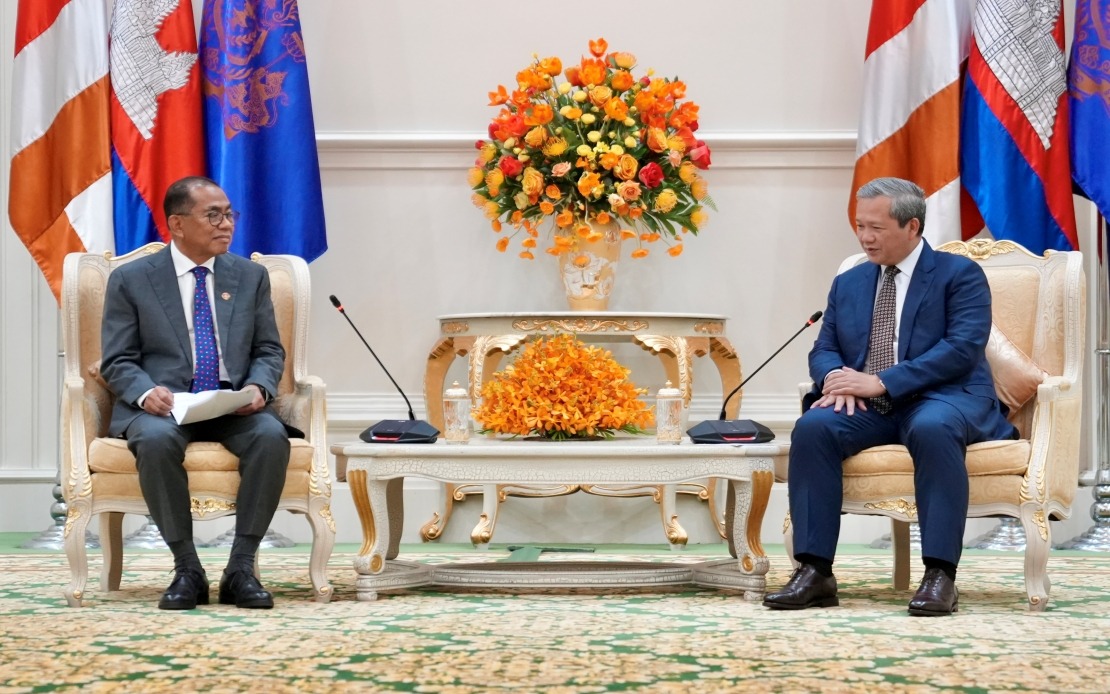
Malaysia and Cambodia are moving closer together on defence matters, with both nations signalling their intention to broaden security cooperation across multiple domains. During a recent visit to Phnom Penh, Malaysia's Defence Minister Datuk Seri Mohamed Khaled Nordin held talks with Cambodian Prime Minister Samdech Thipadei Hun Manet and Defence Minister General Tea Seiha, where discussions centred on deepening bilateral ties while strengthening ASEAN's collective security posture amid an increasingly complex regional environment.
At the core of these discussions lies a long-awaited bilateral agreement. The Malaysia-Cambodia Defence Cooperation Memorandum of Understanding, now in its final stages of negotiation, is expected to serve as a comprehensive framework for future military coordination. Mohamed Khaled expressed confidence that the document would be signed during the upcoming ASEAN Defence Ministers' Meeting in the Philippines, marking a significant milestone in the two countries' relationship. The completion of this MoU will formalise arrangements for cooperation that have been developing informally for some time.
Both countries have identified specific areas where defence partnership can expand meaningfully. Jungle warfare training ranks among the new cooperation avenues, reflecting the shared geographical and strategic interests of nations with extensive forested terrain and comparable security challenges. Beyond traditional military domains, Malaysia and Cambodia are exploring collaboration in defence industrial capacity, a sector that remains underdeveloped across much of Southeast Asia. The inclusion of artificial intelligence and drone technology underscores how both nations recognise the importance of modernising their defence capabilities in line with contemporary security threats.
Regional stability concerns featured prominently in the bilateral discussions. Malaysia reiterated its backing for the ASEAN Observer Team mechanism, a critical confidence-building measure that helps manage potential flashpoints across the region. Particularly relevant to Cambodia is the situation along its border with Thailand, where tensions have periodically flared. Mohamed Khaled expressed Malaysia's hope that the ceasefire arrangement between those two neighbours would hold, reflecting Kuala Lumpur's broader interest in preventing conflict escalation that could destabilise the entire region.
The two countries also aligned their positions on the South China Sea Code of Conduct, a protracted negotiation process among ASEAN members and China aimed at establishing mutually agreed rules governing behaviour in contested waters. Malaysia and Cambodia both view finalising this instrument as essential for maintaining the rules-based international order that underpins maritime commerce and security across Southeast Asia. Given the significant economic interests at stake and the risk of accidental escalation, progress toward a binding code remains a priority for Malaysian policymakers.
Malaysia's continued commitment to regional security cooperation extends beyond Cambodia, as evidenced by Defence Minister Mohamed Khaled's concurrent working visit to Vietnam. He held bilateral discussions with Vietnam's Defence Minister General Phan Van Giang and paid a courtesy call on Prime Minister Le Minh Hung, demonstrating a systematic approach to reinforcing Malaysia's defence partnerships across key ASEAN members. These sequential visits underscore how Kuala Lumpur views regional stability as a shared responsibility requiring sustained diplomatic and military engagement.
The broader strategic context for these developments is Malaysia's Defence White Paper, which provides the overarching framework guiding the country's security strategy. According to the Defence Ministry, Mohamed Khaled's regional tour represents implementation of the Third Pillar of the National Defence Strategy, identified as Credible Partnerships. This pillar recognises that Malaysia's security cannot be achieved in isolation but requires robust relationships with neighbouring states and demonstrated commitment to collective regional mechanisms. By engaging Cambodia, Vietnam, and other ASEAN partners, Malaysia seeks to build a network of defence relationships that strengthen mutual deterrence against potential threats.
The timing of these engagements carries additional significance given Malaysia's recent conclusion of its ASEAN Chairmanship. Although no longer holding the rotating chair, Mohamed Khaled stressed that Malaysia's commitment to supporting peace and stability remains unchanged. This messaging is important for regional partners who might otherwise assume a change in Malaysia's strategic priorities following the transition of chairmanship responsibilities. It signals continuity and steadfast dedication to ASEAN's foundational principle of non-interference while promoting dialogue and consensus-building on security matters.
Looking ahead, Mohamed Khaled identified 2027 as a milestone year for Malaysia-Cambodia relations, marking the 70th anniversary of their diplomatic ties. The strengthening of defence cooperation provides an opportunity to renew and deepen a relationship rooted in shared ASEAN membership and geographical proximity. Such long-term relationship building is characteristic of Southeast Asian diplomacy, where historical consciousness and ceremonial markers often accompany practical security cooperation.
The Malaysian delegation undertaking these visits includes senior military and civilian defence officials, reflecting the seriousness with which Kuala Lumpur approaches regional engagement. Chief of the Royal Malaysian Navy Admiral Tan Sri Zulhelmy Ithnain and Deputy Secretary-General of the Defence Ministry Datuk Mohd Yani Daud accompanied Mohamed Khaled, ensuring that discussions at the highest political level are supported by expert military and administrative input. This composition signals that conversations extend beyond symbolic gestures to encompass detailed defence planning and operational matters.
For Malaysia, engagement with Cambodia and other ASEAN members serves multiple purposes simultaneously. At the immediate level, it addresses shared security challenges ranging from transnational crime to maritime domain awareness. At the institutional level, it strengthens ASEAN as a meaningful security forum capable of addressing regional problems through consensus. At the strategic level, it helps shape a regional environment favouring stability and predictability over great power competition. By visibly committing to these partnerships, Malaysia positions itself as a responsible stakeholder invested in Southeast Asian peace.

