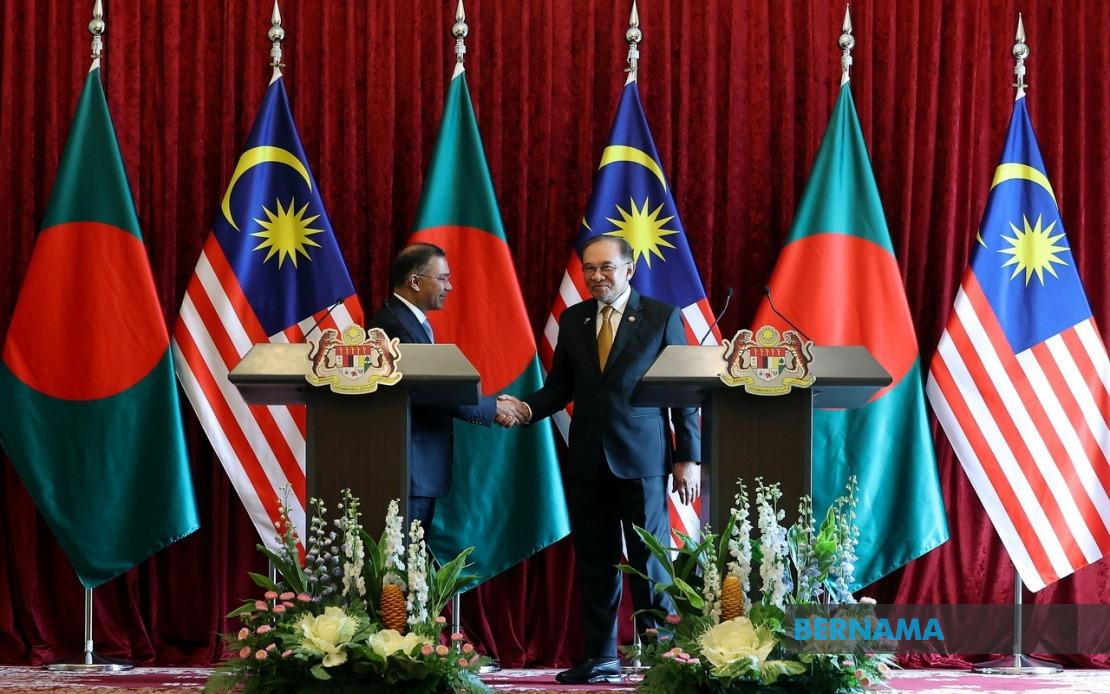
Malaysia and Bangladesh have signalled their intention to substantially deepen defence collaboration by moving beyond established protocols toward comprehensive strategic partnership. During Bangladesh Prime Minister Tarique Rahman's official visit to Putrajaya on June 22, both nations committed to fully operationalising the Memorandum of Understanding on Defence Cooperation, marking a significant escalation in what has historically been described as an excellent bilateral relationship anchored in military science and technical knowledge exchange.
The bilateral defence relationship, while longstanding, has largely operated through episodic engagement channels—regular high-level military visits, personnel training assignments, and goodwill naval port calls have provided the traditional infrastructure for cooperation. The new commitment reflects recognition that a more systematic institutional approach is required to address the evolving security environment facing both nations and their region. By activating dormant or underutilised provisions within existing agreements, Malaysia and Bangladesh aim to create sustained momentum rather than relying on periodic diplomatic gestures.
Central to this enhanced framework is the forthcoming convening of the Joint Committee on Defence Cooperation, which both leaders identified as essential for charting a structured defence roadmap. This institutional mechanism is designed to move cooperation beyond ad-hoc initiatives into planned, measurable programming that can accommodate shifting defence priorities and capabilities. The JCDC will serve as the coordinating body for translating broad commitments into concrete operational outcomes, allowing both nations to synchronise defence modernisation timelines and capacity-building agendas.
A cornerstone of the expanded arrangement involves systematic capacity development through advanced military education and professional development. Both countries have agreed to enhance defence capability by offering mutual seat allocations at their respective National Defence Colleges and Command and Staff Colleges. This educational exchange is particularly significant for Southeast Asia, where officer development shapes institutional culture and strategic thinking for decades. Malaysian military personnel will gain exposure to Bangladesh's operational experience in South Asian geopolitics, while Bangladeshi officers will benefit from Malaysia's experience navigating maritime security challenges and managing diverse religious and ethnic communities within a military structure.
Peacekeeping operations form another substantive pillar of the partnership. Both nations reaffirmed commitment to supporting United Nations peacekeeping missions through joint tactical exercises, pre-deployment training collaboration, and systematic expertise exchange. This reflects Bangladesh's significant contribution to global peacekeeping efforts—the nation consistently ranks among the world's largest peacekeeping troop contributors—and provides Malaysia with opportunities to benefit from this accumulated operational knowledge while contributing Malaysian capabilities to joint preparation initiatives. The emphasis on addressing "an increasingly complex global security environment" signals both governments' recognition that contemporary conflicts demand interoperable forces prepared for hybrid threats and multifaceted challenges.
Counterterrorism and countering violent extremism represent critical shared security priorities in the Indo-Pacific region. Malaysia and Bangladesh committed to strengthening cooperation through intelligence sharing, information exchange, capacity-building initiatives, specialised training programmes, and exchange of best practices. For Malaysia, this partnership carries particular relevance given its experience with maritime terrorism and transnational extremist networks operating across Southeast Asia. Bangladesh's frontline experience managing security challenges in the Bay of Bengal and its land borders offers complementary perspectives. The emphasis on intelligence sharing and information exchange indicates both governments recognise that terrorism prevention increasingly requires real-time coordination and shared situational awareness across borders.
Beyond purely military dimensions, the defence relationship encompasses broader educational and research cooperation. Both nations agreed to strengthen academic partnerships, including university-to-university collaborations and joint research programmes emphasising technical and vocational education. This multidimensional approach acknowledges that modern defence challenges—from cybersecurity to logistics—require grounding in civilian technical expertise and research capacity. The alignment of academic programming with labour market requirements suggests both governments are thinking strategically about how defence sector employment integrates with broader economic development.
The presence of approximately 11,000 Bangladeshi students in Malaysia forms an underappreciated foundation for sustained bilateral cooperation. These students represent not merely educational exchange but potential future leaders, technicians, and professionals who will carry personal connections and institutional knowledge back to Bangladesh. Both governments recognised this human dimension explicitly, acknowledging the positive contribution these students make to academic exchange and socio-economic linkages. The emphasis on graduate mobility and skills development indicates both nations see educational cooperation as extending beyond knowledge transfer to workforce development that serves national capacity-building objectives.
Tourism cooperation features prominently in the bilateral agenda, particularly in conjunction with Malaysia's "Visit Malaysia 2026" and "Malaysia Year of Medical Tourism 2026" campaigns. While potentially appearing tangential to defence considerations, tourism promotion between neighbouring nations builds public familiarity, facilitates people-to-people connections, and generates economic interdependence that underpins political stability. Malaysia's explicit welcome to Bangladeshi travellers and commitment to enhanced tourism promotion and cultural exchanges create the civilian-level relationships that complement official defence partnerships.
For Southeast Asia more broadly, the Malaysia-Bangladesh defence deepening reflects broader regional trends toward institutionalising bilateral partnerships and moving away from episodic diplomacy. The emphasis on structured frameworks, mutual capacity development, and systematic knowledge exchange demonstrates how mid-sized nations approach security cooperation in an era of multipolar competition. The partnership also highlights how nations with different strategic locations—Malaysia's position in the Strait of Malacca versus Bangladesh's presence in the Bay of Bengal—can develop complementary security arrangements addressing shared regional challenges.
The commitment to operationalising the defence MoU occurs within a context of evolving Indo-Pacific geopolitics where regional nations increasingly seek to strengthen institutional relationships independent of great power alignments. Neither Malaysia nor Bangladesh appears oriented toward exclusive security partnerships, instead positioning their cooperation as contribution to regional stability and mutual capacity enhancement. This approach allows both nations to maintain strategic flexibility while deepening practical cooperation in domains where interests clearly converge—peacekeeping, counterterrorism, professional military development, and maritime awareness.
Looking forward, the success of this enhanced framework will depend on sustained political commitment and effective bureaucratic coordination. The JCDC will need adequate resources and clear mandates to translate high-level commitments into implemented programmes. Personnel rotations, training seat allocations, and joint exercises require sustained planning and budgetary support. Whether both governments maintain momentum beyond the current bilateral visit will determine whether this represents genuine institutional deepening or primarily a diplomatic achievement marking the occasion of Prime Minister Rahman's visit.

