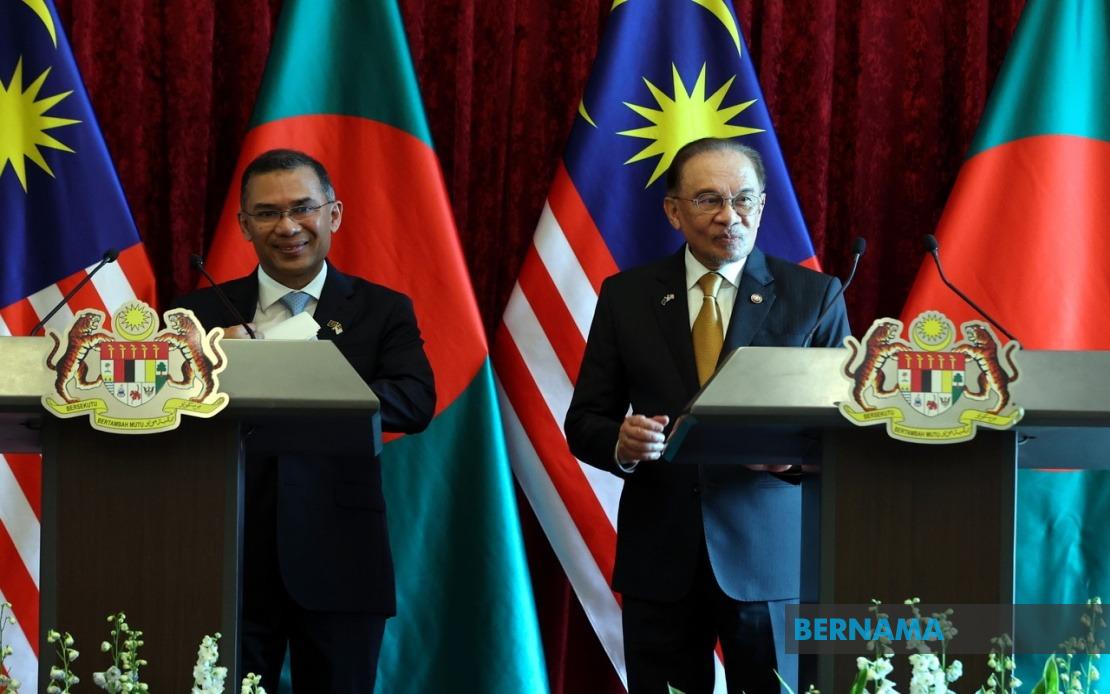
Prime Minister Datuk Seri Anwar Ibrahim has underscored the strategic convergence between Malaysia and Bangladesh on several critical international matters, emphasizing their mutual commitment to the Palestinian cause and regional stability across the Middle East. During a joint press conference in Putrajaya on Monday, Anwar highlighted the depth of agreement between the two nations on Palestine, Gaza, the Gulf region, and Iran—positions that both governments intend to champion through continued diplomatic engagement with the international community.
The Malaysian premier's remarks came as Bangladesh Prime Minister Tarique Rahman concluded the opening day of an official state visit, marking her first international trip since taking office in February this year. The timing of Rahman's visit to Malaysia carries particular significance, as it demonstrates the priority both nations place on their bilateral relationship and signals a strengthening of ties between two major Muslim-majority democracies in Asia. By selecting Malaysia as her inaugural foreign destination, Rahman has sent a clear message about the importance of cooperation with Kuala Lumpur on matters of regional and global consequence.
Anwar elaborated that both countries share deep concern for the humanitarian situation in Gaza and hold firm positions regarding what Malaysia characterises as atrocities committed by the Israeli regime. This alignment reflects a broader consensus among Southeast Asian and South Asian nations that have traditionally supported Palestinian self-determination and viewed the Israeli-Palestinian conflict through a lens sympathetic to Palestinian aspirations. The convergence of positions between Malaysia and Bangladesh on this issue underscores how regional powers continue to coordinate their stances in international forums, potentially amplifying their collective voice on matters affecting the Middle East.
Beyond Palestine, the two prime ministers affirmed their shared interest in maintaining stability across the Gulf region, an area of strategic importance to both nations. Malaysia, as a maritime trading nation heavily dependent on secure passage through the Gulf and its vicinity, has long maintained careful diplomatic balances in the region. Bangladesh, with significant expatriate populations working in Gulf countries and considerable economic ties to the region, shares similar interests in preserving peace and predictability. Their alignment on Iran, another critical regional actor, suggests both governments favour pragmatic engagement with Tehran rather than confrontational approaches.
The joint press conference served as a platform for Anwar to welcome Rahman warmly, describing the relationship between Malaysia and Bangladesh in familial terms. His characterisation of Rahman as part of an "enlarged family" reflected the cultural and historical bonds that link the two nations, rooted in shared Islamic heritage, democratic traditions, and economic interdependence. Such language, common in Southeast and South Asian diplomacy, seeks to elevate bilateral relations beyond transactional arrangements to a deeper level of mutual understanding and solidarity.
Anwar expressed gratitude for Rahman's willingness to undertake the journey to Malaysia, acknowledging her administration's constructive approach to regional cooperation. He pledged Malaysia's commitment to strengthening what he termed "family bonds and brotherly relations" between the two countries, signalling an intent to deepen engagement across multiple sectors. This rhetoric, while diplomatic in nature, suggests both governments see value in closer coordination on foreign policy matters and potentially in expanding economic and cultural exchanges.
The visit itself represents a continuation of high-level political dialogue between Malaysia and Bangladesh, a pattern that has characterised their relationship in recent years. Regular visits by senior leadership help maintain momentum in bilateral affairs and provide opportunities to address emerging issues of mutual concern. For Rahman, the visit also serves a domestic political purpose, demonstrating her government's ability to engage constructively with regional partners and maintain Bangladesh's standing as a respected voice in Asian affairs.
The emphasis on shared positions on global issues reflects a broader pattern among developing nations seeking to coordinate their responses to international challenges. Malaysia and Bangladesh, both active participants in multilateral forums including the United Nations, ASEAN, and the Organisation of Islamic Cooperation, frequently find themselves advocating for similar causes and perspectives. Their public alignment on Palestine, the Gulf, and Iran signals that this coordination extends to some of the most contentious geopolitical issues facing the international community.
For Malaysian readers and policymakers, the visit underscores the importance of maintaining strong relationships with other significant regional actors. Bangladesh, with a population exceeding 170 million, represents a substantial market and diplomatic partner for Malaysia. The convergence on foreign policy matters provides a foundation for deeper collaboration in trade, education, defence cooperation, and cultural exchange. Furthermore, alignment on Middle Eastern issues carries implications for Malaysia's role in representing Southeast Asian and Muslim perspectives in international discourse.
The timing of Rahman's visit also reflects the evolving geopolitical landscape in Asia, where nations are increasingly seeking to build coalitions around shared values and interests rather than rigid bloc alignments. By publicly reaffirming their positions on Palestine and regional stability, Malaysia and Bangladesh are staking out positions that resonate with broader constituencies within the Muslim world and the Global South, while maintaining their own independent foreign policy trajectories.

