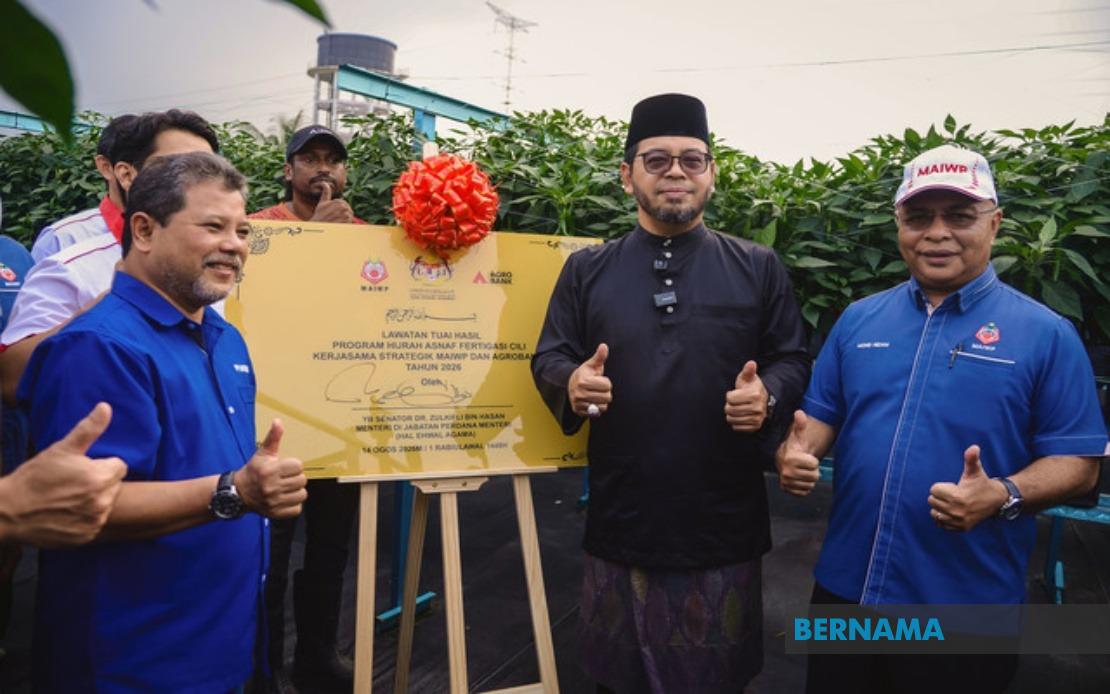
Malaysia's Islamic Development Department (MAIWP) is scaling up its chilli fertigation project for asnaf participants after demonstrating impressive financial and social returns in its initial phase. The expansion to five acres represents growing confidence in the model as a sustainable poverty-alleviation and skills-transfer programme, with the first harvest alone producing 16.7 tonnes of chillies and generating revenue exceeding RM207,000 for participating farmers.
The success reflects a strategic pivot within MAIWP's welfare approach, moving beyond traditional cash assistance towards equipping economically disadvantaged participants with marketable agricultural skills. Minister in the Prime Minister's Department (Religious Affairs) Dr Zulkifli Hasan emphasised this philosophy, noting that the chilli project exemplifies how structured skills training can unlock self-sufficiency among zakat recipients. The expansion decision underscores MAIWP's confidence that the model can be replicated and sustained across multiple locations and participant cohorts.
Central to the project's appeal is the fertigation technology employed—an efficient irrigation and fertilisation system that optimises water and nutrient delivery to chilli plants. This approach reduces input costs while maximising yields, making it particularly attractive for smallholder farmers operating on limited budgets. The system also lowers labour intensity compared to conventional farming methods, an important advantage for participants juggling multiple economic pressures or family responsibilities.
Beyond primary crop production, MAIWP recognises that downstream value-addition creates additional income pathways for participants. The initiative actively encourages beneficiaries to process fresh chillies into sauces, dried products, pastes, and other branded offerings that command premium retail prices. This diversification strategy acknowledges market volatility in fresh produce while positioning participants to capture higher margins through processing and direct-to-consumer sales channels.
Participant Alinda Rosely, 49, exemplifies the programme's transformative potential for vulnerable demographics. As a single mother, she had limited avenues to rebuild financial stability until joining the initiative. Her testimony reveals the dual benefit structure: she acquired genuinely valuable technical knowledge about fertigation systems while simultaneously generating income—earning RM40,000 within six months during a favourable chilli price period. Her success narrative is particularly significant for marketing purposes and for encouraging other single mothers to participate.
The programme's alignment with MAIWP's broader institutional mission to foster self-reliance and competitiveness among asnaf communities suggests this represents more than a one-off initiative. Rather, it reflects deliberate repositioning of zakat distribution away from consumptive welfare towards productive social investment. This philosophical shift echoes approaches in other Muslim-majority nations where religious endowments increasingly fund skills training and microenterprise development.
The financial scale of MAIWP's overall zakat operations provides context for understanding the chilli project's significance. As of mid-August 2026, the department had distributed RM699.57 million in zakat through 38 distinct welfare assistance schemes, demonstrating substantial institutional capacity. The chilli initiative, while initially modest in geographic scope, represents a testing ground for agricultural development models that might eventually absorb larger allocations of zakat funds if expansion continues to deliver measurable poverty reduction outcomes.
From a Malaysian development perspective, this initiative addresses structural challenges within rural and semi-rural asnaf communities. Many participants lack collateral and credit history to access commercial financing for farm inputs or equipment. MAIWP's direct provision of training, land, and technical support effectively circumvents banking sector barriers while building household productive capacity. The model also creates potential for forward linkages with food processing industries and commercial agricultural suppliers.
The chilli market itself offers interesting dynamics for Malaysian asnaf farmers. Domestic demand remains robust due to chillies' centrality in Malaysian cuisine, while regional export opportunities exist for processed chilli products to Singapore, Brunei, and increasingly to Middle Eastern markets with large diaspora populations seeking familiar ingredients. Price volatility, however, remains a risk—as Alinda's comments imply—making crop diversification and value-addition critical success factors for long-term sustainability.
The expansion to five acres signals MAIWP's intention to deepen the programme's impact beyond awareness-raising towards establishing a replicable operational model. Scaling requires addressing practical challenges including ensuring consistent access to water supplies, securing appropriate land leases with long-term certainty, establishing reliable markets for output, and maintaining technical support networks for participating farmers. Success in managing these complexities will largely determine whether five acres becomes ten, and whether chillies become a template for other high-value crop initiatives.
For Malaysian policymakers monitoring poverty-alleviation effectiveness, the chilli project offers encouraging preliminary evidence that skills-based agricultural interventions can deliver measurable economic uplift for zakat recipients. The strong first-year financial performance—combined with documented participant empowerment narratives—suggests sufficient promise to justify continued institutional investment and potentially expanded funding allocations. However, longer-term monitoring of retained earnings, crop stability across seasons, and market sustainability will be essential for assessing whether initial success translates into durable poverty reduction.

