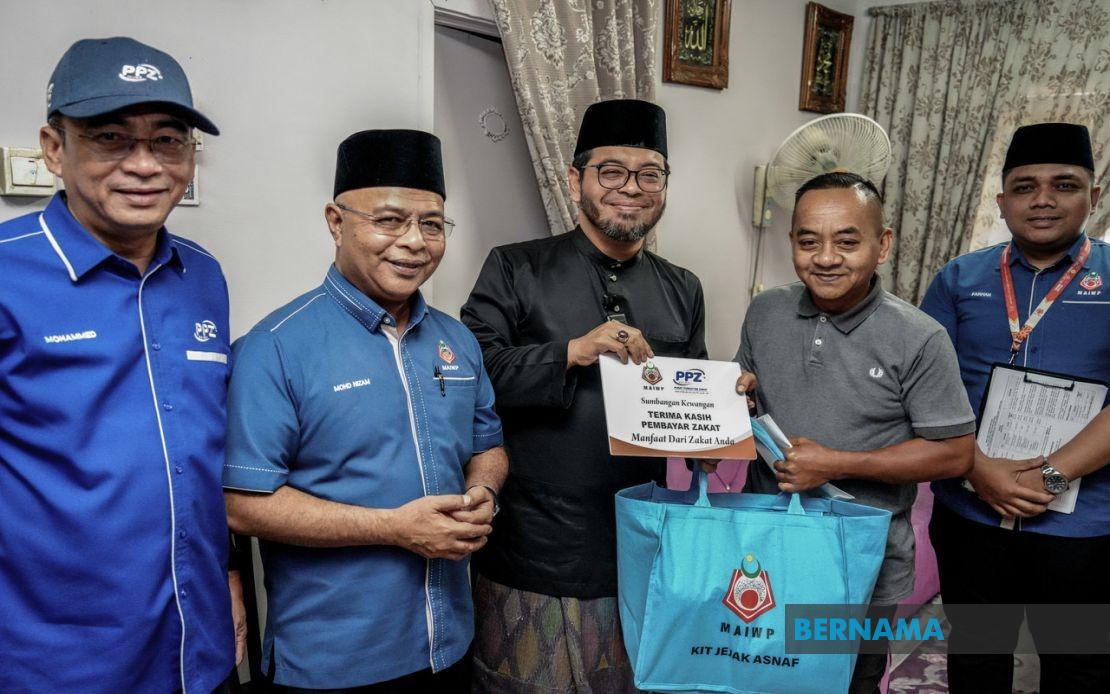
The Federal Territories Islamic Religious Council (MAIWP) has committed comprehensive financial support to a widow now solely responsible for raising five children aged between six and 15, following her husband's death in early August. The assistance package addresses immediate household needs including monthly living expenses, rental costs and educational fees, reflecting a broader institutional focus on targeted welfare for vulnerable families in Kuala Lumpur and its surrounding federal territories.
Minister in the Prime Minister's Department (Religious Affairs) Senator Datuk Dr Zulkifli Hasan underscored the importance of ground-level engagement when administering aid programmes, noting that direct interaction with beneficiary families enables MAIWP to comprehend their genuine circumstances and calibrate support accordingly. His remarks came following site visits to multiple households receiving council assistance, highlighting an administrative philosophy that prioritises understanding over standardised handouts.
The widow's case exemplifies the type of crisis intervention MAIWP increasingly handles. She had previously benefited from the council's General Schooling Aid scheme, but her family's changed circumstances—the loss of a primary income earner—necessitated expansion of that initial support. The new package directly targets the family's most pressing vulnerabilities: maintaining household stability through rental assistance, sustaining nutritional and daily needs through living expense support, and preserving educational continuity despite economic disruption.
Beyond the widow's situation, Zulkifli's visit encompassed other households navigating economic hardship. A second family, comprising a married couple with eight school-attending children, receives ongoing medical assistance covering nappies and diabetic supplies alongside mobility equipment and schooling support. The father's employment as a Kuala Lumpur City Hall driver places the household in Malaysia's lower-middle income bracket, a demographic segment increasingly vulnerable to unexpected expenses that can trigger financial crisis.
A third household visited featured a divorced single mother who has independently raised three children since 2018. She receives monthly cost-of-living assistance alongside basic necessities provision and educational support. These cases reflect a significant demographic shift within Malaysian society: an expanding cohort of households headed by women managing multiple dependents on constrained incomes, a pattern replicated across Southeast Asia as economic pressures reshape family structures.
MAIWP's multi-faceted approach extends beyond cash transfers. The council implements complementary programmes addressing specific vulnerabilities—medical assistance programmes, educational support schemes, and basic necessities provision—that collectively create a safety net more nuanced than simple financial relief. This layered intervention model recognises that poverty rarely stems from a single cause, requiring instead orchestrated responses targeting education, health, housing and daily sustenance simultaneously.
The council's asset position underscores institutional capacity for such interventions. As of 12 August 2026, MAIWP had distributed RM699.57 million in aggregate assistance, a substantial sum reflecting accumulated disbursements across multiple assistance schemes and beneficiary categories. This resource base enables the council to respond to emerging crises like the widow's situation whilst maintaining ongoing support for established beneficiaries.
For Malaysian policymakers and observers tracking social safety net effectiveness, MAIWP's operations offer instructive lessons. The council's emphasis on personalised assessment rather than rigid programme parameters allows responsive targeting of limited resources. The practice of ministerial site visits—beyond symbolic gesture—generates institutional knowledge about beneficiary circumstances that informs programme design and identifies emerging vulnerability patterns before they crystallise into broader social challenges.
The widow's case also reflects evolving mortality patterns within Malaysia. Early death amongst working-age males, whether from disease, accident or other causes, remains a significant source of household economic collapse, particularly within lower-income segments lacking substantial savings, insurance coverage or extended family support networks. Government and quasi-government agencies like MAIWP function as critical interventions preventing such deaths from triggering multigenerational poverty.
Regional context enriches understanding of Malaysia's welfare landscape. Across Southeast Asia, Islamic religious councils have assumed expanding social welfare roles, compensating for limited government safety net provisions in countries like Malaysia where demographic pressures and economic volatility outpace institutional capacity. MAIWP's operations represent an adaptation to this reality, leveraging religious institutional infrastructure for secular social welfare outcomes.
The assistance provided to these three families signals institutional priority toward preserving household stability and educational continuity during economic disruption. Educational interruption represents a particularly pernicious consequence of family-level economic crisis, as children withdrawn from school face diminished lifetime earnings prospects and reduced social mobility. By explicitly supporting schooling alongside living expenses, MAIWP invests in long-term human capital development rather than merely addressing immediate want.
Minister Zulkifli's framing of these interventions—"Insya-Allah, these are among the measures we are implementing to assist the community and the people as effectively as possible"—reflects institutional acknowledgment that welfare support requires continuous adaptation. Widow-headed households, divorced mothers, families with disabled members or chronic health conditions represent distinct vulnerability categories demanding differentiated responses. MAIWP's willingness to customise assistance suggests recognition that cookie-cutter welfare programmes inadequately address Malaysia's complex social reality.

