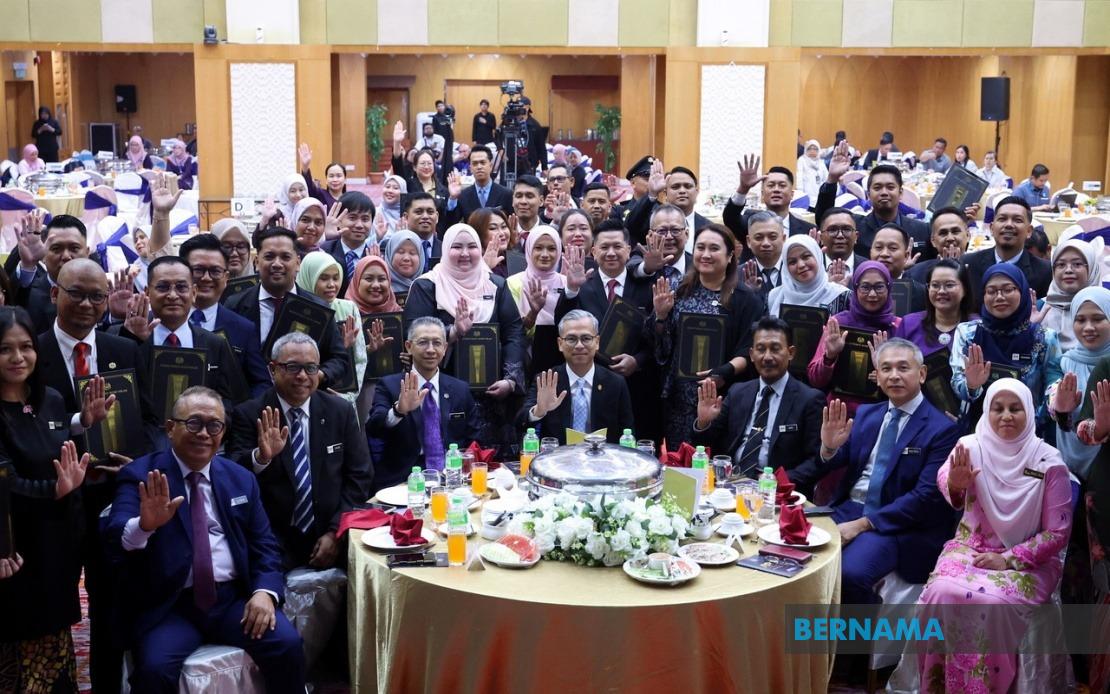
The MADANI Government remains dedicated to building what officials describe as the 'people's economy'—a framework designed to ensure that gains from the nation's economic performance reach all segments of society, Communications Minister Datuk Seri Fahmi Fadzil said during an event in Kota Kinabalu on Friday. Speaking at the Communications Ministry's Sabah and Labuan Zone Excellent Service Awards ceremony, Fahmi highlighted the government's determination to convert broader macroeconomic achievements into concrete improvements in citizens' living standards.
While Malaysia's economic indicators demonstrate positive momentum across investment, government revenue, foreign reserves, gross domestic product and trade figures, Fahmi stressed that these headline numbers alone do not define policy success. The true test, he argued, lies in measuring how substantially and visibly these gains manifest in the everyday experiences of working families, pensioners, small business operators and rural communities. This perspective represents a deliberate shift from purely technical economic reporting towards outcomes-based governance that places lived experience at the centre of evaluation.
Fahmi illustrated this principle through Malaysia's ongoing diesel subsidy retargeting programme, known as BUDI MADANI, which aims to direct financial support more efficiently while maintaining affordability for vulnerable groups. He noted that implementation of such policies requires careful calibration because geographic and demographic realities vary significantly across the country. In Sabah and Sarawak particularly, considerable distances between districts mean that transportation costs and fuel expenses represent a substantially larger proportion of household budgets than in more densely populated peninsular areas. These regional variations demand that national policies be adapted intelligently rather than applied uniformly without regard for local circumstances.
The minister indicated that Prime Minister Datuk Seri Anwar Ibrahim and his Cabinet recognise the political and social significance of ensuring that flagship economic policies produce measurable benefit for families struggling with cost-of-living pressures. The emphasis on subsidy retargeting reflects a philosophy that government support should reach those who need it most, rather than dispersing resources across the population regardless of actual need. This targeted approach aims to maximize the effectiveness of public expenditure whilst sending clear signals to citizens that leadership understands their financial challenges.
Fahmi underscored that national economic excellence carries little legitimacy among voters unless tangible improvements become visible in household bank accounts and purchasing power. Citizens must be able to identify concrete ways in which their government's economic stewardship has improved their circumstances—whether through lower fuel prices, more affordable food, better wages or improved access to essential services. Without this connection between macroeconomic performance and individual welfare, even strong GDP growth risks generating public cynicism about government competence and intentions.
The minister also addressed the government's broader responsibility to communicate policies clearly and comprehensively to prevent public misunderstanding or distrust. Ministries and agencies must ensure that complex policy decisions—particularly those involving subsidies, pricing, or benefit distribution—are explained in accessible language that helps citizens understand the reasoning and expected impacts. Poor communication about subsidy retargeting, for instance, can generate confusion that undermines public acceptance of necessary reforms, even when those reforms ultimately benefit intended recipients.
Fahmi's remarks reflect growing recognition within the MADANI administration that economic governance extends beyond traditional finance ministry functions to encompass communications, implementation integrity and sensitivity to diverse regional conditions. The presence of multiple ministry officials at the Sabah and Labuan awards ceremony underscored the government's intention to coordinate across agencies to ensure that excellence in service delivery reaches all communities. The awards programme itself represents an effort to reinforce public sector professionalism and recognise officials who consistently deliver quality services to citizens.
The focus on people's economy aligns with the government's broader MADANI framework, which emphasises inclusivity, sustainability and equitable development. For Sabah and Sarawak particularly, this approach addresses long-standing concerns about resource distribution and ensuring that East Malaysian communities receive proportionate investment and policy attention. Geographic challenges mean that economic growth in peninsular Malaysia does not automatically translate into improved conditions across Borneo unless policies are deliberately calibrated to account for distance, infrastructure limitations and demographic differences.
Fahmi's emphasis on translating economic indicators into household welfare carries particular resonance in the Malaysian context, where inflation and cost-of-living pressures have generated significant public anxiety despite generally positive macroeconomic conditions. Middle-income households report ongoing strain from rising housing costs, education expenses and healthcare fees, suggesting that headline growth figures may not reflect actual improvements in real living standards for many Malaysians. The government's pivot toward explicitly measuring policy impact through the lens of household experience represents an acknowledgment of this disconnect between official economic statistics and public sentiment.
Looking forward, the minister's statements signal that government agencies will be evaluated increasingly on their ability to deliver tangible benefits to citizens rather than merely maintaining efficient operations or achieving administrative targets. This outcome-focused approach demands that ministries think strategically about how their policies and programmes affect people's daily decisions, finances and opportunities. For communications and information agencies particularly, the responsibility extends to ensuring accurate public understanding of government initiatives, recognising that confusion or misinformation can undermine even well-designed policies.

