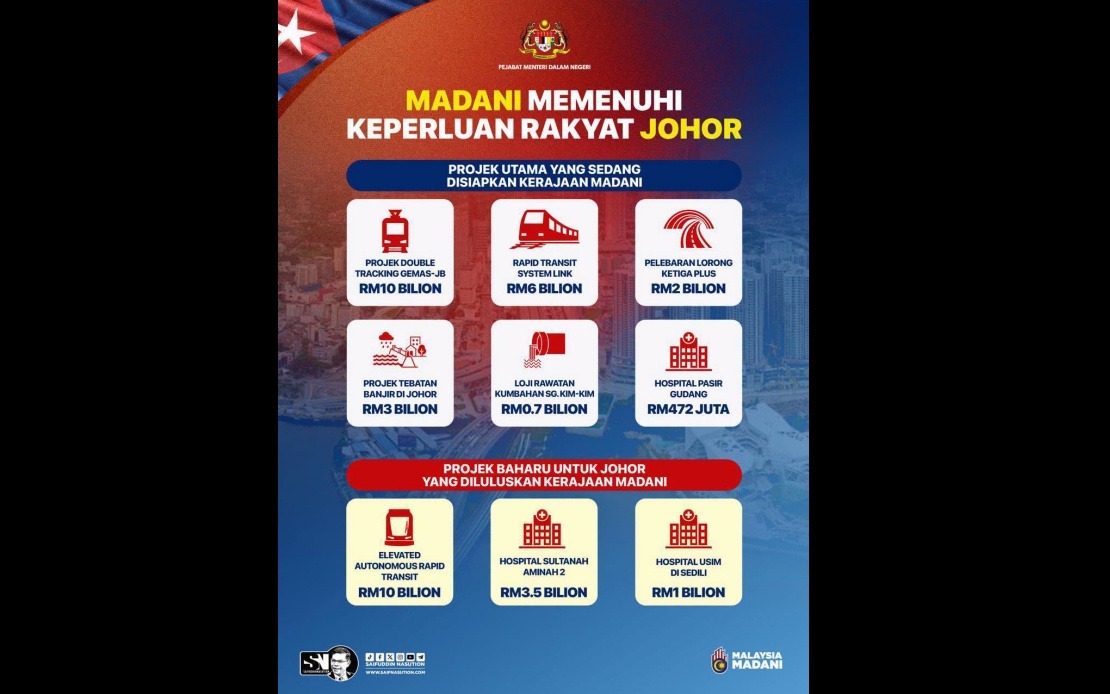
The MADANI administration has renewed its pledge to advance sustainable and inclusive development across all Malaysian states, with Johor emerging as a focal point for demonstrating this commitment through a substantial portfolio of transformative projects. Pakatan Harapan secretary-general Datuk Seri Saifuddin Nasution Ismail made the declaration while emphasising that under Prime Minister Datuk Seri Anwar Ibrahim's stewardship, the government has established infrastructure development, public transportation networks, healthcare accessibility, and climate resilience through flood mitigation as core pillars underpinning quality-of-life improvements for ordinary Malaysians.
The Home Minister underscored that Johor has moved onto a trajectory of accelerated expansion through a carefully coordinated implementation of projects with substantial regional impact. This narrative frames development not merely as a numerical exercise of expenditure allocation, but as tangible improvements citizens experience in their daily lives—encompassing employment generation, commuting efficiency, medical service quality, and broader societal wellbeing. Such framing addresses a critical perception challenge facing the administration: translating large capital outlays into concrete benefits that reach ordinary households.
Across Johor's development landscape, several flagship initiatives are advancing simultaneously. The Gemas-Johor Bahru Electrified Double Tracking Project represents a significant railway modernisation effort intended to enhance passenger and freight capacity along a strategically important corridor. The Rapid Transit System (RTS) Link addresses urban mobility challenges in the densely populated Iskandar Malaysia region and surrounding areas, while the third lane widening of the PLUS Highway targets congestion relief on one of Southeast Asia's busiest north-south commercial arteries.
Environmental resilience forms another dimension of the development strategy. The Johor flood mitigation project and Sungai Kim Kim Sewage Treatment Plant directly address infrastructure deficiencies that have plagued the state, particularly the industrial heartland of Pasir Gudang, which experienced severe water contamination crises in recent years. These investments signal recognition that sustainable development must encompass environmental protection and pollution management alongside economic expansion.
Healthcare infrastructure represents the third major thrust. Pasir Gudang Hospital expansion complements newer facilities including Sultanah Aminah Hospital 2 and USIM Hospital in Sedili, collectively addressing healthcare accessibility in a state where population growth has strained existing medical capacity. The hospital projects carry particular significance for a state serving as both an industrial centre and increasingly a residential destination for workers from across the region and Singapore.
The recently approved Elevated Autonomous Rapid Transit (E-ART) system exemplifies the government's willingness to invest in emerging transport technologies. This elevated autonomous transit concept, if successfully implemented, could position Johor as a testing ground for innovative urban mobility solutions and potentially establish a blueprint for other Malaysian metropolitan areas grappling with congestion and environmental concerns stemming from automobile dependency.
For Southeast Asian observers, Johor's development trajectory carries particular relevance given the state's geographic positioning as a gateway between Malaysia and Singapore, its role as an industrial and petrochemical hub, and its emerging status as a residential and investment destination. The scale and diversity of projects under implementation reflect sophisticated planning that acknowledges Johor's multifaceted economic and social role within both the Malaysian federation and the broader regional ecosystem.
The government's emphasis on measuring development success through citizen welfare outcomes rather than purely financial metrics addresses legitimate criticism that infrastructure spending occasionally generates white-elephant projects disconnected from genuine public needs. By explicitly linking projects to employment creation, transportation efficiency, healthcare access, and living standards, the administration frames development as people-centred rather than statistic-driven—a distinction that carries weight with voters evaluating government performance.
Yet translating announced commitments into completed, functional infrastructure remains a persistent challenge across Malaysia. Project execution timelines, cost overruns, and operational efficiency of newly completed facilities will ultimately determine whether the MADANI government's development narrative gains traction among Johor residents. The credibility of future development pronouncements hinges substantially on whether projects currently listed in various planning stages and under construction deliver the promised benefits within reasonable timeframes and budgetary parameters.
For policymakers across Southeast Asia monitoring Malaysia's development approach, the MADANI strategy demonstrates an attempt to balance multiple competing priorities—economic growth, environmental sustainability, healthcare provision, and transport modernisation—within a single state framework. Whether this integrated approach succeeds in improving measurable indicators of quality of life, reducing regional disparities, and maintaining fiscal sustainability will offer valuable lessons for neighbouring governments pursuing similar development objectives in increasingly urbanised and economically complex contexts.

