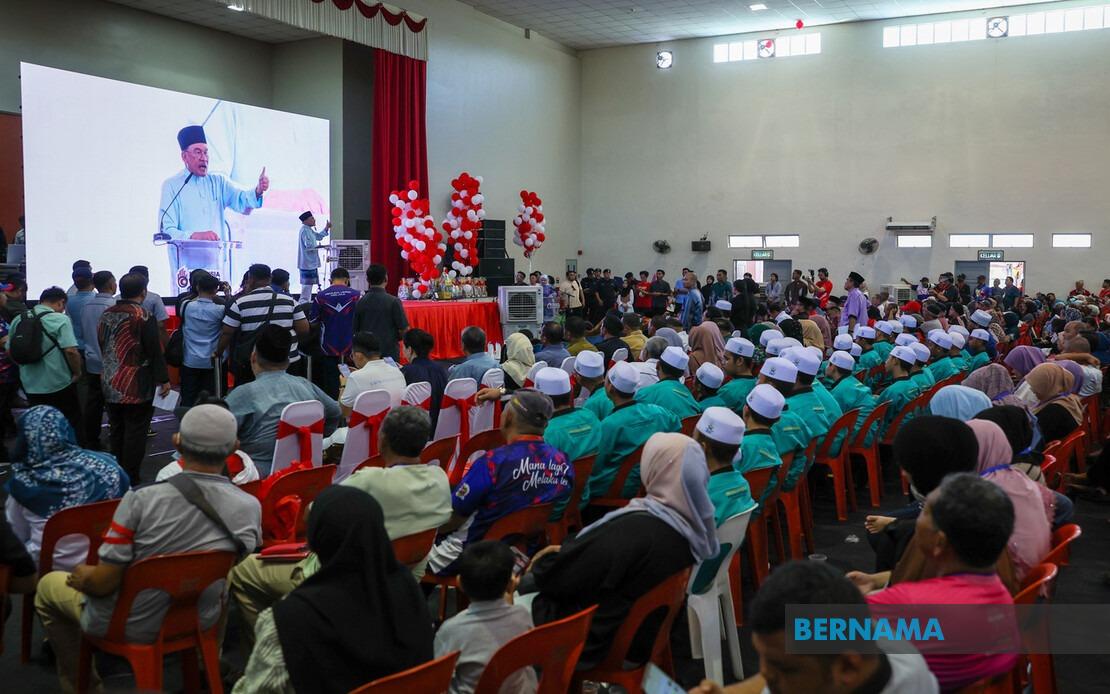
Prime Minister Datuk Seri Anwar Ibrahim has moved to address sensitivities around education funding by reaffirming the MADANI Government's commitment to equitable treatment of all educational institutions regardless of religious or cultural affiliation. Speaking at the Gelombang MADANI Carnival in Alor Gajah on August 7, Anwar emphasised that the administration would continue addressing the needs of all communities and learning streams without marginalising any group, signalling an attempt to balance competing demands from Malaysia's diverse stakeholder base in the education sector.
The Prime Minister's remarks come as the government ramps up financial support for Islamic educational facilities, which had previously been starved of substantial government assistance. Anwar acknowledged that many pondok schools and tahfiz institutions had languished for years without meaningful state backing, necessitating the current injection of resources. However, he was careful to clarify that this prioritisation does not represent a shift away from supporting vernacular institutions that serve Malaysia's Chinese and Tamil communities. He pledged that detailed announcements regarding approved allocations for Chinese and Tamil schools would be made within two weeks in Kuala Lumpur, suggesting a calculated sequencing of announcements designed to preempt accusations of favouritism.
This measured approach reflects broader political sensitivities within Malaysia's multicultural framework. The Unity Government that coalesced around Anwar's leadership encompasses coalition partners with varying constituencies and priorities. By explicitly stressing that support for one community's educational interests does not diminish commitment to others, the Prime Minister appears intent on maintaining the delicate balancing act necessary to hold the coalition together while managing diverse expectations. The education sector, deeply intertwined with identity and cultural preservation concerns, remains politically fraught terrain where perceptions of unfair treatment can rapidly inflame communal tensions.
At the event in Melaka, Anwar distributed RM1.29 million in infrastructure upgrades across thirteen Islamic educational institutions throughout the state. Individual recipients included prominent establishments such as Madrasah Tahfiz Al-Quran Wal Qiraat Kota Melaka, which received RM250,000, and Sekolah Rendah Arab Jabatan Agama Islam Melaka at Pernu, allocated RM200,000. Additional allocations ranged from RM100,000 to RM160,000 for various other institutions. These investments represent tangible improvements to facilities that serve students pursuing Islamic education alongside their secular curriculum.
Anwar framed the expanded support for religious schools within a modernisation narrative, noting that the government is now introducing artificial intelligence and computer training into pondok schools. This framing attempts to position increased funding as part of a broader developmental agenda rather than simply a reallocation of resources. By emphasising technological upgrading alongside traditional Islamic education, the government seeks to demonstrate that supporting these institutions serves contemporary economic and social needs rather than representing purely sectarian policy-making. The integration of AI training particularly signals an intention to ensure that Islamic educational pathways do not leave students educationally disadvantaged relative to their peers in conventional schools.
The Prime Minister's invocation of the concept of ummatan wasatan, derived from Surah Al-Baqarah verse 143, provided theological grounding for the government's approach to education and social cohesion. According to this interpretation, a balanced community should excel across domains of faith, knowledge, character, and inter-communal relations. Anwar extended this religious framework to encompass environmental stewardship and anti-corruption commitments, suggesting that educational excellence should serve not merely academic advancement but broader moral and civic development. This theological embedding of policy objectives reflects an attempt to mobilise religious legitimacy for programmatic choices that might otherwise be perceived as politically motivated.
The historical context matters significantly for understanding the political calculus at play. Anwar noted that assistance for religious schools had been discontinued before the formation of the Unity Government in 2022, then restored in 2023 and further increased in 2024. This narrative arc presents the current administration as correcting a previous imbalance while simultaneously emphasising continuity in support for other educational streams. The timeline suggests that the current expansion represents catching-up for previously neglected institutions rather than an entirely new directional shift in education policy. For Malaysian observers tracking shifts in how resources are allocated across the education ecosystem, this context helps clarify whether funding changes represent genuine rebalancing or preferential treatment.
The presence of Melaka Chief Minister Datuk Seri Ab Rauf Yusoh and Deputy Higher Education Minister Adam Adli Abdul Halim at the event underscores the political importance attached to education funding announcements. The inclusion of the Prime Minister's wife, Datuk Seri Dr Wan Azizah Wan Ismail, added symbolic weight to the occasion. These attendance patterns signal that education policy implementation and funding distribution carry sufficient political salience to warrant high-level governmental representation, particularly in state-level events that carry implications for how federal resources are deployed locally.
For Malaysian education stakeholders, the key takeaway involves managing expectations around the announced funding sequences. The two-week timeline for announcing support for vernacular schools becomes a critical reference point for assessing government follow-through on equitable commitments. Delays or smaller-than-expected allocations could rapidly undermine the Prime Minister's reassurances regarding balanced treatment. Conversely, substantial and timely announcements for Chinese and Tamil school support would reinforce claims that the government is genuinely pursuing a multi-stream education strategy rather than merely deploying rhetoric to deflect criticism from one community while prioritising another.
Regionally, Malaysia's approach to education funding reflects broader Southeast Asian challenges around maintaining social cohesion in plural societies. Other nations in the region have experienced intensified communal tensions partly rooted in perceptions of unequal educational support or resource allocation. Malaysia's deliberate emphasis on equitable treatment across educational streams offers a model, however imperfect, for how governments might attempt to balance developmental investment with intercommunal fairness. The success or failure of this approach will likely influence how other regional governments navigate similar pressures.
Looking forward, the government's articulation of education policy will require sustained consistency. One-off announcements of funding allocations, while politically useful in the short term, will not fundamentally address structural questions about long-term parity in educational quality and opportunity across all streams. Observers will watch to see whether the MADANI Government develops comprehensive, multi-year funding frameworks that institutionalise equitable treatment rather than relying on episodic announcements timed for political convenience. The transition from ad-hoc funding to systematic, institutionalised support would represent genuine progress toward the multicommunal education system the Prime Minister described.

