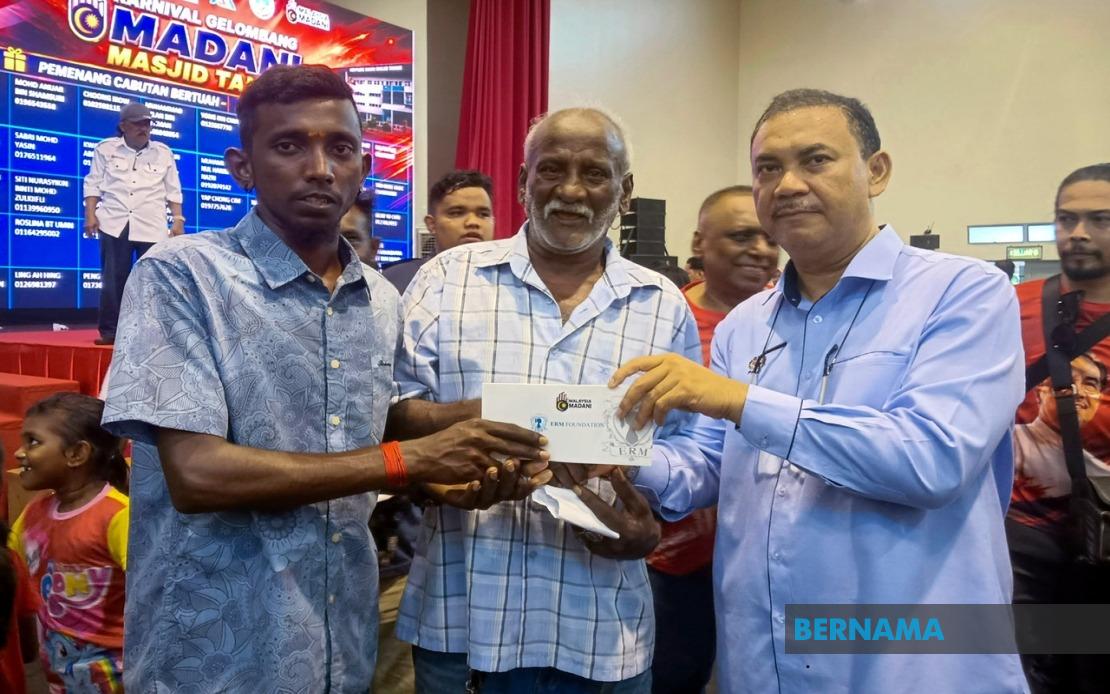
Approximately 2,000 financially disadvantaged residents across the Masjid Tanah parliamentary constituency received cash assistance on August 7 through the Sentuhan MADANI Donation programme, held as part of the broader Gelombang MADANI Carnival in Alor Gajah. The initiative represents a targeted poverty alleviation effort aimed at providing immediate relief to vulnerable household segments facing economic strain.
Prime Minister's political secretary Datuk Azman Abidin outlined the programme's scope and beneficiary categories during the distribution ceremony at the Masjid Tanah Sports Complex. Each recipient received RM200 in direct cash transfers, a modest but meaningful contribution designed to address pressing household expenses. The allocation reflects a pragmatic approach to short-term financial relief, acknowledging that even small injections of liquidity can significantly impact survival budgets among lower-income families.
The aid distribution spanned five state constituencies nested within the parliamentary boundary: Kuala Linggi, Lendu, Tanjung Bidara, Ayer Limau and Taboh Naning. This geographical spread ensured equitable coverage across different demographic zones within Alor Gajah, reaching rural and urban pockets of poverty. The structured multi-constituency approach suggests deliberate planning to ensure no eligible area was overlooked, reflecting administrative coordination between federal and state-level political machinery.
Beneficiary selection explicitly prioritised four vulnerable population segments: members of the bottom 40 percent income bracket (B40), persons with disabilities, senior citizens, and low-income wage earners. This tiered categorisation acknowledges that poverty manifests differently across demographic groups, with each facing distinct challenges. Elderly residents, for instance, may struggle with healthcare costs and reduced earning capacity, while disabled individuals often encounter employment discrimination and accessibility-related expenses that non-disabled peers do not face.
Ramlah Othman, a 63-year-old recipient from Tanjung Bidara, articulated how the assistance addressed her immediate household challenges. Her gratitude underscored a broader reality for elderly poor Malaysians: retirement often arrives without adequate savings or pension security, forcing seniors into dependency on irregular family support or state assistance. At her age, employment prospects narrow considerably, making targeted government transfers critical to maintaining basic living standards. The RM200 translated into tangible relief across essential categories—food, utilities, medication—stretching limited household budgets.
N. Mariappan, a 69-year-old stroke survivor from Ladang Sungai Baru, represented another critical beneficiary class. Post-stroke individuals typically require ongoing physiotherapy, medication, and sometimes home care support, all of which impose financial burdens exceeding typical household expenses. Mariappan's participation highlighted how the MADANI initiative acknowledged that disability-related poverty operates through multiple channels: reduced earning capacity, elevated healthcare costs, and social exclusion from mainstream income-generation opportunities. His presence at the ceremony symbolised official recognition of disabled Malaysians' economic vulnerabilities.
The Sentuhan MADANI programme reflects broader government strategy to address poverty through direct cash transfers rather than in-kind assistance or conditional transfers. This approach prioritises recipient autonomy, allowing beneficiaries to allocate funds according to their specific needs rather than imposing bureaucratic judgement about how poor households should spend resources. Such flexibility proves particularly valuable in diverse communities where needs vary significantly—a widow's expenses differ substantially from a disabled worker's or an elderly retiree's.
From a policy perspective, the carnival format serves dual purposes. Beyond the practical function of distributing aid, the Gelombang MADANI Carnival creates public occasions where government efforts toward poverty reduction receive visibility and celebration. Recipients can access assistance while experiencing recognition rather than stigma, potentially contributing to psychological wellbeing that complements material support. The ceremonial dimension also grounds political messaging around inclusive governance, particularly relevant in constituencies where multiple demographic groups compete for limited resources.
The initiative assumes particular significance within Malaysia's broader poverty landscape. Despite middle-income classification, Malaysia continues experiencing localised pockets of absolute poverty, particularly in rural Peninsular areas like those served by Masjid Tanah. Agricultural dependency, limited industrial development, and demographic aging create conditions where traditional safety nets—family support, community mutual aid—stretch thin. Government transfers fill critical gaps, especially for households ineligible for formal employment-based social insurance schemes.
Sentuhan MADANI's ripple effects extend beyond immediate recipients. Cash injections into economically depressed areas stimulate local demand, potentially benefiting small traders and service providers whom poor households patronise. A RM200 transfer circulates through village economies—purchasing rice from the sundry shop, paying for transportation, purchasing medicine from clinics—multiplying initial impact beyond the direct beneficiary household.
The programme also signals political investment in Masjid Tanah at a time when Malaysian electoral dynamics remain fluid and constituency-level competition intense. Systematic poverty alleviation efforts, when coupled with visible government presence and ceremonial acknowledgment of recipients' difficulties, create positive associations that can influence electoral outcomes and social cohesion. This calculus partly explains why poverty relief carries political dimensions in electoral democracies.
Looking forward, the sustainability question arises. Single cash transfers, while valuable, require complementary structural interventions addressing root causes of poverty: education access, skills training, employment creation, healthcare provision. The Sentuhan MADANI Donation appears positioned as immediate relief rather than long-term poverty exit strategy. Combining such transfers with investments in human capital development, infrastructure, and economic diversification would create more robust poverty reduction architecture across regions like Masjid Tanah that experience persistent material disadvantage.

