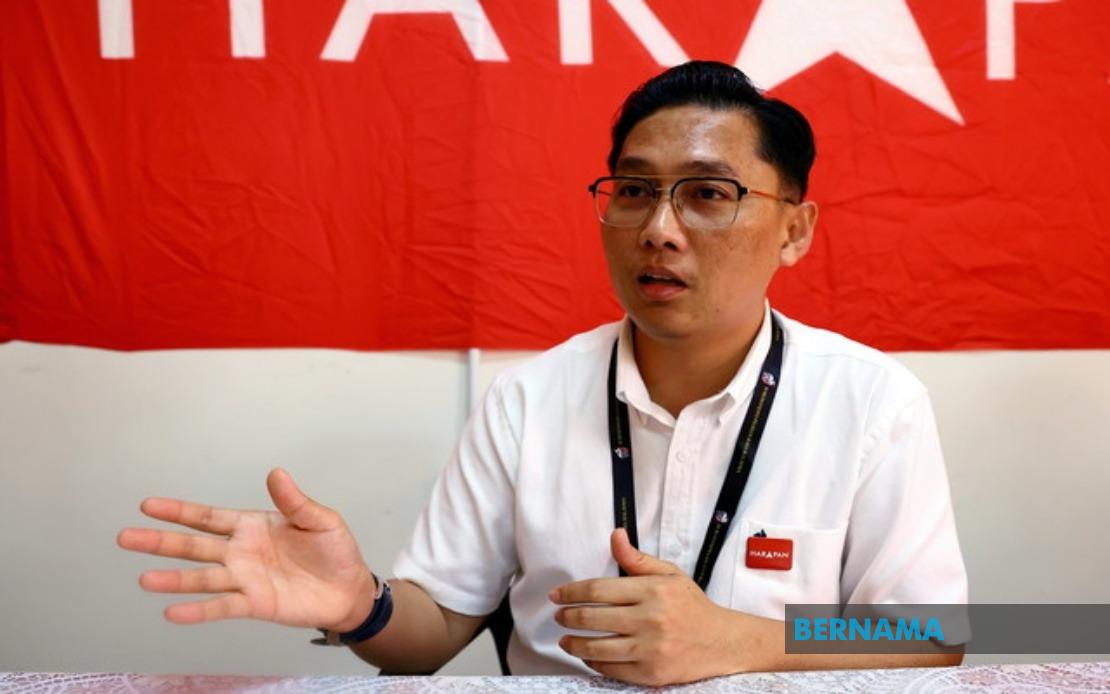
Nur Hafiz Roslan, the Pakatan Harapan candidate for the Machap state assembly seat, has dismissed concerns about challenging Johor's incumbent Menteri Besar Datuk Onn Hafiz Ghazi in the forthcoming state election. Speaking at the PH campaign headquarters in Simpang Renggam, Nur Hafiz expressed confidence that the perceived disadvantage of contesting against the state's top executive would not diminish his commitment to serving constituents or the quality of his campaign.
With nearly two decades of professional experience in the legal sector, Nur Hafiz brings substantive credentials to a constituency that has long been considered a stronghold for Barisan Nasional. His legal background positions him as a candidate capable of understanding complex policy frameworks and translating them into practical solutions for voters. Rather than viewing his opposition to an established political figure as an insurmountable barrier, he framed the contest as an opportunity to demonstrate that experience and commitment matter more than incumbency or organisational advantage.
The candidate grounded his optimism in historical precedent, noting that Malaysia's political landscape has repeatedly defied assumptions about unbeatable seats. He cited examples of former Johor Menteri Besars including Tan Sri Abdul Ghani Othman and Datuk Seri Khaled Nordin, both of whom experienced electoral defeats despite holding high office. These examples underscore a broader truth in Malaysian politics: no seat, regardless of historical voting patterns, is truly immune to electoral shifts. In 2022, Onn Hafiz secured Machap with a majority of 6,543 votes, a substantial but hardly insurmountable margin in a state where political fortunes have proven fluid.
Nur Hafiz's campaign strategy pivots on a deliberate rejection of what he characterised as outdated political narratives. He explicitly denounced politics rooted in fear, personal attacks, and the instrumentalisation of race, religion, and royalty—what he termed the "3R sentiments." This positioning reflects a growing recognition among opposition candidates that voters increasingly seek substantive engagement on bread-and-butter issues rather than divisive identity-based appeals. For Malaysian and Southeast Asian readers, this signals a potential recalibration in how elections are being fought, particularly in states where opposition parties are attempting to broaden their appeal beyond traditional support bases.
The emphasis on "mature politics" carries particular weight in Johor's electoral context. The state has been a BN and UMNO stronghold for decades, and the party's dominance has historically relied on consolidated Malay-Muslim support alongside significant Chinese and Indian communities. A campaign strategy that explicitly targets voters across demographic lines, rather than appealing to each group separately through communal messaging, represents a different political calculus. Nur Hafiz's stated intention to focus on policies addressing daily concerns—presumably ranging from cost of living to healthcare access to employment opportunities—reflects an assumption that cross-cutting economic issues can transcend traditional voting blocs.
The Machap contest itself is shaping up as a direct two-way battle between Nur Hafiz and Onn Hafiz, eliminating the possibility of vote splitting that might otherwise benefit either candidate. This binary outcome heightens the significance of turnout and campaign messaging. In such contests, the candidate able to reframe the narrative around his preferred issues—in this case, policy solutions and good governance—typically gains momentum in the final campaign stretch.
Nur Hafiz's confidence in Pakatan Harapan's campaign machinery also warrants attention. He described the PH operations in Machap as organised, stable, and free from the internal factional disputes that have occasionally hampered opposition efforts elsewhere in Malaysia. For a coalition that has experienced significant political turbulence at the national level, the ability to project unity and discipline at the constituency level is strategically valuable. A well-coordinated ground game can compensate for organisational or financial disadvantages when competing against incumbent parties with greater state resources.
The candidate articulated an additional strategic priority: positioning himself as an effective intermediary between state and federal governments. This framing acknowledges the reality that Machap voters, regardless of which party they support, expect their representative to navigate the complexities of multi-level governance and secure resources and attention from Kuala Lumpur. For constituents in a state governed by BN and a federal government that may eventually shift hands again, the assurance of stable cross-party communication has genuine appeal.
Johor's July 11 state election represents a crucial test not just for individual constituencies but for broader trends in Malaysian politics. The election occurs in a context where the federal government composition remains fluid and state-level contests increasingly influence national political momentum. Machap, while seemingly a marginal seat in a larger state election, encapsulates broader questions about whether opposition parties can credibly challenge entrenched incumbents through policy-focused campaigns and whether voters are genuinely receptive to appeals for "mature politics" over identity-based mobilisation.
Early voting is scheduled for July 7, offering a compressed campaign window in which both candidates must make their cases to the 6,543 voters who determined the outcome in 2022, plus any newly registered electors. The fact that Nur Hafiz and his team are framing their challenge not as an insurgent effort but as a serious bid to replace the Menteri Besar suggests that internal polling or ground feedback may have indicated sufficient movement in voter sentiment to make the contest genuinely competitive. Whether that confidence is validated will become clear when results are declared on election night, but the Machap race is undoubtedly one the PH coalition will view as a meaningful indicator of broader electoral viability in a state long considered beyond its reach.

