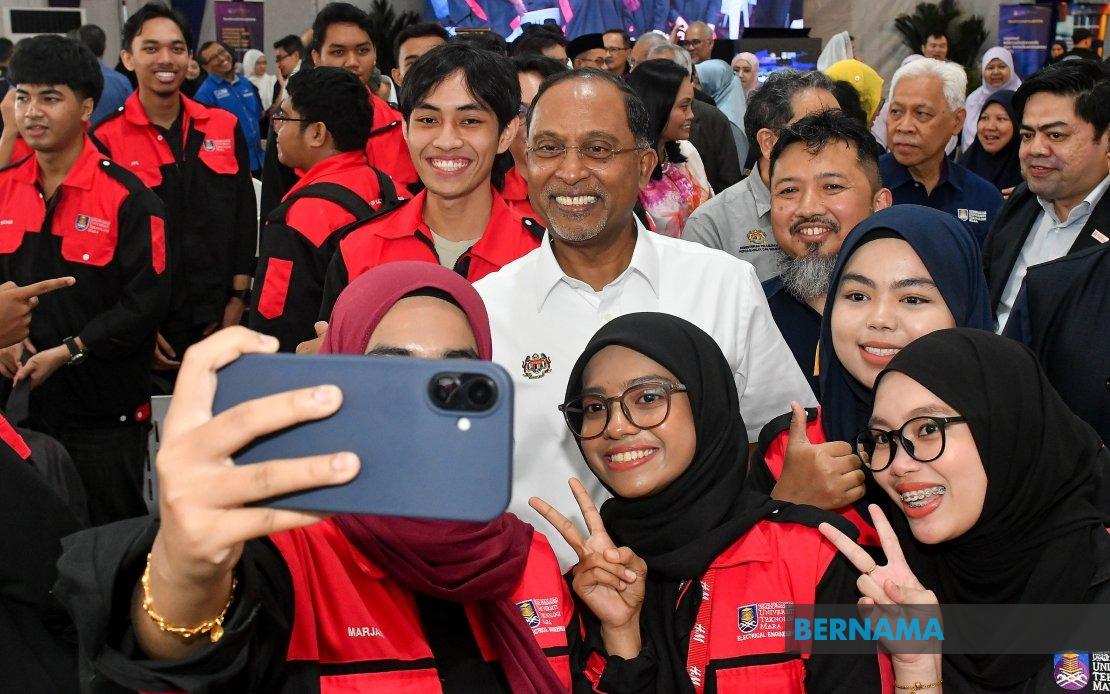
The launch of the Light Rail Transit 3 (LRT3) Shah Alam Line has created immediate practical benefits for the student population at Universiti Teknologi MARA (UiTM) Shah Alam, addressing long-standing mobility challenges across the sprawling campus and surrounding areas. Higher Education Minister Datuk Seri Dr Zambry Abd Kadir highlighted how the new rail service fundamentally changes the commuting experience, particularly for the thousands of students who previously relied entirely on private vehicles or bus networks to reach campus. The introduction of dedicated public transport infrastructure signals a broader shift in how Malaysia's education hubs are designed to support student welfare and operational efficiency.
The minister observed visible enthusiasm among students at the newly opened UiTM Shah Alam Station, attributing much of the positive reception to the tangible relief it provides for daily travellers navigating congested roads during peak hours. The rapid development across Shah Alam has exacerbated traffic pressures, creating bottlenecks that previously made campus access time-consuming and stressful. By connecting UiTM to the wider Klang Valley transit network through the LRT3 system, the station addresses this challenge while simultaneously reducing transportation expenses for a student demographic often sensitive to cost pressures. The timing of the infrastructure investment reflects government recognition that educational institutions require modern transport connectivity to remain competitive and attractive to prospective students.
The 20-station LRT3 network stretches across the Klang Valley with comprehensive coverage spanning from Bandar Utama through to Johan Setia, creating a integrated mobility corridor that extends far beyond the university campus itself. Stations including Bandar Utama, Subang, Stadium Shah Alam, and Jambatan Kota anchor the system within high-density population and commercial zones, enabling seamless connections for residents and workers across the metropolitan region. This broader connectivity demonstrates how campus-focused infrastructure investments can generate spillover benefits for entire communities by improving regional transportation efficiency and reducing vehicular congestion on main arterial routes.
To accelerate adoption, Prime Minister Datuk Seri Anwar Ibrahim implemented a free-fare promotion when the line officially launched, allowing all passengers complimentary access from June 29 through July 31. This promotional period serves multiple strategic objectives: it eliminates financial barriers that might deter trial usage among cost-conscious students, it generates ridership data essential for future service planning, and it builds public familiarity with the system during its critical operational launch window. Such promotional tactics are increasingly common in Southeast Asian cities introducing new transit infrastructure, recognizing that initial usage patterns strongly influence long-term adoption rates and system viability.
Parallel to the transit infrastructure expansion, Minister Zambry officially launched the Semiconductor@UiTM initiative, a strategically significant programme reflecting Malaysia's determination to strengthen its position within global semiconductor manufacturing and design ecosystems. The RM20 million government allocation represents substantial investment in purpose-built facilities, curriculum development, and expertise cultivation specifically designed to produce electrical and electronics engineering graduates meeting international industry standards. This capital commitment demonstrates Kuala Lumpur's strategic prioritisation of semiconductors as a cornerstone technology sector, particularly as global supply chain vulnerabilities have elevated the geopolitical and economic importance of semiconductor production capacity outside traditional centres like Taiwan and South Korea.
The Semiconductor@UiTM initiative directly supports Malaysia's National Semiconductor Strategy (NSS), which aims to systematically develop the domestic talent pipeline necessary for sustained industry competitiveness. By positioning UiTM as a leading research and training centre for semiconductor engineering, the government creates domestic capacity for technical skill development while reducing reliance on international recruitment for technical positions. The initiative emphasises that Malaysia's semiconductor contribution currently represents 13 per cent of global market share and generates over RM300 billion in annual economic value, underscoring the sector's critical importance to national prosperity and establishing clear rationale for educational investment in this domain.
Beyond classroom instruction, the Semiconductor@UiTM framework integrates direct engagement with industry players and practical exposure to contemporary production technologies and supply chain operations. This academy-industry partnership model recognises that semiconductor engineering requires continuous alignment with rapidly evolving global practices, and that students benefit immensely from direct exposure to real-world manufacturing challenges and technological cutting edges. By facilitating cross-learning between academic researchers and industry practitioners, UiTM positions itself to generate not merely competent technicians but innovative contributors capable of advancing Malaysia's semiconductor ecosystem beyond basic manufacturing into higher-value design and development functions.
The confluence of transport infrastructure and advanced technical education initiatives reflects a comprehensive approach to institutional development that Minister Zambry emphasised throughout his messaging. Improved campus accessibility supports student recruitment and retention while reducing operational friction in daily campus life, creating conditions where academics and research can flourish without competing against transportation-related stress. Simultaneously, the semiconductor initiative invests in the intellectual capital and physical infrastructure necessary for UiTM to compete globally in knowledge-intensive fields where national competitive advantage depends on educational excellence and research capability rather than cost minimisation.
For Malaysian readers and particularly the Klang Valley community, these developments signal government commitment to treating higher education as essential infrastructure requiring the same investment rigour applied to highways, ports, and power generation. The LRT3 Shah Alam Line demonstrates recognition that student success depends on frictionless mobility, while Semiconductor@UiTM demonstrates commitment to aligning university curricula with national economic strategy and global industry requirements. Together, these initiatives position UiTM as a model for how Malaysia's established educational institutions can modernise operations and relevance while supporting broader national development objectives in critical technology sectors.
Looking ahead, the semiconductor initiative specifically positions UiTM to serve as a benchmarking reference for other Malaysian universities seeking to develop specialised technical competencies aligned with government priorities. Rather than pursuing generic broad-based programmes, the approach encourages institutional differentiation and excellence concentration, where each university develops distinctive strengths reflecting both its existing capabilities and national economic requirements. This strategic specialisation potentially strengthens Malaysia's overall higher education ecosystem by ensuring systematic coverage of critical skill domains and reducing wasteful duplication of expensive specialised infrastructure and expertise across multiple underfunded centres.

