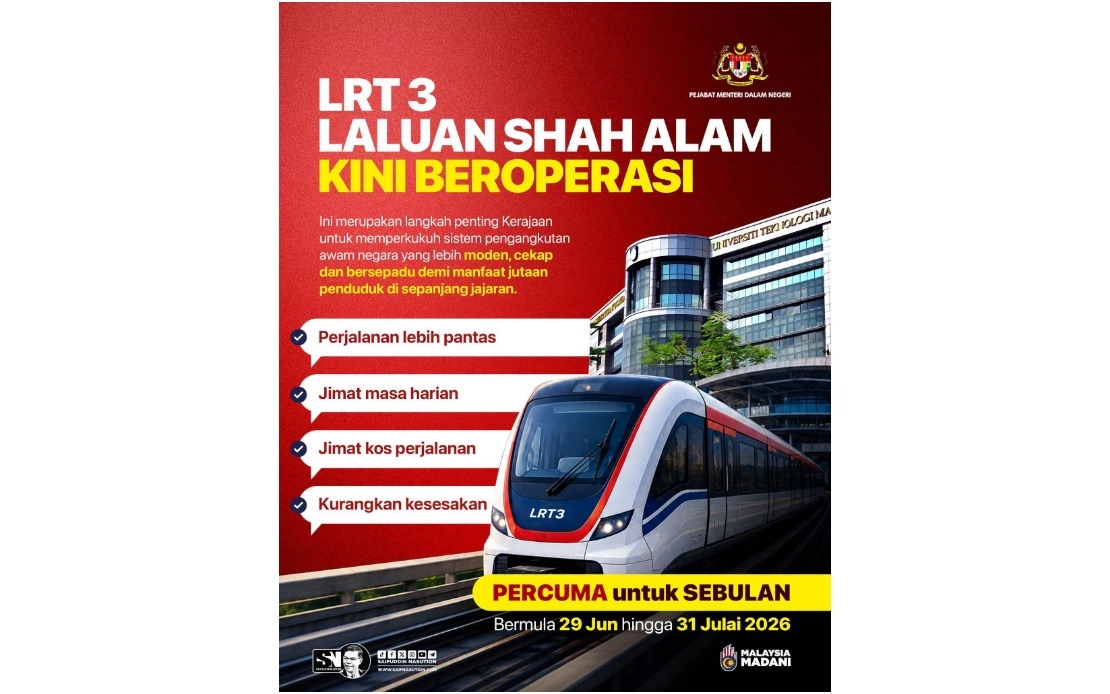
The opening of the Shah Alam Line LRT3 represents a defining moment in the MADANI Government's broader agenda to reshape urban mobility across Malaysia, according to Home Minister Datuk Seri Saifuddin Nasution Ismail. Speaking in the days following the line's operational launch, Saifuddin positioned the new rail corridor as tangible evidence of the administration's commitment to delivering infrastructure that directly improves citizens' daily experiences and quality of life. The characterization reflects a strategic framing of the project as more than mere construction—it is presented as a government investment that addresses longstanding transportation challenges while creating foundational links in an increasingly integrated national transit network.
The Shah Alam Line LRT3 tackles a critical infrastructure gap within Malaysia's most densely traveled commuter corridor. The Klang Valley region has long grappled with severe traffic congestion that constrains productivity and diminishes livability across its sprawling urban footprint. By introducing a dedicated rapid transit option, the government seeks to siphon substantial volumes of vehicle traffic away from congested roads, thereby unlocking capacity on existing highways and local arteries. The transport corridor serves as a vital link connecting Shah Alam, Klang, Subang and numerous intermediate communities—neighborhoods that collectively house millions of commuters, students and workers whose daily mobility patterns have been shaped largely by automobile dependence.
Beyond congestion relief, the new line offers tangible economic benefits to regular commuters throughout the service area. Travel time reductions translate directly into productivity gains for workers and students, while lower daily commuting expenses free up household budgets for other essential expenditures. This cost dimension proves particularly consequential for lower and middle-income residents of Shah Alam and surrounding districts, where public transport access has historically lagged behind wealthier areas. The LRT3 alignment thus carries an implicit equity dimension—extending modern transit infrastructure to populations that have long relied on less efficient alternatives.
The Prime Minister Datuk Seri Anwar Ibrahim marked the operational commencement on Sunday by announcing a promotional free-fare initiative spanning from June 29 through July 31. This temporary elimination of user costs extends across both the main line and feeder bus services operated by Prasarana Malaysia Bhd, creating a month-long window during which potential riders face no financial barrier to trial the new system. The promotion represents a calculated policy intervention designed to generate immediate ridership momentum while citizens evaluate whether the new service fits their commuting patterns and preferences.
Saifuddin explicitly urged residents and workers throughout the service corridor to exploit the free-fare opportunity. His messaging emphasizes the psychological and practical dimensions of the trial period—encouraging individuals to suspend automobile use temporarily and experience the reliability, comfort and convenience of the rail alternative. The appeal carries an implicit recognition that modal shift requires not merely infrastructure availability but also behavioral experimentation and attitudinal change among existing car-dependent commuters. By lowering the experiential threshold to zero cost, the government removes a decisive barrier to trial adoption.
The feeder bus integration component demonstrates systems-thinking in the LRT3 deployment. Dedicated bus services extending from stations into surrounding residential neighborhoods expand the geographic reach of the main line beyond immediate station proximities. This spoke-and-hub approach ensures that passengers living in areas without direct rail access can still access the system efficiently, thereby broadening the effective service population. The synchronized free-fare treatment of both rail and bus components means promotional benefits flow through the entire integrated chain, rather than merely privileging main-line users.
From a governmental perspective, the LRT3 project reflects broader MADANI administration priorities around infrastructure modernization and quality-of-life enhancement. Public transport expansion addresses multiple policy objectives simultaneously—congestion mitigation, emission reduction, urban livability and equitable service distribution. The project's framing as a strategic investment underscores ministerial messaging that contemporary infrastructure spending represents long-term foundations for national competitiveness and citizen welfare, not merely cyclical political opportunism.
The timing of the free-fare campaign carries strategic significance. By positioning the offer during the initial operational weeks, authorities capitalize on natural curiosity and media attention surrounding the line's launch. Early adopters converting to regular users during the promotional period may sustain ridership even after fares resume, establishing usage habits that persist. The window through July 31 extends across school holiday periods and mid-year work schedules, potentially capturing diverse user segments and use cases—commuters, students, weekend leisure travelers—that inform usage patterns.
For the broader Southeast Asian context, Malaysia's continued investment in rapid transit networks signals recognition that motorized road-based transport systems alone cannot sustainably serve growing urban populations. The LRT3 joins existing systems—the Kelana Jaya Line, Ampang Line, Seremban Line and others—in forming an increasingly interconnected metropolitan rail framework. This network maturation positions Kuala Lumpur and the Klang Valley alongside regional peers in transit-oriented urban development, though significant gaps remain compared to systems in Bangkok, Singapore and Jakarta.
The success of the LRT3 initiative depends substantially on post-promotional ridership sustainability. Government success in converting trial users to paying customers will determine whether the line achieves operational viability and justifies its capital investment. This transition from promotional to regular-fare operations represents a critical juncture where the behavioral changes encouraged during the free-fare window must persist despite reintroduction of user costs. The strength of the government's public advocacy—exemplified by Saifuddin's personal appeal—suggests leadership recognition of this challenge.
Saifuddin's messaging strategy emphasizes personal agency and individual choice—inviting residents to experience the service and make autonomous decisions about future usage. This rhetoric contrasts with heavy-handed prescriptive approaches, instead positioning public transport adoption as a rational choice aligned with residents' self-interest regarding time, cost and convenience. The framing acknowledges that sustainable modal shift requires voluntary participation rather than mere infrastructure provision, reflecting contemporary understanding of transport behavior change.

