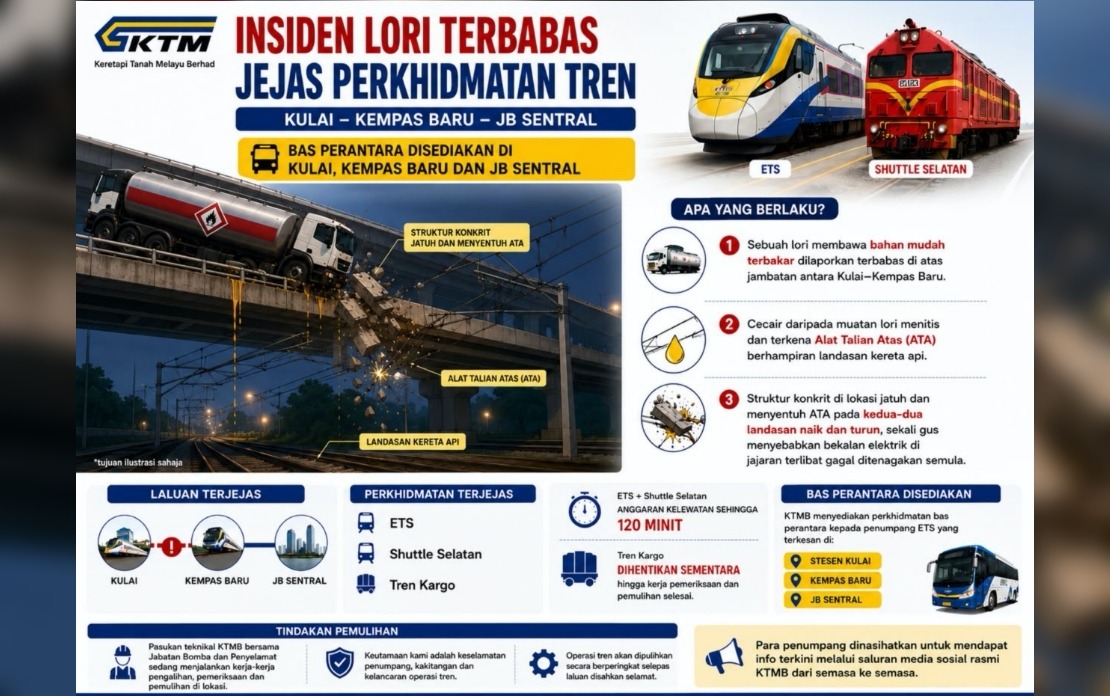
Rail services between Kulai and Kempas in Johor came to a standstill on August 5 when a lorry transporting flammable liquid skidded near the railway tracks, severing the power supply to the corridor and disrupting both the Shuttle Selatan and Electric Train Service (ETS) operations. The incident, which occurred during peak evening hours, prompted immediate intervention from Keretapi Tanah Melayu Berhad (KTMB) and emergency responders, as cleanup operations and electrical repairs commenced to restore normal service.
The accident highlighted the vulnerability of critical transport infrastructure to external disruptions, particularly when hazardous cargo is involved. The proximity of the lorry to the railway tracks created a potentially dangerous situation, necessitating careful handling during the recovery phase. KTMB's rapid communication through social media channels demonstrated the operator's commitment to keeping commuters informed, though the cascading effects of a single incident on multiple service lines illustrated how interconnected Malaysia's transport network has become.
According to KTMB's evening updates, the operational impact was substantial. ETS train 9449 was running approximately 32 minutes behind schedule, while train 9533 faced a more significant delay of 55 minutes as technicians worked to restore electrical connectivity. These delays were expected to fluctuate based on the pace of repairs and the complexity of restoring the power infrastructure, which remained subject to ongoing technical assessments and unforeseen complications that sometimes emerge during emergency restoration work.
To mitigate passenger inconvenience, KTMB implemented a comprehensive contingency plan that reflected the operator's established protocols for service disruptions. Shuttle bus services were activated at three key stations—Kulai, Kempas Baru, and JB Sentral—to provide ETS passengers with alternative connectivity and maintain mobility for those dependent on the rail network for their commute. This response underscored the importance of maintaining dedicated backup transport capacity for emergency situations affecting major transit corridors.
Passengers relying on Shuttle Selatan, KTMB's longer-distance coach service, faced greater uncertainty as the operator advised them to seek alternative transportation arrangements rather than simply substituting buses into the stalled service. The distinction reflected the different operational scope of the two services, with ETS being a regional commuter network where rapid substitution was feasible, while Shuttle Selatan operates across broader geographic networks requiring more complex rerouting decisions.
Compensation measures were promised to affected commuters, with KTMB indicating that fare adjustments would be provided to passengers inconvenienced by the service disruptions. This policy approach, while addressing immediate goodwill concerns, highlighted broader questions about how transport operators should balance the costs of external incidents—many beyond their direct control—against their responsibility to paying customers who depend on reliable service.
The incident occurred in Johor Bahru, Malaysia's second-largest metropolitan area and a critical commercial and residential hub in the southern region. The Kulai–Kempas corridor serves commuters, freight operators, and long-distance travellers, making any disruption to this route particularly consequential for the local economy and daily mobility patterns. The geographical significance of the affected region meant that alternative road routes, while available, would experience congestion as diverted traffic competed for limited capacity.
From a broader perspective, this accident demonstrated the ongoing challenge of managing hazardous cargo transportation near critical infrastructure in densely developed areas. While specific details about the lorry driver's condition or the cause of the skid were not provided, such incidents often prompt reviews of traffic management, speed restrictions, and safety protocols in corridors adjacent to railway lines. Transport authorities frequently grapple with balancing commercial logistics needs against safety requirements when hazardous materials transit populated regions.
KTMB's appeal for passengers to contact station staff on duty for further assistance represented a human-centred approach to managing the crisis, ensuring that real-time information and personalised support remained available beyond automated updates. This element of responsive customer service, while modest, becomes particularly valuable during chaotic conditions when standard information channels may become overwhelmed or unclear.
The incident also raised questions about infrastructure resilience and redundancy within Malaysia's rail network. The power supply disruption affecting both Shuttle Selatan and ETS simultaneously suggested that the services may share critical electrical infrastructure, potentially creating a single point of failure. As Malaysia continues to expand and upgrade its rail capacity, particularly with plans for high-speed rail and additional commuter routes, integrating independent power systems or backup capabilities could reduce vulnerability to external disruptions.
For Malaysian commuters and transport planners, this event served as a reminder that despite advances in scheduling technology and operational efficiency, complex transport networks remain vulnerable to unforeseen accidents. The resilience of the system depends not only on rapid response capabilities—which KTMB demonstrated—but also on preventative measures, redundancy planning, and infrastructure hardening against foreseeable risks. Moving forward, dialogue between transport operators, hazmat logistics companies, and road safety authorities could yield shared protocols that better protect critical transport corridors.

