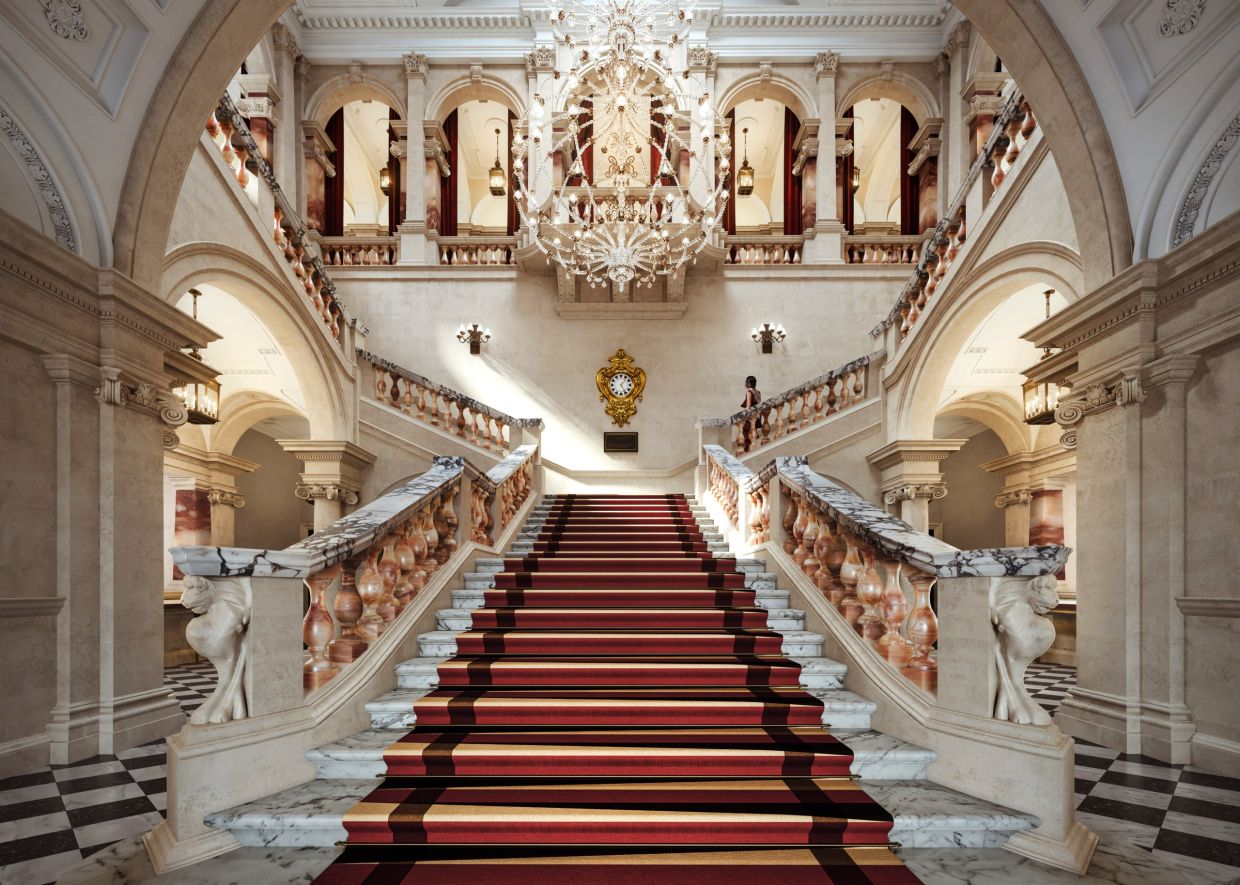
Some of London's most prestigious addresses, long restricted to the nation's power brokers and intelligence operatives, are now welcoming guests with deep pockets and a taste for history. The Raffles London at the OWO—housed in the former Old War Office—allows visitors to sip cocktails in basement rooms where British intelligence officers once analysed classified intelligence. Across the city, NoMad London occupies a converted magistrates court in Covent Garden, where tourists can walk through the very cells where Oscar Wilde faced trial. Meanwhile, the Chancery Rosewood in Grosvenor Square has claimed the seat of one of the world's most prestigious ambassadorial posts, the former United States Embassy. These conversions represent far more than mere real estate recycling; they offer something genuinely scarce in the tourism industry—unfettered access to spaces that were deliberately designed to exclude and intimidate ordinary citizens. Rooms commanding nightly rates exceeding £1,000 (RM5,506) now sell precisely because of the institutional aura these buildings retain, transforming governmental authority itself into a marketable luxury commodity.
This phenomenon extends across the Atlantic. Paris has witnessed ministries reborn as upscale hotels, whilst Lisbon has similarly converted government properties, and Rome's former central bank headquarters now hosts discerning guests. Yet London stands apart in the sheer concentration and calibre of such transformations. As Britain's government divests itself of infrastructure it no longer requires, a remarkable process is underway whereby private developers have become unlikely custodians of the nation's civic architecture. The underlying economics are straightforward: governments face mounting maintenance obligations on sprawling Victorian and Edwardian structures, whilst simultaneously grappling with fundamentally altered workspace requirements. Hybrid work arrangements and reduced civil service rosters mean vast swathes of office space sit underutilised. Private hospitality operators, by contrast, possess both the capital and operational flexibility to repurpose these properties profitably.
John O'Ceallaigh, an associate director at hospitality consultancy PRCO, articulates the appeal clearly. "These buildings are a gift," he observes, noting that the domineering facades, soaring ceilings, and authentic period detailing cannot be manufactured by contemporary architects. A sleek new construction may offer standardised comfort, but it cannot replicate the psychological allure of inhabiting spaces designed to project power. O'Ceallaigh emphasises that whilst guests might forget another marble spa, they will vividly remember exploring a museum within a former courthouse or sleeping in rooms saturated with historical resonance. There exists, he suggests, something distinctly "subversive" in socialising within spaces that were deliberately kept impenetrable to ordinary citizens. In an era of widespread political disillusionment, guests appear to derive peculiar satisfaction from temporarily accessing the inner sanctums of authority—a kind of sanctioned transgression that would have been literally criminal mere years earlier.
Admiralty Arch, a grand neoclassical edifice and Edwardian gateway straddling the ceremonial route between Trafalgar Square and Buckingham Palace, exemplifies this trajectory. Long serving as offices until 2011, it housed luminaries including Louis Mountbatten, Winston Churchill, and Ian Fleming. By later this year, it will reopen as a Waldorf Astoria. Jamie Reuben, principal at Reuben Brothers—the developer spearheading the project—frames the conversion as restoration of a national monument to public circulation, benefiting both Londoners and international visitors. The building's ceremonial location, employed during Trooping the Colour and royal processions, adds additional cache to its luxury reincarnation. For over a century, Reuben notes, its doors remained sealed to all but naval and governmental elites. The irony of rendering such bastions of exclusivity accessible to paying guests—provided they can afford the premium tariffs—encapsulates the entire phenomenon.
The urgency of finding new uses for these properties has intensified considerably. Whilst London's office market has recovered from its pandemic-induced contraction, occupiers have become markedly more discriminating. They gravitate toward highly efficient buildings featuring contemporary mechanical systems, robust environmental credentials, and amenities designed to entice staff from home offices. Government buildings typically fail these criteria spectacularly. Their distinguished exteriors frequently conceal an infrastructure nightmare: antiquated electrical systems, deteriorating plumbing, ageing HVAC installations, and cellular office layouts optimised for bureaucratic hierarchy rather than modern collaboration. Hotels, however, operate under fundamentally different spatial logic. Brightly lit perimeter rooms transition naturally into guest suites, whilst darker internal spaces accommodate kitchens, spas, storage facilities, staff quarters, and service corridors without compromising the guest experience.
Geoff Hull, a director at EPR architects overseeing the Raffles redesign, explains that Britain's governmental real estate requirements have fundamentally transformed over the past two decades. The combination of hybrid work practices and a leaner civil service has obliterated demand for the expansive office complexes that once housed legions of administrators. Meanwhile, private developers possess capabilities that government departments simply lack. The Hinduja Group's renovation of the Old War Office and the Reuben Brothers' conversion of Admiralty Arch required precisely the capital, construction expertise, and long-term vision that public agencies cannot muster. Raffles London's 2023 reopening followed an extraordinary £1.4 billion (RM7.7 billion) redevelopment comprising three additional floors above the existing structure and six basement levels excavated beneath—a transformation that consumed eight years and navigated labyrinthine regulatory requirements.
The renovation process itself proved extraordinarily complex. Fire regulations, structural concerns, water infiltration, and modern environmental control systems all demanded accommodation within a protected historic structure. Because the building qualifies as a nationally significant heritage asset, even seemingly trivial alterations—adding doorways, for instance—required approval from local planning authorities in consultation with Historic England. Hull emphasises that heritage designation created simultaneous advantages and constraints: the building's inherent character and solidity proved invaluable, yet any modification demanded meticulous justification and historical sensitivity. Architects ultimately persuaded Historic England to authorise additional entrances, fundamentally transforming what had functioned as a fortress-like structure into a hotel that radiates hospitality through restaurants, bars, and public spaces spilling onto Whitehall.
The financial dimensions of these transactions remain contentious. The British government disposed of Admiralty Arch for approximately £60 million (RM330.13 million) in 2012, and the Old War Office for £350 million (RM1.926 billion) in 2016. These sales have generated controversy, with editorial voices questioning whether taxpayers effectively surrendered valuable national assets. The Guardian's 2015 critique characterised the Old War Office sale as "public theft," capturing lingering unease about state divestiture. David Brock, head of Historic England's government historic estates unit, acknowledges the inherent risks in disposing of strategically positioned government properties. Yet he maintains that conversion to hotels often represents the preferable alternative to watching landmark buildings succumb to vacancy and deterioration. "The government just isn't using as many buildings as it used to," Brock observes. "The civil service in particular has a smaller bureaucracy." For heritage conservationists, a luxury hotel operating successfully within a protected building proves infinitely preferable to abandonment, neglect, or insensitive redevelopment.
Developers and architects behind these conversions have identified and capitalised upon a pronounced shift in luxury travel preferences. Contemporary affluent travellers increasingly reject standardised, interchangeable hotel experiences. They seek properties with authentic narratives, distinctive atmospheres, and genuine connection to place. Richard Tubb, project director at EPR who orchestrated the NoMad transformation, articulates this directly: "Guests don't want cookie-cutter hotels any more. They want experiences. They want authenticity. They want to feel like they're actually in that location, not just another repeat hotel." Hotels have transformed institutional history itself into their primary competitive advantage. NoMad houses the Bow Street Museum of Crime & Justice, detailing narratives of London's earliest law enforcement apparatus. Raffles employs tour guides who illuminate the building's espionage heritage, recounting episodes such as Boy Scouts traversing vast corridors delivering wartime dispatches. Guests occupy rooms once utilised by spies, prime ministers, and military commanders, whilst cocktails in the basement Spy Bar evoke MI5 briefings. Online reviews consistently highlight these heritage dimensions, with history enthusiasts expressing particular delight in guided tours and the distinctive atmospheric qualities that rival properties cannot replicate.
London's luxury hotel market continues demonstrating formidable resilience despite geopolitical turbulence. The concentration of rooms commanding nightly rates exceeding £1,000 (RM4,089) positions the city among the world's premier luxury destinations, consistently attracting affluent international clientele. Average daily rates and revenue per available room across the luxury segment have continued rising throughout the current year, defying expectations generated by post-Brexit uncertainty and the elimination of tax-free shopping in 2021. Heritage buildings substantially reinforce this market strength. According to real estate analytics firm CoStar, such properties possess inherent advantages within the luxury segment precisely because they function as distinctive, irreproducible assets. Cristina Balekjian, director of hospitality analytics at CoStar, emphasises that heritage architecture naturally aligns with luxury positioning: "These buildings lend themselves really well to luxury because they're distinct." In an increasingly homogenised global hotel landscape, the combination of authenticated history, architectural distinction, and exclusive access to formerly restricted spaces has emerged as perhaps the most powerful currency in premium hospitality.
For Southeast Asian readers observing these developments, the implications prove particularly resonant. Malaysia, Singapore, and the broader region host significant architectural heritage that might similarly be reimagined for contemporary economic purposes. As heritage conservation increasingly competes with adaptive reuse economics, these London conversions offer instructive case studies in how public institutions can transition to commercially sustainable operations whilst preserving historical character. The success of properties like Raffles London and NoMad demonstrates genuine market demand for authenticity and historical narrative—a demand that luxury developers across Asia might systematically address through thoughtful heritage conversion projects. Furthermore, the premium positioning commanded by such properties suggests that heritage assets, rather than representing maintenance burdens, can constitute substantial competitive advantages in the global luxury market. London's experience suggests that governmental real estate holdings throughout Asia might similarly merit evaluation not merely as administrative infrastructure but as potential vehicles for heritage preservation, cultural tourism revenue generation, and sustained public access to historically significant buildings.

