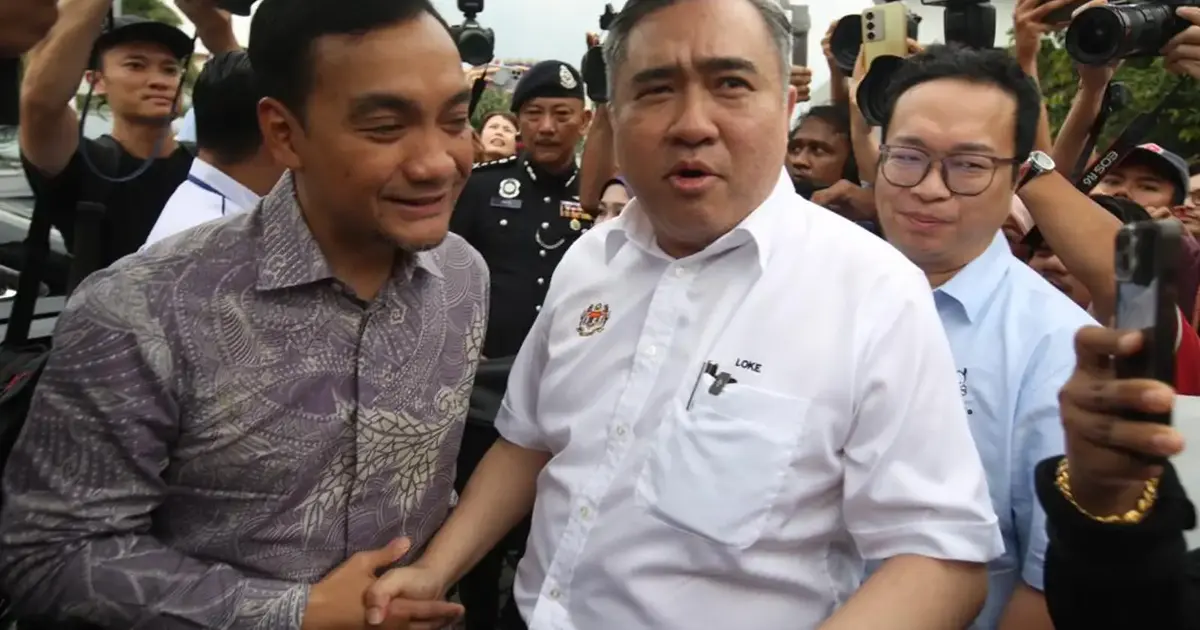
Transport Minister Anthony Loke and Johor Menteri Besar Onn Hafiz have demonstrated a capacity for political pragmatism by conducting their first face-to-face meeting since a recent online disagreement in a cordial manner, signalling that personal tensions need not derail official business between federal and state governments. The two leaders' ability to interact without public acrimony, despite their earlier social media exchange, offers a template for how political rivals can maintain constructive working relationships when institutional responsibility demands it.
During remarks at a transport ministry event that Onn Hafiz attended, the Johor Menteri Besar made a pointed observation about the circumstances of his attendance, noting that he had been compelled to adjust his existing schedule to accommodate what he described as a last-minute invitation from Loke. The comment, delivered within a speech setting rather than through confrontational rhetoric, functioned as a subtle acknowledgment of the earlier friction while framing the logistical inconvenience in measured terms that avoided escalating tensions.
This approach reflects a broader political maturity increasingly visible among Malaysia's leadership cadre. While online platforms have lowered the barriers to immediate public recrimination, the continuation of substantive government work requires that senior officials distinguish between rhetorical positioning and operational necessity. The transport ministry and Johor's state administration must coordinate on numerous practical matters ranging from infrastructure development to urban planning, making sustained acrimony counterproductive for both parties.
The previous online exchange between the two leaders had drawn public attention because it illustrated the fraught relationship between Malaysia's federal government and certain state-level administrations. Johor, as one of the nation's most economically significant states, maintains significant autonomy in regional policy matters, yet remains dependent on federal resources and coordination for major development projects. This interdependence creates natural friction points where political differences can quickly become amplified through media and social channels.
Onn Hafiz's comment about rearranging his schedule carried subtle messaging beneath its surface politeness. The reference to short notice and the need to reorganise commitments could be read as a gentle rebuke regarding protocol and the respect due to a state Menteri Besar when requesting his attendance at federal events. In Malaysian political culture, such signals are often transmitted through ostensibly courteous language rather than explicit confrontation, allowing officials to stake positions while maintaining the facade of cooperation.
Loke, for his part, proceeded through the event without publicly responding to the implicit criticism, instead allowing the moment to pass with professional decorum. This restraint suggests both leaders recognise the reputational costs of allowing interpersonal disputes to metastasise into public feuds. The transport ministry oversees initiatives that extend across multiple states, and Loke's effectiveness depends partly on his capacity to build working relationships with state governments regardless of political affiliation or personal friction.
The meeting's significance extends beyond the bilateral relationship between these two individuals. It demonstrates how Malaysia's coalition-based federal government manages relationships with non-coalition state administrations. Johor's political alignment with Perikatan Nasional creates a different dynamic than cooperation with Pakatan Harapan-ruled states, yet federal institutions must operate effectively across these dividing lines to serve the nation's economic and development objectives.
For Malaysian observers and regional stakeholders, the maintenance of civil working relationships between federal and state actors carries broader implications for institutional stability. The normalisation of acrimony between government levels could impede infrastructure development, delay investment decisions, and undermine policy implementation across multiple sectors. By choosing to keep disagreements relatively compartmentalised, Loke and Onn Hafiz preserve space for pragmatic collaboration on matters of genuine national interest.
The incident also highlights the evolving role of social media in Malaysian politics. While online platforms enable rapid mobilisation and direct communication with constituencies, they simultaneously create pressure for immediate public responses to perceived slights. Senior officials increasingly face a tension between maintaining political relevance through social engagement and preserving the diplomatic flexibility that effective governance requires. The measured approach adopted in this case suggests some Malaysia leaders are learning to navigate this tension.
Looking forward, the relationship between the transport ministry and Johor's state government will likely continue oscillating between cooperation and competitive positioning, reflecting the broader dynamics of Malaysia's federal structure and contemporary political configuration. However, this first cordial meeting since the online disagreement suggests that both Loke and Onn Hafiz possess the sophistication to compartmentalise their differences sufficiently to enable functional interaction on infrastructure, planning, and development matters that transcend partisan boundaries.
The subtext of the Menteri Besar's remarks about schedule adjustments will likely circulate within political circles, understood by those versed in Malaysia's diplomatic language as a message about respecting state-level autonomy and the importance of proper protocol. Simultaneously, the overall tone of cordiality sends a signal to investors, development partners, and federal stakeholders that Johor remains open to collaboration despite the political tensions that periodically surface. This calculated balance between maintaining political positions and enabling functional government represents the ongoing challenge of managing diversity within Malaysia's federal system.