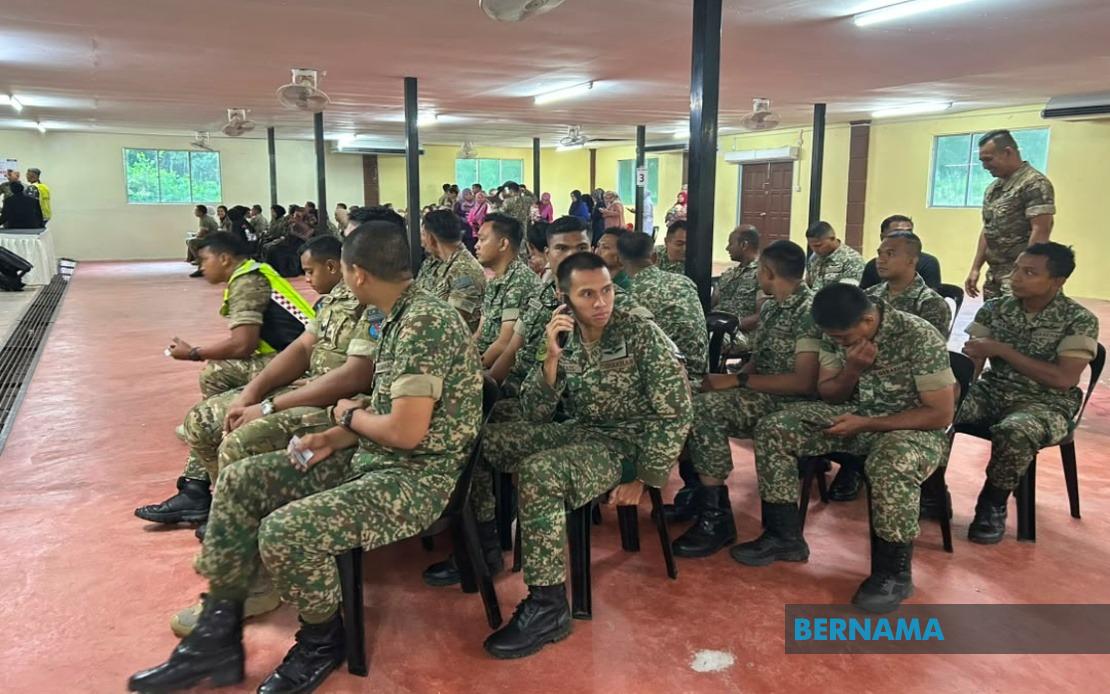
More than 24,000 military personnel, police officers and their families participated in advance voting for Johor's 16th state election on Monday, with top government officials using the occasion to reinforce the importance of democratic engagement. Home Minister Datuk Seri Saifuddin Nasution Ismail and Defence Minister Datuk Seri Mohamed Khaled Nordin issued separate appeals through social media, urging early voters to approach the ballot with a commitment to integrity and the principles underlying Malaysia's electoral system. The call reflected a broader political message in the lead-up to Saturday's general polling day, when all 56 state seats will be contested across the entire state.
The contingent of early voters included 12,041 members of the Malaysian Armed Forces and their spouses alongside 12,710 police personnel and their families. This demographic represents one of the largest organised groups in any Malaysian election, reflecting the practical necessities of accommodating voters whose professional duties prevent them from attending on the main polling date. Sixty-four early voting centres operated throughout Monday morning and afternoon, with operations closing in stages between noon and 6 pm depending on voter concentration and local circumstances. The staggered schedule ensured orderly processing while managing crowd flow at individual locations.
Saifuddin Nasution, who additionally serves as Pakatan Harapan secretary-general, framed voting as both a right and a responsibility deserving serious engagement. His message extended beyond the immediate early voting cohort, calling on the opposition coalition's campaign machinery to maintain professionalism and public engagement right through the formal campaign period. This emphasis on campaign conduct suggests heightened attention to maintaining electoral credibility at a time when state-level contests have increasingly become proxy battlegrounds reflecting national political dynamics. The implicit message carries particular weight given Malaysia's recent electoral history and ongoing discussions about democratic standards.
Defence Minister Mohamed Khaled approached the matter from a developmental angle, connecting individual voting participation to Johor's broader trajectory of economic and social progress. His framing positioned the election not simply as a procedural exercise but as part of a continuing narrative about the state's future direction. This rhetorical approach resonates with voter concerns about tangible governance outcomes, particularly in a state that has historically served as Malaysia's industrial and commercial hub. Johor's economic performance influences not only local communities but ripples across the wider Southeast Asian region given its strategic location and cross-border connections with Singapore.
Menteri Besar Datuk Onn Hafiz Ghazi, speaking on behalf of the ruling Barisan Nasional coalition, employed complementary messaging while emphasizing continuity and institutional stability. His appeal to early voters reflected the incumbent administration's core campaign themes of predictability, established governance structures and proven delivery on infrastructure and welfare commitments. The contrast between opposition and government messaging on early voting day illustrates how even procedural electoral moments become opportunities for parties to articulate competing visions about governance philosophy and priorities.
Both Pakatan Harapan and Barisan Nasional are fielding candidates in all 56 contested seats, with 172 candidates distributed across the two principal coalitions and independent contenders. The total of 172 candidates across 56 seats indicates significant primary competition and candidate selection processes within the major coalitions. This level of contestation suggests that certain constituencies remain genuinely competitive, while others may reflect either coalition strength or factional dynamics within larger political organisations. For Malaysian observers and regional analysts, Johor's electoral outcome carries significance beyond state-level politics, potentially indicating shifts in voter sentiment affecting national coalition calculations.
The appeals from the three senior figures shared a common thread emphasising smooth, peaceful and orderly conduct of the voting process itself. These calls for procedural propriety may reflect lessons from previous elections or heightened attention to maintaining public confidence in electoral integrity. In the Malaysian context, where concerns about election administration occasionally surface in public discourse, explicit reassurance from senior ministers about the voting environment serves psychological as well as practical functions. It signals commitment to institutional credibility at moments when rival factions might otherwise interpret procedural irregularities through partisan lenses.
The early voting arrangement itself reflects practical accommodation of Malaysia's security personnel, who constitute a significant voting bloc in any national or state election. The precedent of organised early voting for military and police serves multiple functions: it enables security personnel to fulfil their civic responsibilities while maintaining operational readiness, and it provides government with an early indication of voting patterns and turnout enthusiasm. Analysts monitoring Malaysian elections frequently examine early voting returns as potential indicators of broader electoral momentum, though such interpretations require methodological care given the unrepresentative demographic composition of early voters.
Johor's election unfolds within Malaysia's broader political context, where state-level contests have assumed elevated importance following systemic changes in national politics. The state's 56 seats represent meaningful legislative weight, and state government positions carry significant patronage and administrative authority. For political parties, Johor remains a consequential arena both for demonstrating electoral competitiveness and for maintaining or expanding power bases that influence national coalition mathematics. The focus on early voting conduct and democratic propriety reflects awareness among senior figures that electoral credibility remains a contested terrain in contemporary Malaysian politics.

