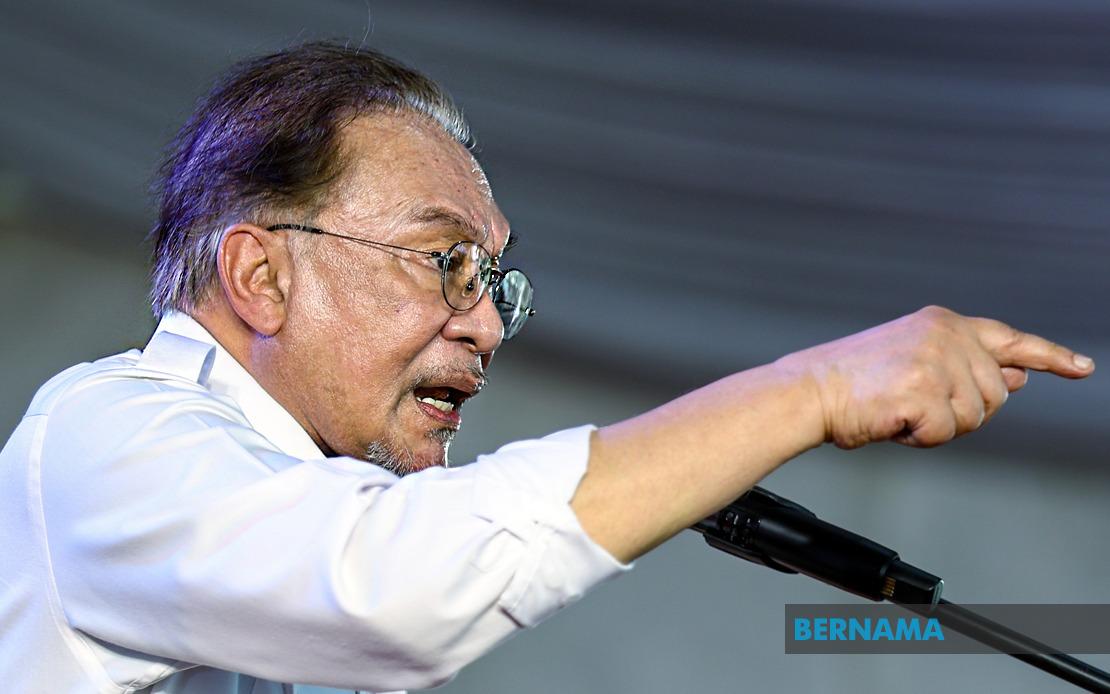
Prime Minister Datuk Seri Anwar Ibrahim has urged leaders at the federal, state and municipal levels to maintain fair and inclusive engagement with all communities, framing such efforts as fundamental to Malaysia's continued unity and prosperity. Speaking during a hi-tea gathering with Johor community leaders in Johor Bahru on July 4, Anwar underscored that while the MADANI Government has implemented nationwide reform initiatives, substantial work remains in translating these policy objectives into tangible outcomes at the state and local administration levels.
Anwar clarified that his appeal does not call for blanket approval of every request or application submitted by citizens and organisations. Rather, he emphasised the importance of creating space for stakeholders to articulate their concerns, present substantive arguments and have their positions considered through procedures that demonstrably uphold fairness and impartiality. The distinction he drew is significant: equitable governance requires not capitulation to all demands but adherence to transparent processes that respect citizens' dignity and right to be heard before decisions are finalised.
Central to Anwar's message is the proposition that fairness in public administration extends beyond economic or administrative convenience. He argued that state governments and local councils must remain receptive to community engagement while simultaneously honouring the legal frameworks and established governance principles that constrain their discretion. This balance—between openness to dialogue and fidelity to law—reflects a nuanced understanding of how decentralised governance systems can maintain both responsiveness and accountability.
The Prime Minister, who also holds the Finance portfolio, broadened his remarks to challenge conventional metrics of national progress. He contended that Malaysia's advancement should be evaluated not merely through gross domestic product expansion or infrastructure development but equally through its capacity to sustain harmony, empathy and reciprocal regard among its multiethnic and multireligious population. This perspective carries particular weight in a country where communal tensions periodically surface and where economic growth, if perceived as unequally distributed across communities, can exacerbate social fractures.
Anwar highlighted the geographic diversification of Malaysia's economic momentum as evidence of this inclusive growth trajectory. Beyond traditional investment destinations such as the Klang Valley and Penang, capital inflows are now reaching Negeri Sembilan, Melaka and Johor through the Johor-Singapore Special Economic Zone framework, while Sabah and Sarawak are attracting enhanced commercial interest. This regional dispersal of economic activity carries implications for reducing development disparities and strengthening the political economy of cohesion across east and west Malaysia.
The Prime Minister further stressed that Malaysia's engagement with transformative technologies and systems—artificial intelligence, digital infrastructure, energy transition—must remain anchored to moral foundations, cultural sensitivity and religious principles. His caution against untethered technological adoption reflects concerns shared across Southeast Asia about whether rapid digitalisation can proceed without eroding traditional social structures or deepening cultural alienation. Anwar's framing suggests that Malaysia should pursue modernisation deliberately rather than passively absorbing external models.
Anwar expressed particular concern regarding persistent racial and religious narratives that strain Malaysia's social fabric and undermine national integration efforts. He positioned religious and community leaders as custodians of responsibility in countering such divisive discourse. Rather than relying solely on governmental prohibition or media regulation, his approach invokes moral authority and community-level persuasion as mechanisms for promoting faith-based values of justice, compassion and understanding. This strategy acknowledges that official pronouncements often prove insufficient in contexts where identity-based grievances run deep.
The Prime Minister further assigned leaders a responsibility to disseminate accurate information and actively resist narratives that instrumentalise race and religion for partisan political advantage. This articulation carries significance given Malaysia's history of communal tensions mobilised during electoral contests. Anwar's advocacy for information integrity and against opportunistic identity politics reflects a diagnosis that institutional remedies alone cannot address fractures rooted in competing narratives about national belonging and resource distribution.
Anwar grounded his broader argument in the aspirations he views as transcending communal boundaries: access to quality education, health security for families, reliable community infrastructure and constitutional protections for religious practice. By anchoring his appeal to these fundamental, shared objectives, he sought to reframe political discourse around concrete welfare concerns rather than abstract identity conflicts. His invocation of the constitutional guarantees provided by Malaysia's founding generation emphasises that inclusive governance represents a continuity with foundational principles rather than a novel imposition.
The framing of inclusive governance as both constitutionally rooted and pragmatically essential positions Anwar's message as addressing immediate implementation challenges while connecting them to long-term institutional stability. Deputy National Unity Minister R Yuneswaran's presence at the event underscored the government's commitment to translating these principles into departmental operations, though the gap between rhetorical endorsement and ground-level practice remains significant across Malaysia's complex federal system.
Anwar's remarks acquire added salience given Malaysia's recent political volatility and the periodic resurgence of communal tensions in public discourse. By situating fair engagement as a matter of national interest rather than merely minority appeasement, he attempts to reframe inclusive governance as a strategic necessity for all communities. The practical challenge lies in ensuring that state and local officials internalise this message and adjust administrative conduct accordingly, particularly where patronage networks or factional interests have historically dominated resource allocation decisions.
Looking forward, the Prime Minister's emphasis on transparent processes and equal access to grievance mechanisms suggests potential areas for institutional reform and monitoring. Whether the MADANI Government will develop measurable indicators of fair engagement or establish mechanisms to track community perceptions of impartiality remains unclear. The durability of his message will ultimately depend on whether federal directives translate into observable changes in how state assemblies, municipal councils and departmental officials interact with diverse constituencies, particularly those communities that have historically experienced marginalisation or neglect in resource distribution.

