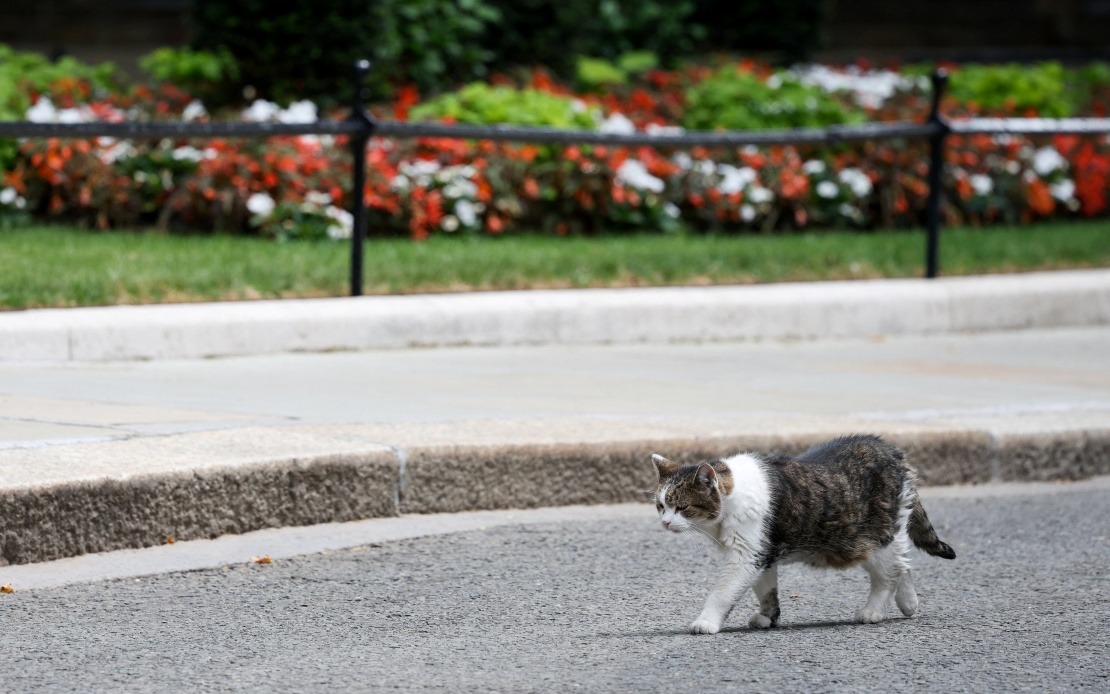
Larry, the celebrated feline inhabitant of 10 Downing Street, has become an unlikely witness to Britain's recent political turbulence, having served as the Prime Minister's residence cat across six successive administrations. The grey tabby was observed wandering the grounds outside the official London residence on Tuesday, July 21, as Britain's newly appointed Prime Minister Andy Burnham conducted his inaugural Cabinet session following his assumption of office.
The sight of Larry roaming the exterior gardens while ministerial colleagues convened indoors underscores the cat's enduring presence through one of the most volatile periods in recent British political history. Since arriving at the iconic address, Larry has maintained a steadfast position within the residence, seemingly unbothered by the constant rotation of occupants and the consequential reshuffling of government priorities and personnel.
For Malaysian observers accustomed to the relative stability of political institutions, the rapid succession of British prime ministers in recent years represents a significant institutional challenge. The turnover reflects deeper constitutional tensions and electoral pressures that have reshaped the political landscape of the United Kingdom. Larry's tenure spanning across these six distinct administrations provides a symbolic continuity through an otherwise chaotic period of governance and policy reformation.
The current administration under Andy Burnham marks a notable shift in the ideological direction of British government. His first Cabinet meeting represents a moment of deliberate repositioning as the new leadership team establishes its operational framework and strategic priorities. The presence of Larry during these early proceedings serves as a reminder of institutional continuity, even as personnel and policies undergo substantial transformation.
In the context of Southeast Asian politics, where institutional stability and administrative continuity are often prized, the British example demonstrates how institutional symbols can maintain their resonance despite significant political upheaval. Larry functions as a living embodiment of the permanence of state institutions, a constant amid the transient nature of political leadership. The cat's indifference to these transitions reflects a broader truth about governmental institutions: they persist and function despite the individuals who temporarily occupy their highest offices.
The appointment of Andy Burnham as Prime Minister represents a development closely watched across British political circles and internationally. His formation of the Cabinet team and the early decisions made during these foundational meetings will establish the trajectory for his administration's approach to domestic governance and international relations. Larry's casual presence on the grounds during these critical early moments captures the intersection of institutional solemnity and the mundane continuity of daily life within the corridors of power.
For international observers, including those in Malaysia, the stability represented by persistent institutional elements like Larry carries symbolic weight. In nations where political transitions can prove destabilizing, the evidence that governmental institutions can maintain their functional integrity across leadership changes offers reassurance about the resilience of democratic systems. Larry's tenure demonstrates that bureaucratic and institutional frameworks, while led by various political figures, maintain their essential character and purpose.
The cat has become increasingly famous in recent years, particularly as the frequency of prime ministerial changes has accelerated. Media coverage of Larry has grown proportionately with each new resident at the address, making the feline something of a cultural icon representing British institutional memory. Visitors and observers have come to recognize Larry as a fixture more permanent than any elected official, a living chronicle of contemporary British political history.
Larry's presence at 10 Downing Street also highlights the human aspect of institutional life. Beyond policy debates, statistical analyses, and strategic positioning, the residence remains a functioning household where daily routines continue regardless of which minister occupies the chief position. The cat's needs for food, shelter, and attention persist independent of electoral outcomes or political reorganization, grounding the typically abstract world of high government in material, everyday reality.
As Andy Burnham's administration progresses and establishes its governmental agenda, Larry will continue his quiet tenure at the residence, a biological constant in an otherwise rapidly changing political environment. The cat's trajectory through six prime ministerial terms suggests that institutional symbols and physical continuities often outlast the temporary occupants of high office, serving as anchors that connect successive administrations and remind observers of the enduring nature of governmental institutions themselves.

