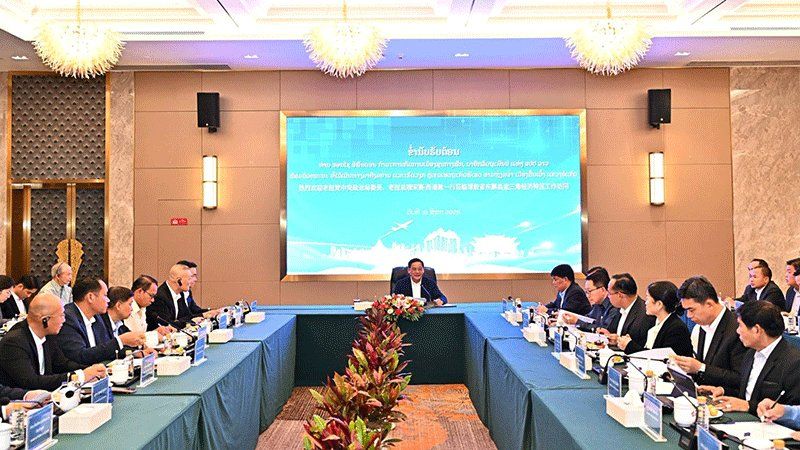
Prime Minister Sonexay Siphandone has signalled a significant shift in Laos's approach to managing the Golden Triangle Special Economic Zone, calling for substantially stricter oversight and more rigorous enforcement of development standards across the sprawling cross-border enclave. During an inspection tour of the zone in Bokeo province's Tonpheung district this week, Dr Sonexay outlined a series of governance reforms designed to address systemic underperformance and strengthen the institutional framework governing what has become one of Southeast Asia's most strategically positioned but contentious investment corridors.
The Golden Triangle SEZ, straddling the banks of the Mekong River where Laos, Myanmar and Thailand converge whilst lying within striking distance of China's Yunnan province, has accumulated approximately US$10 billion in foreign direct investment since its formal establishment in 2007. Yet despite nearly two decades of development, the zone encompasses just 10,000 hectares, with only 3,000 hectares allocated for commercial activities whilst 7,000 remain designated as forested areas. This geographical configuration reflects the zone's intended positioning as both an economic engine and a conservation area, though tensions between these objectives have become increasingly apparent.
The Prime Minister's disclosure that merely 60 per cent of contractually mandated activities have materialised represents a damning assessment of implementation capacity. This substantial shortfall indicates systemic weaknesses extending across investment promotion, project supervision and regulatory compliance. The underperformance encompasses diverse sectors including manufacturing, real estate, hospitality, trading, financial services and tourism, suggesting that the problem transcends any single industry segment. Rather, it appears rooted in deficient administrative oversight and inadequate mechanisms for enforcing developer accountability.
Dr Sonexay's directive to strengthen the one-stop-service system reflects recognition that streamlined bureaucratic processes can simultaneously enhance investor confidence whilst maintaining regulatory standards. By concentrating investment approvals and licensing functions, authorities can theoretically monitor compliance more effectively and identify problems earlier in the development cycle. This approach acknowledges that cumbersome or fragmented administrative systems often enable non-compliance by creating confusion about responsibilities and enforcement obligations.
The Prime Minister's insistence that all commercial transactions—encompassing trade, investment, wages and service provision—flow through Laos's banking system addresses a critical governance vulnerability. Informal or parallel financial channels have historically facilitated corruption, enabled tax evasion and obscured beneficial ownership structures, compromising both state revenue and regulatory visibility. By channelling economic activity through formal banking infrastructure, Laotian authorities can establish auditable transaction records and enforce financial compliance more systematically.
Border management represents another significant concern flagged by the leadership. The zone's location at a geographical nexus where four countries converge creates obvious security and administrative complications. Enhanced entry-exit protocols and strengthened mechanisms for managing cross-border labour flows address trafficking risks, irregular employment arrangements and the proliferation of undocumented workers that characterises many regional special economic zones. Better coordination with Myanmar and Thailand could establish shared standards for worker protections and cross-border mobility.
The Prime Minister's emphasis on tourism, manufacturing, processing, transportation, education and healthcare reflects strategic thinking about sustainable economic diversification. Tourism development leverages the zone's distinctive geographical assets and cultural proximity to China and Thailand whilst creating employment across hospitality, transportation and service sectors. Manufacturing and processing operations establish supply chains and add value to raw materials, whilst transport infrastructure investments enhance regional connectivity. Education and healthcare investments simultaneously serve workers and neighbouring populations, generating goodwill and supporting long-term human capital development.
The governance framework itself requires substantial reinforcement. Dr Sonexay's call for revising concession agreements to align with current legislation suggests that existing contracts contain obsolete or inadequate provisions. The Management and Administration Committee, which theoretically oversees zone operations, apparently requires additional authority and resources to execute effective supervision. With more than 10,000 registered workers and an equivalent number of additional investors, operators, residents and tourists, the zone functions almost as a city-state, yet administrative capacity has evidently not scaled proportionally.
The presence of over 400 government officials from various agencies working within the zone indicates substantial state presence, yet this personnel density has evidently not translated into effective regulatory outcomes. This discrepancy suggests that the problem extends beyond staffing levels towards structural coordination failures, unclear lines of authority and inadequate training or performance accountability systems. Consolidating scattered responsibilities under unified command structures could improve enforcement consistency.
For regional observers, the Prime Minister's intervention signals that Laos recognises the reputational and fiscal costs of continued underperformance. The zone's strategic positioning and substantial accumulated investment make it crucial to national development ambitions, yet persistent non-compliance and incomplete project execution threaten long-term viability. Enhanced cooperation with Myanmar and Thailand, which Dr Sonexay specifically requested, could establish shared interests in zone governance that transcend individual national bureaucracies.
The directive to improve airline connectivity particularly underscores tourism ambitions and reflects awareness that physical accessibility profoundly influences investment decisions and visitor flows. Direct flight linkages from regional capitals and beyond would materially enhance the zone's competitiveness against rival development corridors and special economic zones elsewhere in mainland Southeast Asia. Transportation infrastructure improvements thus constitute investments in the zone's economic fundamentals rather than peripheral amenities.
Dr Sonexay's call for developers to maintain a vibrant environment reflects implicit acknowledgement that the zone risks becoming characterised by stagnation or underutilisation if current trajectories persist. Strategic leadership initiatives, coordinated marketing campaigns and enhanced investor relations programmes could reinvigorate confidence and attract higher-quality development projects. The consolidation of regulatory authority around clearer standards and more predictable implementation timelines would particularly appeal to multinational corporations requiring certainty about operating conditions.
Ultimately, the Prime Minister's intervention addresses a fundamental tension within special economic zones globally: the competing imperatives of growth promotion versus regulatory rigour. Laos's determination to strengthen oversight whilst simultaneously accelerating development suggests policymakers have concluded that authentic, sustainable expansion cannot proceed without institutional credibility and reliable rule of law. Whether this recalibration of governance priorities translates into measurable improvements in contract fulfilment and investment quality will substantially influence Southeast Asia's perception of Laos as a development destination and regional economic partner.

