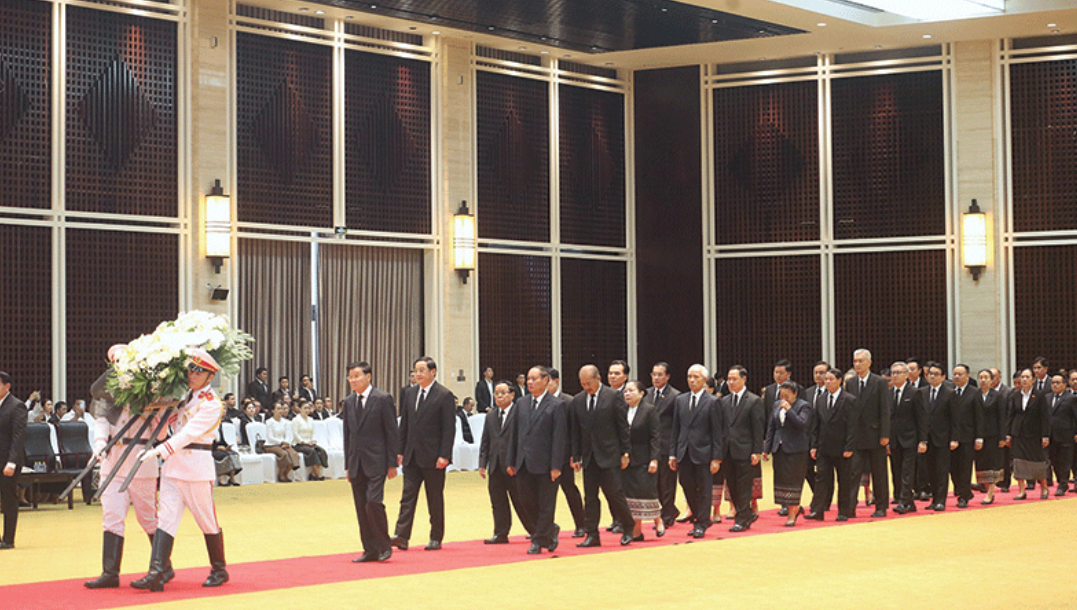
Laos has entered a period of national mourning following the death of National Assembly President Xaysomphone Phomvihane, with party and state leaders gathering on Sunday to pay their final respects at the National Convention Hall. The solemn ceremony, led by Party Secretary General and President Thongloun Sisoulith, drew senior government officials, members of the legislative body, representatives from various sectors, and family members of prominent political figures who came to honour a leader whose career spanned decades in service to the nation.
Xaysomphone, who held the position of both National Assembly President and membership in the Politburo of the Lao People's Revolutionary Party Central Committee, passed away on Saturday following a life devoted to state service. His death represents a significant loss to Laos's political establishment, particularly within the National Assembly where he spent much of his professional life shaping legislative processes and contributing to national governance across defence, development, and socio-economic matters. The outpouring of tributes from across the Lao political hierarchy underscores the depth of his influence within the ruling party structure.
The wreath-laying ceremony proceeded with formal delegations from the party's central institutions and state apparatus. The Central Committee of the Lao People's Revolutionary Party led the tributes, followed by delegations representing the National Assembly's Standing Committee, the Prime Minister's Office, and various ministerial bodies. Deputy Prime Minister and Minister of Finance Santiphab Phomvihane represented the Phomvihane family, while multiple delegations from party offices and government agencies participated in the ceremonial proceedings. This structured approach to paying respects reflected the formal protocols governing state funerals in Laos and the hierarchical nature of the nation's political system.
The ceremony also illustrated the close strategic relationship between Laos and Vietnam, with a high-level Vietnamese delegation attending to pay respects. Tran Thanh Man, a member of the Politburo of the Communist Party of Vietnam Central Committee and Chairman of the National Assembly of Vietnam, led the delegation in placing wreaths. Vietnamese representatives from the Ministry of Public Security and the Ministry of National Defence also attended, signalling the depth of bilateral ties between the two communist-ruled nations. Vietnam subsequently declared two days of national mourning on August 10-11, demonstrating the significance accorded to Xaysomphone within the region's political networks.
Born on December 12, 1956, Xaysomphone was the youngest son of former President Kaysone Phomvihane, one of modern Laos's founding leaders. His five brothers include Santiphab Phomvihane, who currently serves as Deputy Prime Minister and Minister of Finance, illustrating how the Phomvihane family has maintained prominent positions within the Lao state apparatus across successive generations. This family connection placed Xaysomphone at the nexus of party power structures and gave him access to influential networks within the ruling elite, contributing to his ascension to the National Assembly presidency.
The Lao government designated five days of national mourning from August 8 to 12, during which the National Convention Hall remained open for tributes. This extended period allowed not only senior party and state officials to pay respects but also foreign diplomats stationed in Vientiane, representatives from the business community, and ordinary citizens to express their condolences. The continued wreath-laying through August 11 provided various segments of society with opportunities to acknowledge Xaysomphone's public service and the loss felt across Lao institutions.
On Monday, the tributes expanded beyond the initial state ceremony as officials from individual ministries, Vientiane municipal authorities, and former party and government leaders visited the National Convention Hall. This broader engagement reflected how Xaysomphone's political career had touched numerous sectors and how his long tenure in the National Assembly had created networks of relationships across the governmental structure. The successive waves of delegations underscored the protocol-driven nature of state mourning in Laos, where elaborate ceremonial processes mark the passing of senior leaders.
Xaysomphone's career in the National Assembly proved instrumental in the legislative body's development as an institution. During his tenure, he contributed to strengthening parliamentary functions and the legislature's role in national governance. The National Assembly, though operating within a single-party communist system, has gradually expanded its consultative and legislative responsibilities, and Xaysomphone's leadership reflected efforts to enhance its institutional capacity. His work bridged the party's political agenda with the assembly's formal legislative procedures, navigating the complex relationship between revolutionary party governance and state institutions in Laos.
The ceremonial arrangements culminated in a state funeral with full honours scheduled for August 12 at the That Luang esplanade, Laos's most sacred Buddhist monument. The cremation ceremony planned for 1pm represented the final formal ritual and indicated the significance the state accorded to Xaysomphone's passing. The location choice at That Luang, a site of national cultural and religious importance, elevated his funeral to a national event rather than a purely party-political one, reflecting both his official status and the symbolic importance of honouring departed leaders within Lao political culture.
Xaysomphone's death removes from the Lao political scene a figure whose entire career was intertwined with party development since the Lao People's Revolutionary Party consolidated power. His passing comes at a time when Laos continues navigating economic challenges and regional geopolitical shifts, particularly given the country's close relationship with Vietnam and evolving ties with other powers. The seamless succession processes and extensive tributes suggest the regime's institutional stability, though the loss of senior figures familiar with decades of party history raises questions about knowledge transfer and continuity within elite political circles as Laos moves forward under its current leadership.

