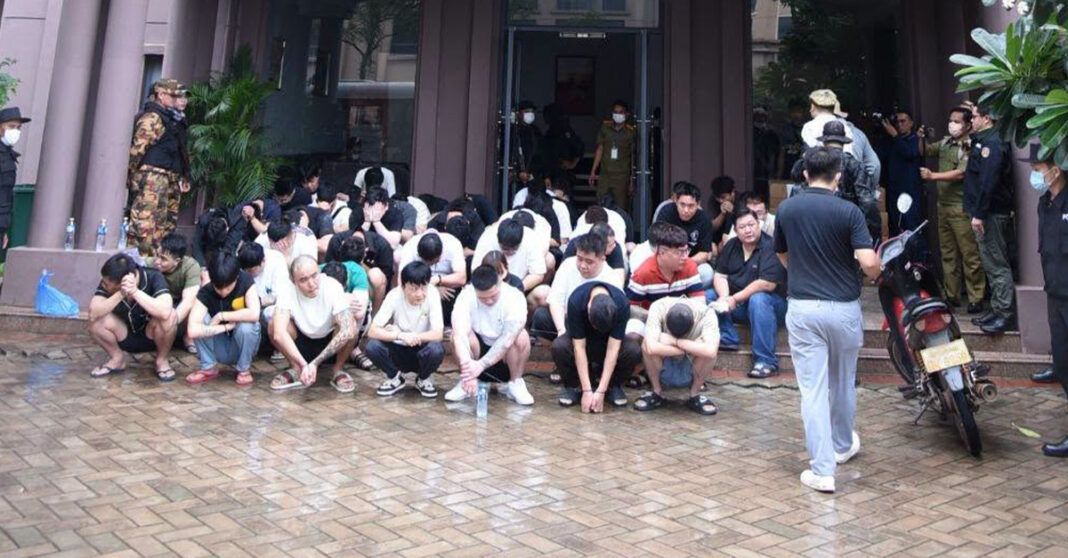
Laotian police have moved aggressively against international telecommunications fraud and online gambling syndicates, conducting a major operation in Vientiane's Thatluang Lake Special Economic Zone on 8 August that resulted in the detention of 261 suspects representing seven different nationalities. The operation represents a significant escalation in the government's wider campaign to dismantle scam networks that have become increasingly entrenched across the country, with authorities seizing nearly 500 computers and more than 2,300 mobile phones used to orchestrate the illicit activities.
The detained individuals reflect the cross-border nature of these criminal enterprises, with Chinese nationals comprising the largest contingent at 153 people, underscoring the dominant role that organized groups from the People's Republic of China have played in establishing and managing such operations throughout Southeast Asia. Vietnamese suspects numbered 61, followed by 36 Thai nationals, with smaller groups of five Taiwanese, two Malaysian, two South Korean, and two Myanmar citizens, illustrating how scam networks recruit operatives from multiple countries to diversify their workforce and complicate law enforcement coordination.
The targeted building in Thatluang Lake SEZ was registered to Lao Thatluang Investment Development Co., Ltd., raising questions about corporate oversight and regulatory gaps within special economic zones that have become attractive bases for transnational criminal organizations. These zones, which offer reduced tax burdens and regulatory flexibility designed to encourage legitimate investment, have increasingly been exploited by syndicates seeking to operate with minimal scrutiny from authorities. The company's involvement signals potential layers of bureaucratic obfuscation that criminal networks deploy to legitimize their operations and establish legal cover for fraudulent activities.
For Malaysian readers, the presence of two Malaysian nationals among the detained suspects reflects a broader pattern in which citizens from throughout the region have been drawn into or recruited by these international scam operations, either as victims of coercion, false employment promises, or voluntary participants seeking substantial illicit earnings. The involvement of Malaysian individuals underscores how porous borders and intraregional migration networks have enabled criminal syndicates to source personnel across Southeast Asia, creating regional security challenges that extend well beyond Laos's borders.
Laotian authorities have signaled their commitment to pursuing the investigation comprehensively, explicitly stating their intention to identify and prosecute the network's leadership and supporting members under existing legal frameworks. This approach suggests recognition that the detained individuals represent primarily mid-level and operational personnel rather than the architects who designed and financed these schemes. The focus on higher-level perpetrators reflects international best practices in combating organized crime, though success depends heavily on cooperation with neighboring countries and willingness to pursue wealthy transnational figures.
Despite the scale of the August operation, the Thatluang Lake raid appears part of a sequential enforcement effort rather than an isolated action. Just two days later on 10 August, Laotian authorities deported 41 Thai suspects to Thailand via the 1st Lao-Thai Friendship Bridge, representing tangible progress in bilateral cooperation mechanisms. These deportations followed an earlier transfer of 32 Thai nationals through the same crossing on 6 August, bringing cumulative deportations to at least 73 individuals and demonstrating functional coordination between Vientiane and Bangkok on law enforcement matters.
Context for these recent operations extends to an earlier July raid that proved even more expansive in scope. On 18 July, authorities conducted a major operation targeting the ST Vegas complex located in Dongphosy village within Hatsayfong district in Vientiane, resulting in the detention of 589 suspected scammers representing a cross-section of nationalities including predominantly Thai personnel alongside Laotian, Vietnamese, and Cambodian nationals. The ST Vegas operation dwarfed the Thatluang Lake raid by scale and arguably represented the more significant enforcement action, yet received less international attention, suggesting multiple simultaneous criminal operations at comparable levels of sophistication and reach.
The concentration of scam operations within Vientiane raises important questions about why the capital has become a particularly attractive hub for these networks. Proximity to major population centers, established infrastructure, relatively developed telecommunications systems, and perceived gaps in regulatory oversight have all contributed to making the city a gravitational center for international fraud syndicates. The localization of multiple large-scale operations in relatively close proximity suggests possible coordination or division of territories among competing criminal groups.
These enforcement actions represent substantive progress in an ongoing battle against well-resourced criminal enterprises that generate enormous profits and cause widespread victimization across Asia. The sophistication evident in the scale of operations—hundreds of personnel operating advanced telecommunications equipment and managing platforms reaching potential victims across multiple countries—indicates that scam networks have achieved quasi-industrial status with hierarchical management structures, specialized divisions of labor, and substantial capital investment. Breaking these networks requires sustained pressure, which the sequence of July and August operations demonstrates Laotian authorities are attempting to maintain.
The broader implications for Southeast Asia extend beyond law enforcement statistics. The prevalence of these operations in Laos suggests that countries throughout the region remain vulnerable to establishing such bases, particularly where special economic zones operate with limited transparency or where regulatory capacity proves insufficient. Malaysia, Thailand, Vietnam, and Cambodia all face similar pressures as organized syndicates continuously seek new jurisdictions offering operational advantages. Addressing these challenges requires not only increased domestic enforcement but also meaningful regional cooperation frameworks, information sharing protocols, and coordinated pressure against the financial institutions and service providers that enable transnational scam networks to function.

